Byron Donalds says states must work with ICE, but a dozen of them aren’t
Oct 14, 2026 | 4:11 pm ET
Description
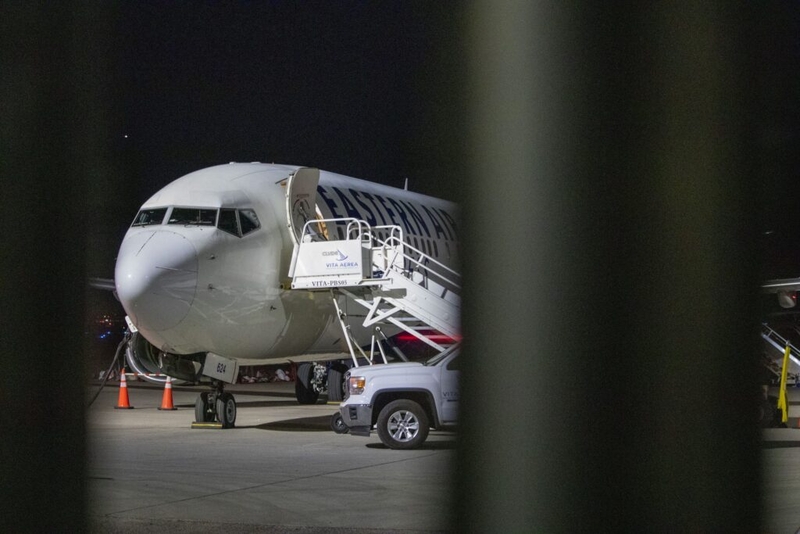
An airplane sits on the tarmac at Mesa Gateway Airport on the evening of April 9, 2026, outside of the Arizona Removal Operations Coordination Center, an ICE facility where detainees are temporarily housed before they are put on a plane to either be deported or moved to a different ICE facility. (Photo by Jerod MacDonald-Evoy/Arizona Mirror)
Florida Republican gubernatorial candidate Byron Donalds says that under the U.S. Constitution, states “have” to work with the federal government in enforcing immigration laws.
However, nine states have adopted laws forbidding compliance with Immigration and Customs Enforcement (ICE) detainers and 12 states overall haven’t reached enforcement agreements with the agency.
Donalds made those remarks Tuesday during a roundtable discussion with members of the business community in Jacksonville. A local homebuilder asked about a scarcity of construction workers able to build affordable housing in Florida “because of the methods of ICE enforcement raiding our job sites.”
“We cannot continue to build houses, and we cannot continue to build houses affordably, if we can’t find the workers to do the work,” said Mathew Meskimen, first vice president of the Northeast Florida Building Association. “So, as governor, how would you protect our workforce and draw workers to the state of Florida so I have enough people to build my houses for our great people in Florida?”
Donalds wasn’t sympathetic, saying that, if elected governor, he would “have to comply with federal law.”
“That’s actually our constitutional requirement,” he said. “In politics, people are saying, ‘Well, governors can pick and choose how that’s going to be implemented.’ That’s actually not true. ICE is federal law enforcement. Not state law enforcement. Under the Constitution, every state has the responsibility to comply with federal law enforcement, because the states gave authority to the federal government for immigration and naturalization, deportation.”
He went on to say, “States don’t set immigration policy. The federal government does.”
A legal analyst counters that what Donalds said is inaccurate.
“There is no federal law that requires states and localities to cooperate with federal immigration enforcement, whether statutorily or constitutional,” said Kathrina Szymborski Wolfkot, senior counsel and manager in the Judiciary Program at the Brennan Center for Justice at the NYU School of Law. Whether local law enforcement agencies are going to cooperate with federal immigration laws is a question of state law, she added.
Florida’s on board
Florida Gov. Ron DeSantis signed a sweeping package of immigration laws aimed at carrying out President Donald Trump’s mass deportation agenda just weeks after Trump was inaugurated as president for a second time in January 2025.
It includes directives for Florida counties — but not municipalities — to enter into 287(g) agreements, which allow state and local authorities to work with federal immigration authorities. Before the legislation, 47 counties and the Department of Corrections had already executed agreements with ICE. The mandate expanded those agreements to all 67 Florida counties.
According to ICE, the agency has signed 2,660 memoranda of agreement for 287(g) programs covering 38 states and two territories.
The Trump administration has initiated an effort to crack down on local governments and states that don’t participate in its mass deportation campaign but has little to show for it. Since Trump returned to the White House last year, the Justice Department has filed lawsuits against more than a dozen Democratic-led states, counties, and cities, according to a CBS News review of court filings.
States like Oregon and Illinois adopted laws preventing law enforcement agencies from asking about or collecting information about immigration status.
“We have states that have passed state laws that forbid state and local officials from entering into 287(g) agreements or honoring immigration detainers, and everywhere that those have been challenged by the federal government the judges — including judges appointed by Donald Trump — have said, ‘No.’ States are completely within their rights under the federal Constitution to pass these laws,” Wolfko saidt.
Florida has the highest rate of requests for local jails to hold people for ICE after they’ve been picked up for another arrest this year, according to a study by the Prison Policy Initiative. It has the second-most detainer-related arrests in the country this year, behind only Texas.
Donalds’ Democratic opponent, David Jolly, has said if elected he would end the state mandate for counties to participate in 287(g) agreements.
What about cities?
There has been some dispute over whether the 2025 Florida legislation requires municipalities to enter into 287(g) agreements. The law says they do not. However, locally elected officials have been threatened by Florida Attorney General James Uthmeier when they’ve considered rescinding agreements with ICE.
The city of South Miami filed suit against the DeSantis administration last year to determine whether municipal governments must participate. In oral arguments, the state’s attorneys argued cities aren’t explicitly required to enter agreement but can’t cancel them once in force.
Mathew Meskimen did not respond to the Phoenix’s request for comment but he’d prefaced his question by saying he is a lifelong Republican, “as conservative as it gets and a capitalist by nature.”
The National Association of Home Builders say the housing industry faces a severe labor shortage, with members reporting increased immigration enforcement and that work site raids are heightening worker fears. They cites government data indicating construction is by short about 300,000 workers.
Donalds acknowledged other states don’t look at immigration enforcement in the same way Florida or Texas does.
“We have leadership in other states that I quite frankly disagree with,” he said. “They’re not doing what their duty is under the Constitution.”
Tallahassee, FL