Trump immigration policies could turn away much-needed foreign doctors, critics say
Oct 13, 2026 | 5:00 am ET
Description
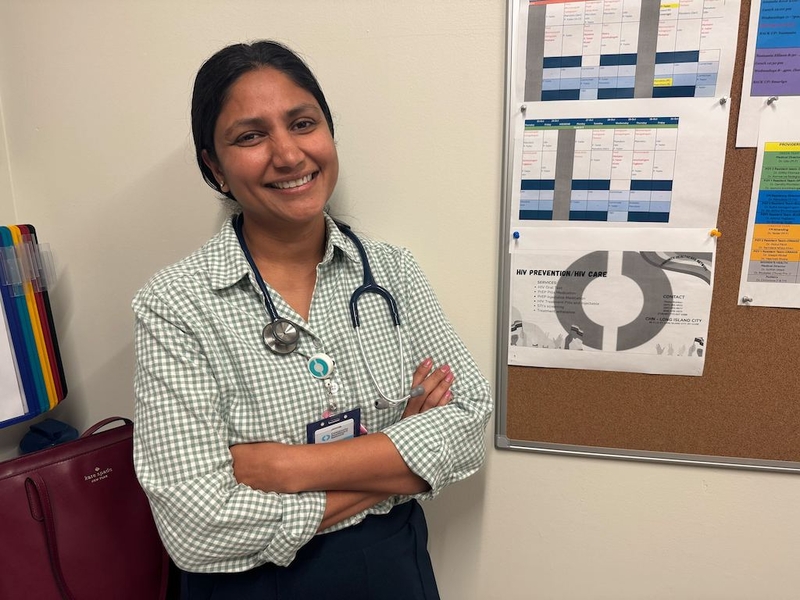
Dr. Sindhura Manubolu, the director of the family medicine program at the Long Island City Health Center in New York, received her medical degree in India. Some fear the Trump administration’s immigration policies will dissuade or prevent doctors who earned their medical degrees in foreign countries from practicing in the United States. (Photo by Shalina Chatlani/Stateline)
As the nation’s physician shortage worsens, some fear the Trump administration’s immigration policies will dissuade or prevent doctors who earned their medical degrees in foreign countries from practicing in the United States.
Among all U.S. doctors, an estimated one quarter were educated abroad. But they make up an even larger proportion of physicians in many specialties, including internal medicine (41%), endocrinology (46%) and geriatrics (52%).
The U.S. has long welcomed foreign-educated physicians as a way to ameliorate its doctor shortage. Already, an estimated 102 million Americans live in communities that don’t have enough primary care providers, according to the federal Health Resources and Services Administration. The agency projects a shortage of 141,160 full-time physicians by 2038.
Foreign-educated doctors are slightly more likely than American ones to work in areas with a shortage of primary care providers. And doctors who are here on H-1B visas — a federal program that allows U.S. employers to temporarily hire non-citizen workers for health care jobs and other positions requiring specialized knowledge — are more likely to work in high-poverty areas.
But last August, the Trump administration issued a rule increasing the fee for employers hiring workers through the H1-B visa program to $100,000, up from between $2,000 and $5,000. It also has issued a travel ban on residents of 39 countries. And earlier this month, the U.S. State Department broadened its “online presence review” of applicants for H1-B and other visas to ensure that they do not “pose a threat to national security or public safety.”
“The United States remains vigilant throughout the visa issuance process to confirm that applicants do not intend to cause harm to Americans or threaten U.S. interests,” the State Department said in its announcement of the expanded vetting.
Dr. Tarun Ramesh, a physician at Massachusetts General Hospital and a health policy researcher at Harvard Medical School, said Trump’s policies will make it more expensive for hospitals and other healthcare employers to hire foreign physicians and might dissuade many international doctors from coming here at all.
“We’ve created a system where we depend heavily on physicians trained abroad, and at the same time, we create immigration policies that make it harder for those physicians to enter, to train, to remain in the country,” Ramesh said. “And that intersection of both the health workforce and immigration workforce and immigration policy makes it a clear tension.”
Both left-leaning and conservative states have taken steps to attract foreign physicians.
As of the middle of this year, about two-dozen states of every political bent had enacted laws to make it easier for foreign nationals to get their U.S. medical licenses.
Georgia Republican state Sen. Dr. Ben Watson, who co-sponsored a law in his state, said there simply aren’t enough U.S. medical school graduates to keep pace with population growth. He said one of his main goals is to increase the number of doctors in rural areas.
“We did it in several different stages to assure quality,” Watson said. “Hopefully we can encourage rural migration from that standpoint, also.”
Since 1994, states also have used the federal Conrad 30 Waiver Program to boost the number of doctors in underserved areas. The law allows a limited number of foreign medical school graduates who have trained in the U.S. using a J-1 visa to waive the normal requirement that they return to their home countries for two years before applying to come back — as long as they practice in an underserved area.
In increasing the H-1B visa fee, the Trump administration argued that some employers, especially tech companies, have abused the program by using it to replace native-born workers with foreigners who will work for less, rather than using it to fill jobs they can’t find Americans to do.
“American IT workers have reported they were forced to train the foreign workers who were taking their jobs and to sign nondisclosure agreements about this indignity as a condition of receiving any form of severance,” President Donald Trump said in the executive order he issued in September 2025. “This suggests H-1B visas are not being used to fill occupational shortages or obtain highly skilled workers who are unavailable in the United States.”
But 20 Democratic-led states sued to stop the fee increase, and in June a federal judge ruled in their favor. The administration was thwarted again in September, but it isn’t giving up: its latest proposal is to levy a $103,265 fee for a subset of H-1B applicants.
Even as the legal wrangling continues, the administration’s proposal has had an effect. In November survey of its members, the American Hospital Association found that 64% of hospitals that utilize the H-1B program had paused, deferred or limited recruitment because of the possibility of the $100,000 fee.
Andrew Wizner, an attorney who represents medical institutions that hire foreign medical school graduates, said the onslaught of new rules, legislative holdups, and confusing court decisions almost certainly has dissuaded some H-1B and J-1 visa applicants from applying to practice or train here.
“If you’re outside the U.S. and loosely following, (you might think) ‘Oh, there’s this rule, and I heard a court may have set it aside, but I don’t really know how their system works, their judicial system, and what that means,’” Wizner said.
He said the message that foreign-educated doctors are receiving is a simple one: “Don’t come here.”
Bradley Cunningham, a regulatory affairs and policy analyst at the Association of American Medical Colleges, said most hospitals simply can’t afford to navigate the new legal challenges and fees associated with H-1B visas.
“There’s a tremendous amount of confusion and misinformation about what’s going on,” Cunningham said. Like Wizner, he said he suspects the uncertainty swirling around H-1B visas is causing many would-be applicants to think twice about coming to the U.S.
“We can’t determine causality, but I can’t imagine that that is helping the situation any more when you’re talking about having to commit your family to come overseas to train at an institution and not having security or assurance that you can complete your training.”
Stateline reporter Shalina Chatlani can be reached at [email protected].