Dunlap and LePage continue campaign quarrels in final debate
Oct 15, 2026 | 10:22 pm ET
Description
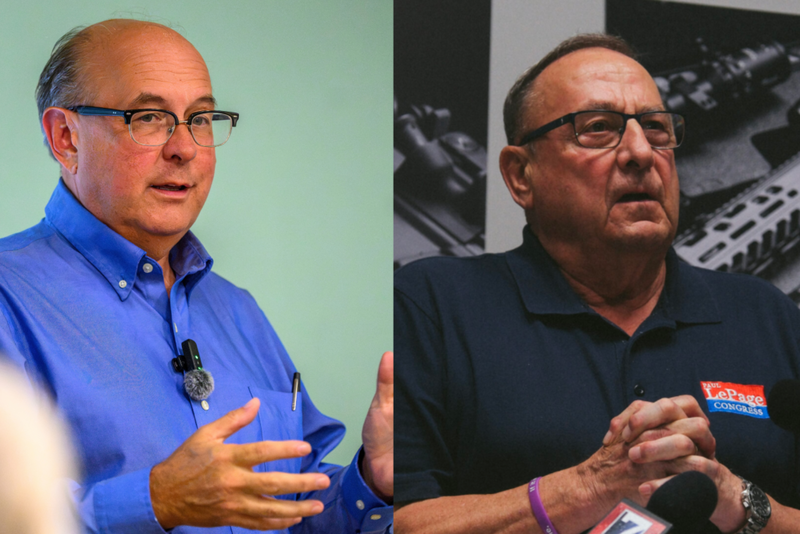
U.S. House candidates Democrat Matt Dunlap (left) and Republican Paul LePage (right) met for the second time on the debate stage on Oct. 15. (Photos by Jim Neuger and Andrew Clark/ Maine Morning Star)
During their second and final debate appearance Thursday evening, Democrat Matt Dunlap and Republican Paul LePage resurrected many of the same disagreements from their initial debate, digging further into each other’s record in state government.
The forum, hosted by WABI and WAGM, gave the candidates vying to replace outgoing Democrat U.S. Rep. Jared Golden in Maine’s 2nd District one last opportunity to make their pitch to voters ahead of the Nov. 3 midterms.
Much of the debate, and subsequent barbs, focused on healthcare.
On Thursday, LePage defended his record as governor, when he vetoed five bills that would have expanded MaineCare, the state’s Medicaid program. He argued that his issue with expansion was that the reimbursement rates to healthcare providers are too low and it endangers services.
“And I never said to get rid of Medicaid,” LePage said. “I said Medicaid, folks, Medicaid would work if you reimburse the hospitals and the medical profession at cost, but below cost, everybody loses.”
On the campaign trail, LePage has repeatedly touted how the state government paid off $750 million in debt to hospitals when he was governor, and brought it up again at the debate.
But Democrats at the time criticized LePage for stalling the payments, and Dunlap noted that LePage vetoed an earlier bill that would have made the payments and expanded Medicaid.
“If you don’t believe people should have healthcare, then you follow Paul LePage, which is getting rid of Medicaid,” Dunlap said. “I don’t see how you actually improve healthcare by taking healthcare away from people.”
As before, LePage pivoted to the issue of fraud.
“The first thing that we should do, and this gentleman has been in the power to do it, is to fight fraud in Maine,” LePage said, referring to Dunlap’s position as state auditor.
Fate of Medicare, Medicaid emerge as key issue in 2nd District race
State and national Republicans have alleged widespread fraud in Maine’s healthcare programs and have tried to make it a key issue throughout the midterm campaign. The Maine Department of Health and Human Services has found five providers guilty of fraudulent billing and suspended their contracts, but Republicans claim the problem is much more rampant.
In the most recent federal review, Maine’s Medicaid payment error rate was 2.4%, lower than the national average of 3.2%. And only about 0.1% of total program spending was confirmed by federal reviewers to be definitively incorrect.
Dunlap said his office is not in charge of pursuing criminal charges, only identifying issues — which it has done.
“I would have assumed, with the experience that Paul LePage touts as governor, that he’d actually understand what my job actually is and what it is not,” Dunlap said.
Social Security
Dunlap also returned to an issue he brought up in the previous debate: a 2014 press release from LePage’s office, which Dunlap argued quotes LePage calling Social Security “welfare.”
“I think that’s something that gives an indicator of how he would feel about this,” Dunlap said. “And I would not trust him to be a champion for Social Security.”
The release discusses how the federal government calculates personal earnings growth and the inclusion of certain benefits, such as Social Security benefits and Medicare payments.
“It doesn’t matter what liberals call these payments, it is welfare, pure and simple,” LePage is quoted as saying in the release.
During the debate, LePage said he “can see” where Dunlap comes from with the accusation, but argued he was talking broadly about transfer receipts, not about Social Security.
“We can read the whole press release, but you said that Social Security was welfare,” Dunlap said.
Medicare for All
LePage also criticized Dunlap’s support for Medicare for All, and said it was too expensive.
“Believe me, if you want somebody that’s going to be a spender, he’s your guy,” LePage said of Dunlap. “If you want somebody that’s going to lower costs, go after fraud. I’m your guy.”
Dunlap defended his support of universal coverage by saying he would reprioritize spending to pay for such a program, which would save money for private businesses and individuals who no longer would have to pay for private insurance.
“We can do these things if we prioritize our neighbors instead of simply prioritizing the desires of the corporate class who just want to bring in more of the pie for themselves,” Dunlap said.
LePage said that he has lived in a “socialized medicine scenario,” although he did not specify where or when that was.
“You get rationing, you lose your doctors because if you go to a hospital, you don’t go to a doctor, you don’t have a private doctor, unless you’re very very wealthy, and so and the cost is astronomical,” LePage said.
Dunlap said that scenario is “not what we’re seeing.”
“I don’t think people should be scared of the idea of having access to healthcare, and scaring them with ideas of rationing and long lines,” Dunlap said.
The conversation turned to whether Dunlap has lived in a place with such a policy, and he reiterated that he’s lived in Maine his whole life.
“Oh, is that right? Well, I’ve lived in Maine longer than you’ve been alive,” LePage said.
Dunlap and LePage try to outgun each other over support for Second Amendment
“Except for the time that you spend in Florida,” Dunlap interjected, returning to a long-time criticism of LePage’s residency.
LePage acknowledged, “Yes, I’m a snowbird.”
“At my age, I don’t like snow anymore,” he said. “I’ve got knee problems, so I don’t ski and I don’t play hockey anymore. So yes, in the winter months we go to Florida. I have never been in Florida a whole year.”
Iran War and affordability
The pair were also asked about heating costs, which Dunlap was quick to point to as the source of the challenge.
“I do think that one of the things that is critical here is the war in Iran, because these prices haven’t sloped up over the years — they’ve spiked since the attacks began at the end of February, and it’s only gotten worse as this war has dragged on,” Dunlap said.
And while LePage agreed it was a factor, he said it wasn’t entirely to blame.
“The Iran War is adding to it, but the bigger problem started under Joe Biden,” LePage said.
Dunlap took the opportunity to criticize LePage for not having a clear stance on the war, and going “back and forth” on the issue.
“I want the war to end as quickly as possible,” LePage said. “However, I do not want Iran to get a nuclear weapon. I do not support having any boots on the ground.”
LePage said the current regime in Iran is not trustworthy, and the United States must force a change.
“Paul LePage is talking about regime change, and yet not putting any boots on the ground,” Dunlap said. “I’m not sure how that happens without having American troops committed in a combat situation, which I don’t think anybody really wants to see happen.”
Throughout the conversation, LePage frequently touted his relationship with President Donald Trump, and his access to the White House — an approach that Dunlap criticized.
“And I want to be very clear here that we don’t elect representatives to Congress to talk to the White House,” Dunlap said. “We elect them to provide oversight of the executive branch.”
But LePage countered that his focus will be on Maine people, not the president.
“Your job may be to have oversight over the president, the White House,” LePage said. “My job is to do the best I can for the people of Maine.”
Dunlap responded, “I think doing the best job that we can for the people of Maine means standing up for the people of the state of Maine in the chamber that you’re elected to, and that’s what I will do in Washington.”
Augusta, ME