In Maine’s 1st District, Pingree and Russell square off again
Oct 13, 2026 | 4:40 am ET
Description
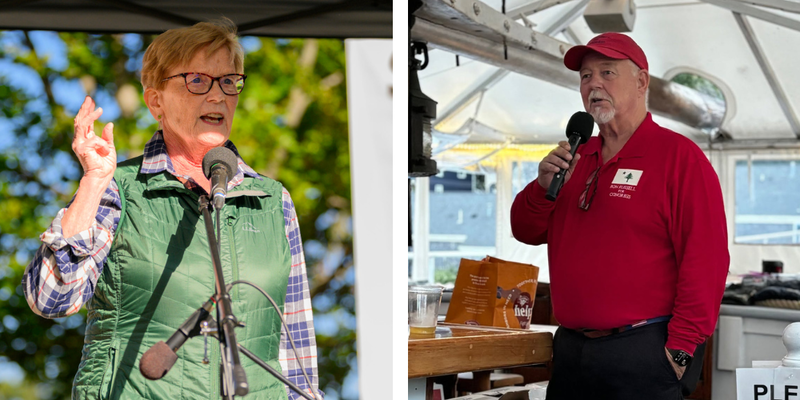
U.S. Rep. Chellie Pingree won nearly 59% of the vote in 2024 against independent Ethan Alcorn and Republican Ron Russell, who is challenging her again to represent Maine's 1st Congressional District. (Pingree photo by Jim Neuger/ Maine Morning Star; Russell photo courtesy of campaign)
The election in Maine’s 1st Congressional District may have fallen to the wayside amid more contentious statewide races, but the names on the ballot are still familiar — it’s the same two candidates who ran for the seat two years ago.
Republican Ron Russell is back again to challenge incumbent Democrat U.S. Rep. Chellie Pingree for her seat in Congress. Pingree had a solid win in 2024, beating Russell and independent Ethan Alcorn.
Russell, 72, grew up in Fort Fairfield, and is a retired Army colonel. He served for just over 30 years as an airborne ranger Green Beret, and was in combat in Panama, Somalia, Afghanistan and other crisis response operations.
After retiring, he founded the North Carolina-based defense contractor Far Ridgeline Engagements, and returned to Maine in 2021. Russell said he knows he’s a repeat candidate for voters, but hopes it will work in his favor.
“There’s certainly nothing different in the way I feel about the issues, probably have refined them somewhat,” Russell said. “But I’m the same person I was back then, and I think, unfortunately, the issues facing the nation and Maine are the same.”
Pingree has represented the district since 2009, and is currently the ranking Democratic member on the Subcommittee on Interior, Environment and Related Agencies under the Committee on Appropriations.
“I never take any campaign for granted,” Pingree said. “The voters deserve to both see us and hear from us, and know that you’re taking it seriously.”
She also served in the Maine Senate from 1992-2000, and was majority leader in her final four years in the state Legislature.
“We all know this is an extremely critical election,” Pingree said. “This has been one of the most challenging two years in our country, and it doesn’t matter which side of the aisle that you’re on.”
The two will meet for one debate, on Oct. 29 in Portland, jointly hosted by Maine Public, NewsCenter Maine and the Portland Press Herald.
President Trump
Like most federal races across Maine and the country, even if President Donald Trump’s name is not on the ballot, he is very much still a central factor in the race, and the 1st District is no exception.
Pingree said in her latest term in office, she has spent a lot of time pushing back against Trump’s actions.
“Especially in the last two years, unfortunately, much of our focus has just been on fighting back from an out of control administration,” Pingree said. “I mean, the amount of things they have done that are illegal or unconstitutional or just extremely damaging to Maine is greater than anything I’ve ever seen before.”
But she said constituents have been incredibly engaged in the issues, and want to see Maine’s congressional delegation protect their interests — and Pingree hopes to do more of that if Democrats can regain a majority in the U.S. House of Representatives.
“So I think this year people want to know that we’re fighting for them, that our goal is if I’m reelected to do everything we can to undo the damage that they’ve done, particularly if we’re in the majority and we have more power to do that,” Pingree said.
Russell has a very different approach, and while he hopes to bring an independent mindset to Congress, he doesn’t disagree with Trump’s priorities.
“I said before I’m not going to be a rubber stamp for President Trump, but I really kind of agree with the things that we are doing and in getting our nation back on board,” Russell said.
I said before I'm not going to be a rubber stamp for President Trump, but I really kind of agree with the things that we are doing and in getting our nation back on board.
But Russell said he doesn’t agree with the way the president goes about enacting his agenda.
“Sometimes how he does what he does, I’m not a big fan of,” Russell said.
Russell added that he thinks Congress can do more to assert its authority to be on par with the president.
“We have three equal branches of government, and I think, to a degree, he does things the way he does because a couple of the branches of government have abdicated their responsibilities,” Russell said.
That point is one Pingree agreed with, and said many Republicans have relinquished a lot of Congress’s constitutional responsibilities.
“As much as I have good friends on the other side of the aisle and I like working with them, uniformly the Republicans have stopped using the power of Congress,” Pingree said. “They forgot we’re a co-equal branch.”
Immigration
Immigration has been a major issue in the 1st District during Trump’s second term, and came to the forefront in July when U.S. Immigration and Customs Enforcement agents shot and killed 25-year-old Johan Sebastián Durán Guerrero in Biddeford.
“The officer was unqualified,” Pingree said. “They literally shot a person who they weren’t even intending to pick up.”
Pingree has been vocal about her opposition to ICE activity around the country, and participated in two ‘shadow’ hearings on the shooting with fellow Democrats.
The federal government has so far declined to investigate or reveal any information about the fatal shooting of Guerrero, a pattern seen across the country in response to violence and wrongful detentions by ICE.
“It’s not what anybody believed that the president was talking about, and he said he was only going to pick up the worst of the worst, the murderers and rapists, and it’s not how you want your tax dollars spent,” Pingree said.
Russell said he doesn’t know if the results of the federal investigation into the Biddeford shooting would be made public, but he said will push for that information to be released.
“Releasing the results of that investigation would be very, very valuable for obvious reasons,” Russell said. “People want to know, and people should know.”
Russell said he thinks that a lack of coordination between federal, state and local agencies has contributed to the death in Biddeford and other shootings by ICE agents around the country.
“You can’t have it both ways,” Russell said. “You can’t insist upon cooperation during the investigation when you’re not coordinating and cooperating before the investigation. And if you did, the investigation would be necessary, from my perspective.”
More broadly, Russell said he opposes sanctuary cities and supports immigration enforcement.
“The fact that the border is closed, our southern border, I think, is a great accomplishment,” Russell said. “And we are having to deal with the millions of illegal immigrants who came across the border during the last administration, and that is what has been problematic.”
On the other side, Pingree said she strongly opposes the quotas in place for ICE agents, and called the agency’s actions unconstitutional.
“It’s just an outrageous use of the taxpayer dollars,” Pingree said. “It doesn’t make us safer, and it goes against what people think is fundamental in a democracy.”
Pingree said her staff regularly hear from constituents struggling to navigate the immigration system, and are confused about the enforcement actions.
She said her Portland office “has a steady stream of new Mainers who come in there, sometimes just looking for a work permit to be renewed.”
“Sometimes it’s employers saying, ‘Hey, I have a whole carload of roofers and I can’t figure out where they’ve been taken,’” she said. “Family members who say to us, ‘Someone was picked up and now they’ve been moved.’”
Pingree pointed to her efforts to get Olivia Andre, a 19-year-old asylum seeker and Portland resident, released from detention after six months. Pingree and other Democratic members of Congress traveled to the detention center in Texas where Andre was held.
“But it took a congressperson to visit all the way to Texas to get them moving on that,” Pingree said. “But that happens every single day.”
Heating costs and the Iran War
As temperatures begin to drop, many Mainers are watching the cost of heating oil, which has reached historic levels this fall as the war in Iran drives up prices.
Roughly half of Maine households use heating oil as their primary heating source. According to the Maine Department of Energy Resources, the average statewide price of heating oil was $5.97 per gallon on Oct. 5, up roughly 79% from last year. That is down slightly from Sept. 21, when the average price reached a record high of $6.02.
Pingree called the latest prices “unthinkable,” and said she is particularly concerned about programs like the Low-Income Home Energy Assistance Program, known as LIHEAP, going far enough for Maine residents this year.
“It’s a bad picture to start,” Pingree said. “And if we get a cold winter, even without a cold winter, this will be a strain on a lot of people there.”
According to a press release from U.S. Sen. Susan Collins’ office on Friday, Maine is set to receive more than $36 million through LIHEAP, one of the earliest releases of funds in the program’s history.
“We need to end the war on Iran to try to bring down that price, but there’s no good reason not to up the amount of money in LIHEAP,” Pingree said.
Pingree has repeatedly voted for War Powers resolutions in Congress, and said the war in Iran is a clear example of Trump abusing the limited exception for the president to defend the country from an imminent attack.
Russell agreed that the war is driving up heating oil, gas and diesel prices, but said he still supports the U.S. military action.
“I think that war was necessary, and I support President Trump doing it,” Russell said. “I’m dismayed that it’s taken as long as it has, for obvious reasons. It’s having a significant impact on gas prices around the world, but I think eventually, and fairly soon, actually, those prices will get back into normal parameters. I think prices will drop precipitously once that situation is resolved, and I think that will resolve itself within a month.”
Russell said he thinks another factor in the price spikes is the lack of natural gas refineries in the country.
“Until we get those up and running again, where we are self-sufficient in terms of refining our own heating oil and diesel fuel, then we’re catching up once again,” he said.
Russell said he would support building those refineries in Maine or other parts of the country, to be less reliant on other countries for processing.
“I would not shy away from not doing it in our backyard because it’s going to be beneficial to the United States,” Russell said. “It will be beneficial to Mainers, and it will get us back on track fixing a lot of the problems that are broken right now.”
Augusta, ME