Nebraska Supreme Court restores LB 20 and lets people with felony pasts register to vote
Oct 16, 2024 | 10:19 am ET
Description
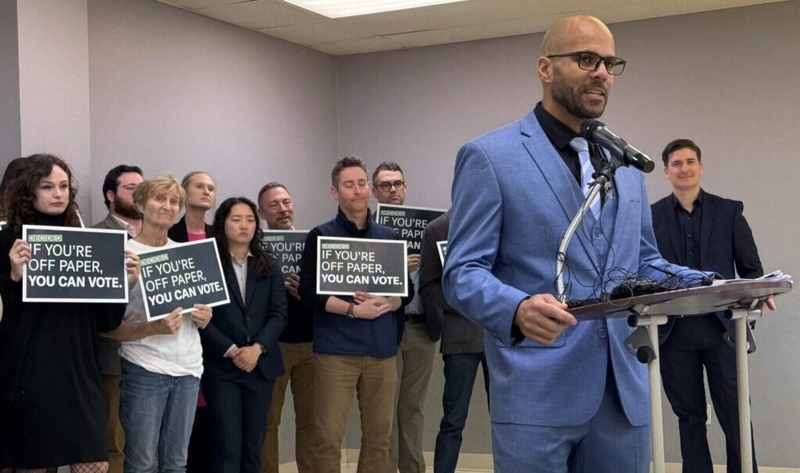
Jason Witmer, a fellow at ACLU Nebraska, and other voting rights advocates on Wednesday celebrate the Nebraska Supreme Court's decision on letting Legislative Bill 20 restore the voting rights of people who have finished serving a sentence for a felony. (Aaron Sanderford/Nebraska Examiner)
OMAHA — The Nebraska Supreme Court ruled Wednesday that Nebraska Secretary of State Bob Evnen was wrong to stop registering voters under a new state law eliminating the two-year wait for people who have served a sentence for a felony conviction.
The court did not decide the constitutional question raised by Evnen and Attorney General Mike Hilgers — which branch of state government has the authority to set the timing of when people who have served a sentence for a felony conviction can vote.
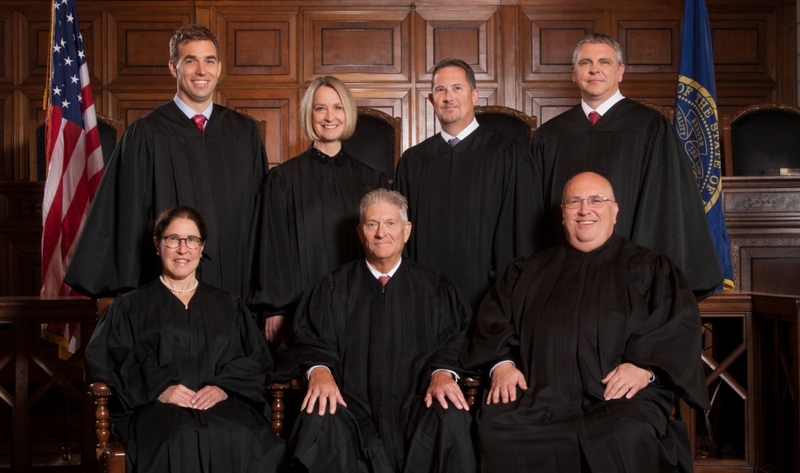
Evnen and Hilgers, in an advisory legal opinion that Evnen cited in deciding to ignore Legislative Bill 20, argued that only the executive branch’s Pardons Board that they and Gov. Jim Pillen serve on can constitutionally restore a person’s civil rights.
Lawyers from ACLU Nebraska, arguing on behalf of Civic Nebraska and two Nebraskans prepared to register to vote, argued that the Legislature has case law and past practice on its side in setting the timing of when someone can legally vote.
One of them is Gregory Spung of Omaha, a plaintiff in the case, who plans to register as a nonpartisan voter. He had registered online before Evnen’s decision and retracted it after Evnen’s decision. He said in a statement that he was “ecstatic.”
For so long, I was uncertain if my voice would truly count under this law. Today’s decision reaffirms the fundamental principle that every vote matters.
“For so long, I was uncertain if my voice would truly count under this law,” Spung said. “Today’s decision reaffirms the fundamental principle that every vote matters. It’s a victory not just for me, but for thousands of Nebraskans.”
The other plaintiff, Jeremy Jonak of Wood River, who plans to register as a Republican, said the decision lifted “a weight off my shoulders” and that of other Nebraskans who had been waiting. He said people had earned a second chance.
“The truth is most of us are just trying to live our lives and leave the past behind us,” Jonak said. “Thanks to this decision, we get to have a say as part of our communities.”
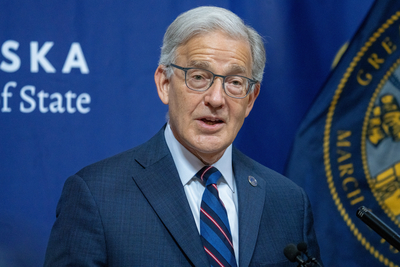
Evnen issued a statement Wednesday afternoon saying he would comply with the decision and that his office was working with county election officials “to ensure that those who were made eligible to register to vote under LB 20 may now do so.”
A Hilgers spokeswoman relayed a statement from the attorney general saying he appreciated “the Supreme Court’s consideration of this important issue” and that he was “grateful that the Court provided clarity before the election.”
The narrower ruling means the court could not find five justices who agree on the constitutionality or unconstitutionality of LB 20 or its predecessor, LB 53 from 2005. LB 53 had restored voting rights two years after serving a criminal sentence.
Under Nebraska’s constitution, it takes five justices to declare a law unconstitutional. Because the court did not rule the law unconstitutional, Evnen and Hilgers are likely out of time to stop registrations for the Nov. 5 general election, now less than three weeks away.
Justice Lindsey Miller-Lerman, in a separate opinion agreeing and disagreeing with parts of the same case, argued that it was important for the court to draw a line against state officials being able to decide which state laws they would implement or ignore.
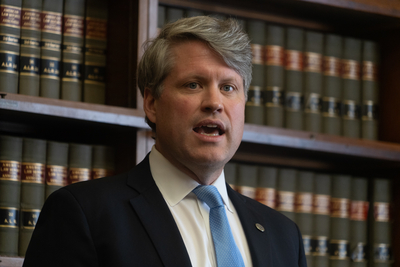
“Do we want to live in a world where every state employee who has a hunch a statute is flawed gets to ignore it?” she wrote. “State officers who take the oath to follow the constitution are expected to follow that oath and not disregard their sworn duty to abide by the Nebraska Constitution.”
Justices Jeffrey Funke and John Freudenberg, in dissenting opinions, sided with Evnen, Hilgers and Pillen’s view that the restoration of civil rights, including voting rights, is constitutionally an authority granted only to the executive branch via the Pardons Board.
“Because partial pardons are a type of pardon and because the restoration of voting rights eliminates a legal consequence of a conviction, the restoration of voting rights has the defining features of [a] pardon,” Funke wrote.
Court ruling personal for three new Nebraska voters who served their time
The court essentially took the simplest of the arguments ACLU lawyer Jane Seu made during oral arguments in late August: It sided with her that Evnen and Hilgers had not met the legal standard needed to prove the law unconstitutional over the court’s deference to state laws.
The ruling means the thousands of people that voting rights advocates said were poised to be newly registered will get their chance, if advocates can execute a plan they discussed to let people know they can now register to vote this fall.
Seu called it “justice.”
“Given the sheer scale of disenfranchisement that this decision corrects, there is no question that it will be remembered as one of our state’s most consequential voting rights decisions,” she said in a statement Wednesday.
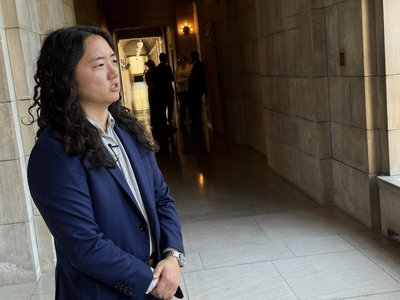
RISE, a re-entry program for incarcerated Nebraskans and others in the justice system, has said more than 7,000 people could be newly eligible to vote. Several have discussed the importance of being able to participate fully as key to re-entry efforts.
Thousands more who were also in limbo after Evnen’s move got the reassurance that their voting rights are still sound, the people who had waited two years under the 2005 law and had already registered to vote — and in many cases voted previously.
Jasmine Harris, director of public policy and advocacy for RISE, thanked the courts for making Evnen uphold the law. She spoke at a news conference for ACLU Nebraska and other advocates.
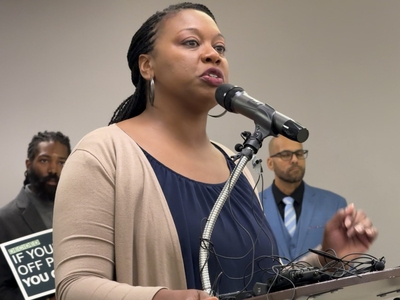
“This is a win, not for me but for the people,” Harris said, wiping away tears. “The people who we’re speaking about, who are impacted by this decision today, are the people who have been pushed to the margins of our society.”
Harris and others credited State Sen. Justin Wayne of Omaha for prioritizing the ideas behind LB 20 and finding enough allies to help get the proposal over the finish line.
Wayne, in a statement Wednesday, credited the court for upholding the principle that “nobody is above the law.”
“The Secretary of State is not free to disregard laws passed by the Nebraska Legislature,” Wayne said. “The court made clear that when the law mandates action, the Secretary must follow it.”
Wayne got emotional Wednesday night after seeing people register to vote because of the legislation. He tweeted that he was enjoying seeing the results of a years-long fight.
“Today, the Supreme Court upheld LB 20, finally bringing those rights back,” he tweeted. “It feels surreal — like a dream fulfilled.”
The time to register voters is tight. Friday is the last day for Nebraskans to register to vote by mail or online for the 2024 general election. The deadline for registering in-person at a county elections office is Oct. 25.
Civic Nebraska, part of a group trying to organize and register voters in time, the Voting Rights Restoration Coalition, said partners would be calling, texting and reaching out to voters to make sure they know of the ruling and their rights.
“From now on, every eligible voter in our state can exercise their constitutional right to participate in our democratic system,” said Steve Smith, a spokesman for Civic Nebraska.
state-ex-rel-spung-v-evnen
Lincoln, NE