My disabled son has civil rights, just like all of us
Aug 08, 2026 | 5:22 am ET
Description
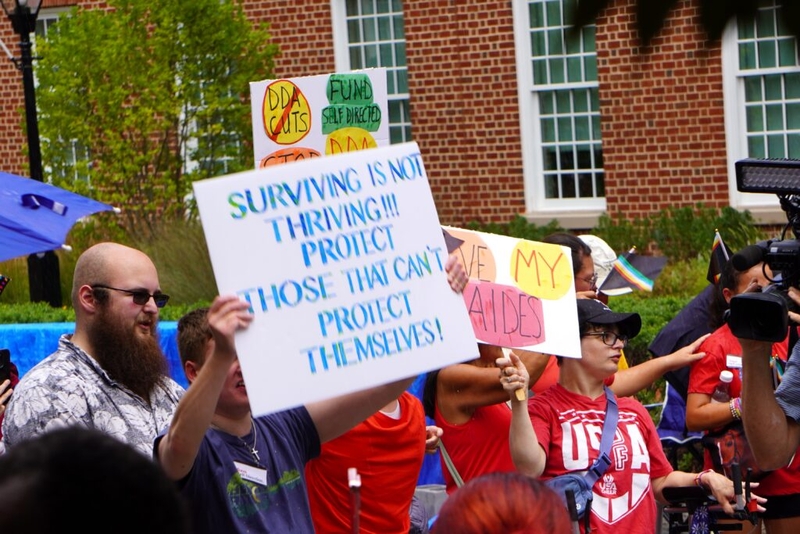
Advocates for people with developmental disabilities called on lawmakers at the special session Monday, Aug. 3, to expand the scope of the special session to include solutions to a $126 million budget cut approved this year. (Photo by Danielle J. Brown/Maryland Matters)
My disabled son Rob and I are often in Annapolis to advocate for health care and disability rights. If the weather’s nice, we sit on Lawyer’s Mall in front of the State House and reflect on the legacy of Thurgood Marshall, whose statue stands there. Maryland has a proud history of protecting the civil rights of marginalized people — except, it seems, for disabled people.
In 2019, when Rob began his advocacy journey at age 21, we joined Little Lobbyists, a family-led advocacy group committed to the rights of children with complex medical needs and disabilities. Through Little Lobbyists, which turns nine this year, we learned about disability civil rights: Rob and others have the right to use their Medicaid funding to allow them to live in their community, not a nursing home. But because Rob has complex medical needs, his transition from high school to adulthood was packed with roadblocks by state agencies.
This winter, the Maryland Department of Health (MDH) pressured the General Assembly to make dramatic cuts to disability services that keep people like my son in their homes and communities, using arguments Fox News Baltimore questioned in recent reporting.
Legislators were told that Medicaid home services to all disabled people were in jeopardy unless they slashed funding to self-directed services, which allow disabled people to hire their own staff (including family members) and make their own choices about where they live and how they want to be part of their community. Self-direction is Maryland’s only Medicaid home services option for people like Rob.
Despite criticism, the Department of Health is taking away critical support from disabled people with complex medical conditions. These include breaks for family caregivers, extra staff for safety considerations, and funding for classes that keep them included in their communities.
In addition, the Department of Health is demanding that family caregivers supply more and more unpaid care, beyond the second-shift levels already required of us to stay eligible for paid nursing care — when nurses are even available. The state is ignoring legal definitions of “extraordinary care” designed to prevent the abuse of family caregivers in state Medicaid programs. This expectation to provide free labor on behalf of the state will drive families like ours into poverty. In addition to providing that routine unpaid care, my husband and I must drop everything at a moment’s notice to fill care gaps due to the home nursing shortage, which leaves us unable to hold traditional jobs outside the home.
The expert care our families provide — amounting to several full-time jobs — saves taxpayers millions in unnecessary ER visits and hospitalizations. We often know more about our child’s medical care than the best home nurse. We are the families who manage medical care for children and adults with tracheostomies, ventilators, tube-feedings, wheelchairs, and other medical interventions.
Our loved ones typically need care from someone who is awake at all times, including overnight. We often go without sleep due to the home nursing crisis. The nursing situation in facilities where the state wants to force Rob to live isn’t any better; in fact, it is far more dangerous.
Now, changes to the programs Rob and people like him count on are limiting paid family caregiving and other resources we critically need. At the same time, the Department of Health is also denying access to respite care, cruelly expecting family members to act as caregivers indefinitely with no one to help them. Existing department policy on home nursing even strips family caregivers of nurses on holiday weekends.
Rob has lived safely and successfully in his community for 29 years. But MDH staff are now questioning whether Rob “can be safe” at home when their own policies are stripping away the resources that would keep him safe.
Maryland has chosen to undermine the civil rights of disabled people with the most complex needs, defunding the programs they need to stay safe, thrive, and beloved in their communities. Caregiving is a collective responsibility and joy, and we cannot do it alone. The state’s decision to turn its back on us has our families facing horrifying choices, including institutionalizing our children because state policy keeps us exhausted and unable to pay our bills.
No parent should ever be asked to choose between themselves and their child.
Annapolis, MD