As an American Jew, my first political loyalty is to American democracy
Aug 07, 2026 | 4:39 pm ET
Description
Getty Images
I’m an American Jew, and my political loyalty is not to Democrats or to Republicans.
It is to American democracy. Full stop.
That shouldn’t be controversial, but for some people, a Jew saying that their first political loyalty is to American democracy will sound like a statement against Israel. They’ll assume I have rejected my Jewish upbringing or drifted away from it.
In fact, the opposite is true.
I was raised in a Jewish household by Jewish parents who were seasonally Kosher, thanks in no small part to our neighbors the Bushnells who took in our leavened products every Passover, a holiday we marked each year with an interminable (to a kid at least) seder at home, presided over by my Syrian grandfather.
Or Hanukkah celebrated each year with my non-Jewish friends imagining 8 nights of amazing gifts, not realizing the reality was one “big” gift and seven other nights of smaller gifts, which one year actually included a stapler. (Oh yes, that happened) And for good measure, I was bar mitzvahed at Temple Emmanuel in Oak Park by Rabbi Kauffman, who, just days before the big event, exasperatedly handed me a sheet with the phonetic pronunciations of the Hebrew I was expected to recite, a feeling with which my future high school Spanish teachers would surely commiserate.
And with that briefest of back stories (I’m Jewish. Believe me, I could go on forever), here’s the point:
My Jewish identity isn’t incidental to this argument. It’s precisely because I take that identity seriously that I believe my highest civic responsibility is to the democracy in which I actually live. Israel matters to millions of Jews for reasons that are deeply personal and entirely understandable. But the United States is the nation whose institutions protect my rights, my neighbors’ rights and my children’s future.
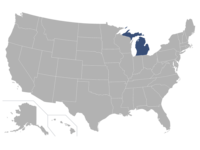
Which brings me to the aftermath of Michigan’s Democratic Senate primary, in which the U.S. relationship with Israel and the war in Gaza took center stage.
For some Jewish Democrats in Michigan, that line seems to be Abdul El-Sayed’s nomination for the U.S. Senate. Reports after Tuesday’s primary show that some lifelong Democrats now plan to vote for Republican Mike Rogers instead of supporting their party’s nominee solely because of El-Sayed’s views on Israel and the war in Gaza.
As someone who values both Jewish principles and American democracy, this leaves me scratching my head.
Jewish history is replete with examples of what happens when strongmen seize power and when minorities discover too late that the institutions they relied on not only can’t protect them, but are actively turned against them. That history should make us especially watchful against authoritarian tendencies, no matter which policies we prefer on any single issue.
My Jewishness lives in family stories, in humor and debate (with arms flailing no doubt) around the dinner table. But it mostly lives in the stubborn insistence on questioning everything — including our own assumptions. If nothing else, being Jewish (religiously or not) is the tradition of asking difficult questions, of wrestling with ideas, of valuing learning and debate. It is the inheritance of immigrant grandparents who arrived with little but language, recipes, and a determination that their children would have a better life. It is the sensibility that turns suffering into satire and survival into storytelling.
None of that, not one bit of it, should obligate Jewish Americans to feel loyalty to a country they likely never lived in and that increasingly may not represent the values they were raised with.
I wish the people who live in Israel and the territories it occupies — Jews, Palestinians, Muslims, Christians, and everyone else — peace, safety, and dignity, just as I wish those things for people anywhere. But wishing human beings well is not the same as pledging blind allegiance to a nation-state.
Jewish ethics stress justice, protecting the vulnerable, pursuing peace, and upholding human dignity. They also teach us that we are responsible not only for ourselves but for the society in which we live.
No candidate is entitled to anyone’s vote. Abdul El-Sayed certainly isn’t, nor is Mike Rogers.
Political disagreements come and go. Elections come and go.
The health of a democracy is much harder to restore once it’s lost.
That, more than any disagreement over foreign policy, is the lesson history urges us never to forget.
Lansing, MI