No political saviors: The Tennessee primary election cycle and the politics of maturity
Aug 07, 2026 | 1:57 pm ET
Description
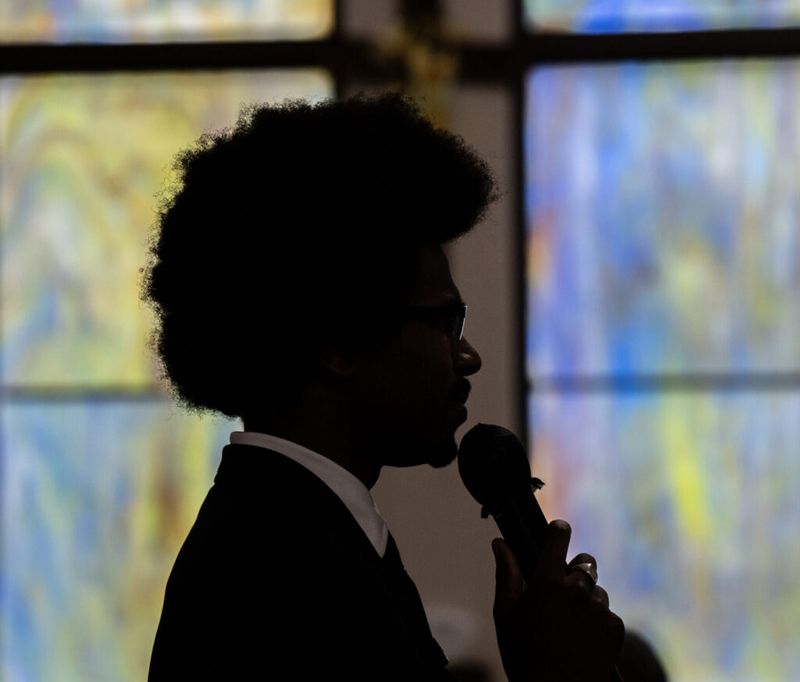
Rep. Justin J. Pearson, photographed at a June 6, 2026 event in a Williamson County church, had nearly every objective measure for political success in his Democratic primary for the 9th Congressional District, writes Rev. Earle Fisher. (Photo: John Partipilo/Tennessee Lookout)
One of the greatest misconceptions in American politics is that elections produce saviors.
They do not. They reveal who “we” are.
Every election exposes the character of a community. Its hopes, fears, priorities, and perhaps most importantly, its level of political maturity. The recent Shelby County election revealed something many of us would rather avoid: our greatest challenge is not simply increasing voter turnout. It is becoming mature enough to build and sustain collective political power.
For generations, Black communities marched, organized, litigated and sacrificed for the right to participate in democracy. Some gave their lives so future generations could exercise a vote that far too many now treat as optional or transactional. That legacy deserves more than our participation. It deserves our discipline.
Democracy has never been about getting everything we want. It has always been about securing enough collective power to improve the quality of life for the people we serve. That requires something increasingly rare in our political culture — the willingness to subordinate personal ambition to the common good.
Memphis has seen the consequences of failing to do so.
In the 2023 mayoral election, seventeen candidates sought the city’s highest office. Every one of them had the legal right to run. The question was never about rights. It was about responsibility. In a nonpartisan plurality election, every additional candidacy diluted an already fractured electorate. The eventual winner, Paul Young, received roughly 27 percent of the vote in an election where turnout hovered around 24 percent.
Before that election, UPTheVote901 organized the Memphis People’s Convention to help citizens and candidates engage one another beyond campaign slogans. The goal was not to crown a winner but to encourage discernment. Democracy depends upon informed voters, not simply ambitious candidates.
This year’s congressional primary presented many of the same challenges.
State Sen. London Lamar had every right to seek Tennessee’s 9th Congressional District seat. U.S. Rep. Steve Cohen had every right to endorse her candidacy. Rights, however, are not the issue. Responsibilities are.
Neither Lamar nor Cohen had to spend valuable time and political capital campaigning negatively against Rep. Justin J. Pearson, the eventual winner of the Democratic primary. They could have made the case for their preferred candidate without diminishing another Democrat who, by nearly every objective political measure — national and statewide name recognition, fundraising prowess, charisma — entered the race with the broadest coalition and the strongest path forward. More importantly, they could have preserved relationships that our community will now need if Democrats hope to reclaim and hold political power in November.
This is not about Lamar or Cohen alone. They are simply the latest illustration of a political culture that too often rewards personal preference over political principle and individual ambition over collective strategy.
Leadership sometimes requires the courage to run.
It also requires the wisdom to recognize that every campaign leaves a residue. The words spoken during a primary often become the obstacles that must be overcome in the general election. The strongest leaders understand that today’s opponent may be tomorrow’s governing partner.
The same immaturity appears among voters.
Too many Americans continue searching for political perfection. If a candidate fails to satisfy 100% of their preferences, they disengage altogether. Others dismiss every election as a choice between “the lesser of two evils” while refusing to acknowledge meaningful differences in healthcare, education, environmental protection, labor rights, voting rights and economic opportunity. In practice, many people surrender 80% of what they could gain because they refuse to accept the imperfect t20%t of progress available today.
Politics was never intended to produce saviors. It was intended to produce accountability.
Voting is not the end of democratic participation. It is the beginning. Every conversation, every registration drive, every candidate forum, every neighborhood canvass and every ride to the polls expands the possibilities of democracy.
But turnout alone cannot save us if our political culture remains captive to personality, impulse and ego.
As a pastor, I cannot separate this conversation from my spiritual formation. Freedom requires responsibility. Love requires sacrifice. Justice requires community. Those virtues do not emerge naturally from self-interest, and neither does democracy.
The consequences of our political immaturity are no longer theoretical. While we divide our coalitions and search for perfect candidates, others are patiently redrawing districts, reshaping courts, weakening labor protections, privatizing public institutions, eroding environmental safeguards and rolling back civil and human rights. They are playing the long game. If we continue substituting personality for strategy and impulse for discipline, we should not be surprised if it takes a generation to recover what we surrendered in a single election cycle.
There is still time to choose a different path before November.
Candidates can repair relationships. Elected officials can unite rather than divide. Organizations can collaborate instead of competing. Pastors can educate, organize and mobilize. Citizens can reject cynicism and recommit themselves to the long work of democracy.
Most importantly, we can stop looking for political saviors.
There are none.
There never have been.
Democracy does not require perfect candidates. It requires mature citizens willing to place the common good above personal preference and political strategy above political ego.
The question before us is whether we are finally ready to become those people.
Nashville, TN