My dad and Montana’s 1972 Constitution
May 20, 2026 | 6:29 am ET
Description
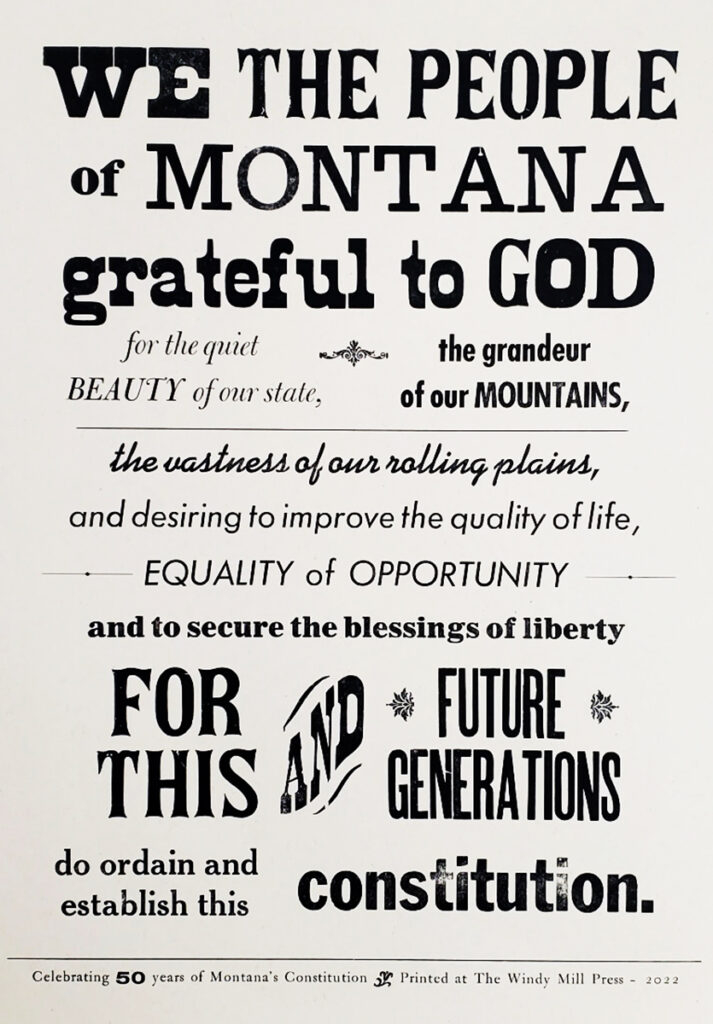
The Preamble of the Montana Constitution (Courtesy of Windy Mill Press).
Human rights, the emerging concern for the environment, and the importance of Indigenous culture were the focuses of my father, Rev. Donald A. Scanlin, as a delegate to the Montana Constitutional Convention of 1972.
In the early ‘70s, Dad, a retired minister, began a second career as an adult educator, thanks to a later-in-life teaching certificate he earned from Rocky Mountain College. His new position at Garfield School, located “on the south side of the tracks” in Billings, fit his lifetime dedication to counseling and inspiring people in need. He taught them English and civics.
His goal with English: To teach the under-educated to read and write to the fourth-grade level, so they could learn new skills and fill out job applications properly to acquire new ways to support themselves and their families. His goal with civics: To educate his adult students about the mechanics of American self-government and their role within it.
Among the 100 elected “Con-Con” delegates in Montana were several ministers and teachers. Dad had always used his role as a minister to speak from the “Bully Pulpit” about current social issues and his parishioners’ responsibility to address them. As an adult education teacher, he carried on in this role, inspiring his students to understand their place in a complex world and take responsibility for it.
The ’70s were an era of increased concern about the environment, about equality of individuals and cultures, and the political context these were in. The call for a constitutional convention to update Montana’s aged 1889 Constitution was a product of this new consciousness.
The ConCon review of Montana’s basic charter was an important part of the civic lessons Dad sought to give to his students. From these school discussions, he was persuaded by his students, according to him, to run for delegate to the Constitutional Convention. Dad’s students heartily campaigned for him in Yellowstone County where he and my mother, Millicent, lived. Through their collective efforts, he came in sixth among the 25 candidates on the ballot, winning a delegate position in this epic event.
Once seated in Helena, Dad’s interest focused on basic human rights, which were newly defined in the Declaration of Rights of the new Constitution. Among them were unique new rights of public participation, the right-to-know, to privacy and to decisions about pregnancy.
With a lifetime that spanned being a lobster fisherman in Maine, an avid trout fisherman in Montana, and an outdoorsman whose hunting skills put venison on the plates of his family, Dad was keenly aware of the natural environment. The new provision recognizing the importance of a “clean and healthful environment” in the proposed new constitution (Article IX) became a highlight of Montana’s document that were subsequently echoed in other jurisdictions. In the 54 years since state voters ratified the new Constitution in 1972, this provision has created many lively discussions and has proven to be an important part of actions taken by the state
Finally, Dad’s daily contact with minorities in the South Side of Billings raised his own consciousness of the cultures they represented, particularly, Native Americans and other minorities who have often been treated as sub-classes of our society. He lived by the premise that all Montanans were created equal. He particularly championed the provision requiring the culture of American Indians be reflected in the public education curriculum in Montana.
Being a delegate to the 1972 Montana Constitutional Convention was definitely a highlight of my father’s life, and an honor for both him and his family.
Helena, MT