Maryland passed a life-saving cancer law. Now the state needs to enforce it.
May 22, 2026 | 5:34 am ET
Description
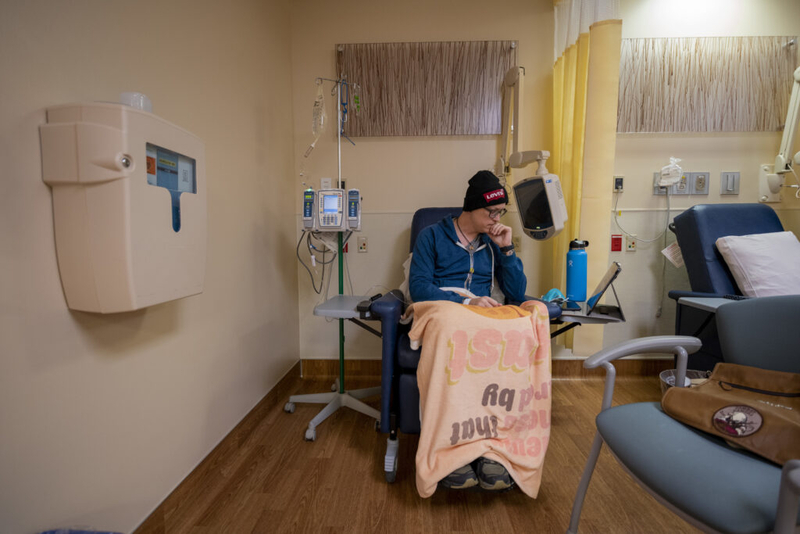
A cancer patient receives chemotherapy at the David Grant USAF Medical Center, Travis Air Force Base, California, in this 2020 photo. Biomarker testing can help avoid costly and painful treatments like chemo, writes Erin Dalder-Alpher, but the state needs to do more to make it possible for patients. (Photo by Nicholas Pilch/U.S. Air Force)
Biomarker testing is quite literally saving my life.
I am one of the lucky ones. I live in a state that, in theory, prioritizes this cutting-edge care. Thanks to a 2023 law, biomarker testing coverage is now required for both state-regulated private insurance and Medicaid in Maryland. But as I have learned through a grueling journey of biopsies and bills, a law on the books is only as good as its enforcement.
It is time for Maryland to move beyond the “signing ceremony” phase and redouble its efforts to ensure that insurance companies comply with the law. Every resident deserves the full benefits of precision medicine, free from insurance companies’ administrative interference.
My journey began in 2020 with a Stage 1 breast cancer diagnosis. Thanks to biomarker testing, my doctors determined I could safely avoid chemotherapy—a massive relief. However, cancer is a moving target; it does not stay static.
Last May, a routine checkup revealed metastatic breast cancer. When a traditional bone biopsy failed to provide a clear path forward, my team at Johns Hopkins turned to a liquid biopsy—a relatively new biomarker testing procedure that examines a tumor’s genetic makeup through a blood draw.
Your opinion matters
Maryland Matters welcomes guest commentary submissions at [email protected].
We suggest a 750-word limit and reserve the right to edit or reject submissions. We do not accept columns that are endorsements of candidates, and no longer accept submissions from public officials or political candidates.
Opinion pieces must be signed by at least one individual using their real name. We do not accept columns signed by an organization. Commentary writers must include a short bio and a photo for their bylines.
Views of writers are their own.
The liquid biopsy showed my doctors that my cancer had not mutated, providing the “actionable information” needed to skip the standard—and often grueling—pathway of radiation and traditional chemo. Instead, I am on a personalized regimen: oral chemo and an inhibitor that blocks my body’s estrogen from fueling the disease.
The results have been nothing short of miraculous. My tumor markers indicate the cancer has been essentially squashed. While metastatic breast cancer is not considered curable, biomarker testing makes it highly treatable.
But here is the catch: My insurance initially refused to cover the procedure. They eventually classified it as “out-of-network,” a move that instantly swallowed my $5,000 deductible. That is money I simply do not have. Like many navigating a serious illness, I am not working and am currently navigating the disability coverage process. Had my insurance followed the spirit of the law, that cost would have been a fraction of the price.
It is shameful that seriously ill patients must jump through hoops and risk financial ruin to access biomarker testing that is already protected by Maryland law.
Biomarker testing isn’t a luxury; it’s a cost-saver. It prevents unnecessary, expensive and harmful treatments and detects relapses earlier. According to the American Cancer Society, 77% of patients who underwent biomarker testing reported that it improved their treatment, and more than half said it increased their likelihood of recovery.
Despite the law’s clear intent, Maryland is falling short on accountability. We were among the first 23 states to pass such a law, yet we are failing the “implementation” test.
Look at Mississippi, where the law requires insurers to provide written explanations for denials and authorizes the Department of Insurance to conduct audits. Look at Georgia and Nevada, where regulators have issued clear bulletins to insurers, signaling that they are closely monitoring.
The Maryland Insurance Administration has remained silent.
Maryland must eliminate the ambiguity that insurance companies exploit. We need immediate measures: issuing a clear compliance bulletin to insurers, requiring written explanations for denials, and conducting proactive audits to identify “bad actors” who ignore coverage mandates.
Metastatic breast cancer patients aren’t the only ones waiting. Those fighting lupus, rheumatoid arthritis, diabetes, and lung or colorectal cancers also rely on this technology. For us, every day matters. Maryland already has a powerful law; it’s time to put some muscle behind it.

Annapolis, MD