More states tighten voting rules ahead of midterm elections
Jun 29, 2026 | 9:56 am ET
Description
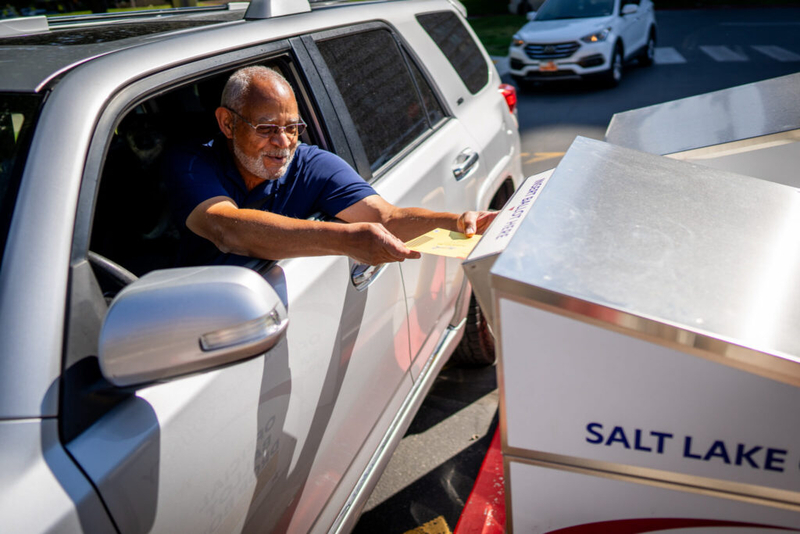
A voter drops off his ballot at the Salt Lake County Government Center in Salt Lake City as votes are cast in Utah’s 2024 primary election. Utah and at least eight other states enacted voting laws this year that will make it more difficult for some voters to cast their ballots during the midterm elections in November. (Photo by Spenser Heaps for Utah News Dispatch)
At least nine states have passed voting laws this year that will make it more difficult for some voters to cast their ballots during the midterm elections in November.
Lawmakers in Florida, Kansas, Kentucky, Mississippi, Nebraska, New Hampshire, South Dakota, Utah and West Virginia passed laws between January and May of this year restricting access to voting, according to an analysis of publicly available data by the Brennan Center and the Goldman School of Public Policy at the University of California at Berkeley.
Champions of such laws say they protect election integrity and ensure that only U.S. citizens vote in elections.
“Safeguarding the electoral process to improve oversight and prevent unlawful influence has been a top priority for my administration since my first days in office,” said Florida Republican Gov. Ron DeSantis in an April statement announcing his signature on a sweeping new elections bill.
“This legislation strengthens the security, transparency and reliability of Florida’s election system.”
But the new laws have alarmed voting rights advocates, who say they will disenfranchise eligible voters and add extra burdens for older people, people with disabilities and those, such as married women, whose last names don’t match their birth certificates due to a name change.
“In Mississippi, rural voters may have to drive hours roundtrip to reach the office where they can obtain official records,” said Sonya Williams Barnes, Mississippi policy director for the Southern Poverty Law Center, in a March statement condemning a new state law that beefs up citizen verification requirements for voters.
“For people living on fixed incomes, cost matters.”
Even some Republicans have noted that noncitizen voting is extremely rare. A yearlong review of Utah’s voter rolls completed in May found just 27 confirmed noncitizens out of more than 2 million registered voters.
“This demonstrates that there is not a widespread problem (with noncitizens voting), and that states and our county clerks, for the most part, do a very good job of making sure that our voter rolls are clean, and that only eligible voters are registering,” Utah’s Lt. Gov. Deidre Henderson, a Republican, said at a news conference in May announcing the results, as reported by the Utah News Dispatch.
The new raft of laws only applies to state and local elections; voters who don’t provide proof of citizenship as outlined in the state laws are still able to vote in federal races. Federal law doesn’t require proof of citizenship to vote, though only U.S. citizens can legally cast a ballot.
Many of the new laws focus on the identification documents required to be able to vote. Florida, Mississippi, South Dakota and Utah now require proof of citizenship before a person can register to vote in state and local elections. Some, such as Florida, New Hampshire and Utah, have narrowed the types of identifying documents that will be accepted.
Florida’s sweeping new elections law has been dubbed the Florida SAVE Act. It won’t go into effect until next year, but it’s similar to the federal SAVE Act backed by President Donald Trump. He’s currently trying to push Congress to approve it by refusing to sign a bipartisan housing bill.
Florida’s new law requires proof of U.S. citizenship for anyone registering to vote, and requires the state to cross-check registration applications against government databases. Much like the proposed federal SAVE America Act, Florida’s version stipulates that if someone’s name on their citizenship document is different from the name on their current ID, they must provide proof of a legal name change. Experts believe this will particularly burden married women and others who have changed their surnames.
Other states have granted federal authorities the right to check voter lists for people they believe aren’t citizens.
Kentucky’s omnibus elections law, passed in April, includes a provision granting federal authorities the right to check voter lists for people they believe aren’t citizens. Mississippi’s law requires the state to check prospective voters against a federal citizenship database.
And some new laws that aren’t explicitly about election integrity have the potential to impact who votes in the midterms.
In Kansas, a new law that requires Kansans to use the bathroom of their biological sex at birth in government buildings also says Kansans must use the gender of their biological sex at birth on their driver’s licenses. This could invalidate one major type of accepted identification that Kansas voters must show to be able to cast a vote in person. It particularly affects transgender voters because it invalidates documents such as birth certificates and drivers licenses that were previously issued to them.
Many of the states that have passed new voting laws, such as Kentucky and Utah, are being sued by the U.S. Department of Justice for not providing voter registration data to the feds.
Republican officials in these states have resisted sharing state voter rolls, which include personal information like birth dates and Social Security numbers, without court order.
“Neither state nor federal law entitles the Department of Justice to collect private information on law-abiding American citizens,” Henderson, the Republican lieutenant governor of Utah, said in a post on X in February.
Ballots become battlegrounds for voting rules, redistricting, election power
Many state Democratic leaders also have criticized the laws.
“We already have a system in place to verify people’s citizenship and it is working,” South Dakota Democratic Party Chair Shane Merrill said in a statement after the state’s new proof of citizenship law passed in March. “There have been no instances of noncitizens voting in our elections. Instead, this law creates a two-tiered system in our state, telling some South Dakotans that they aren’t good enough to vote.”
Some state voting laws are now facing legal challenges. In Florida, voting rights advocates filed a lawsuit in federal court against the state’s SAVE Act, hoping to block it before it goes into effect in 2027. The plaintiffs claim the new law throws up barriers to voting and will disenfranchise people who are otherwise eligible to vote.
In New Hampshire, a federal judge struck down a 2024 Republican-backed law that required hard proof of citizenship to register to vote; the state has just appealed the ruling with a few months to go before the September state primary.
Some states are still considering new voting restrictions. Next week, the North Carolina House is expected to vote on an election bill that passed from committee without unanimous Republican support. The legislation would require voter identification from military and overseas voters, among other restrictions.
Stateline reporter Anna Claire Vollers can be reached at [email protected]