House set to vote on sweeping election bill despite opposition to overseas voter restrictions
Jun 25, 2026 | 5:19 pm ET
Description
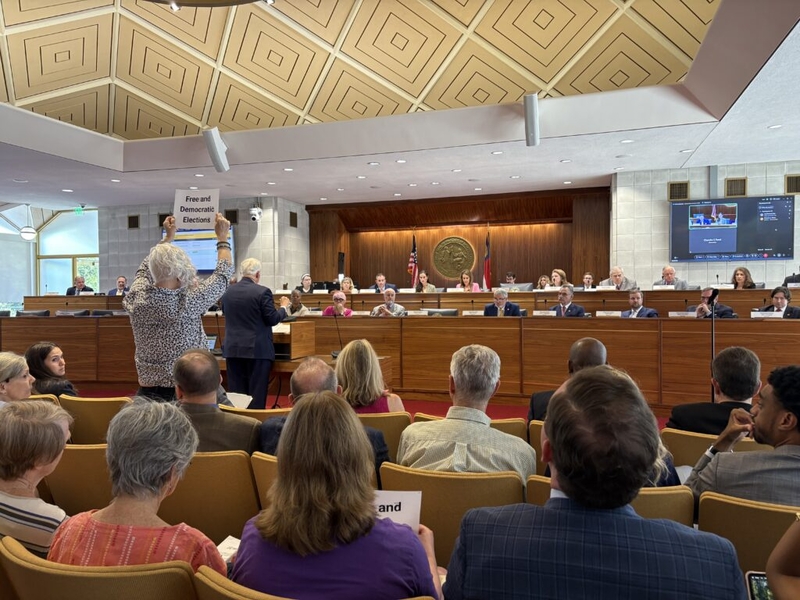
The first protester rises at the House Rules Committee on Wednesday, June 24, 2026, moments before members of the public are ejected from the auditorium. (Photo: Brandon Kingdollar/NC Newsline)
The North Carolina House of Representatives is expected to vote on a hotly contested election reform bill next week after it passed the powerful House Rules Committee on Wednesday.
House Bill 958 passed the committee by a margin of 14-9, becoming one of the rare bills to not receive the support of all Republicans on the panel. That’s in part due to backlash over provisions that would require voter identification from military and overseas voters, among other restrictions.
The bill did not arrive on the House floor Wednesday as lawmakers took up a slew of veto overrides instead. Speaker Destin Hall (R-Caldwell) told members of the media he expects a vote next week, though there may be additional changes coming to the bill.
“I think you’ll see the House pass one out next week,” Hall said. “As always, we’re talking to our Senate counterparts about the ideas they have for an elections bill, and so especially on something like that, we try to at least have a general understanding.”
NC House committee okays a sweeping election bill, but its sponsor says it needs more work.
The bill’s Republican authors say its provisions are intended to safeguard elections from voter fraud. Democrats say the legislation will instead prevent lawful voters from exercising their right to cast a ballot.
Some of the more controversial elements of the bill were removed after it was pulled from a vote in the Rules Committee on June 17.
The provisions removed from the bill before Wednesday’s hearing include a ban on ranked-choice voting, a bid to criminalize pay-per-signature petition drives, and a requirement for military and overseas voters to provide residency documentation when registering to vote, such as a utility bill or bank statement.
The new version of the bill also narrowed a ban on state and county election officials from “encouraging or promoting voter turnout in any election,” which sparked backlash from voting rights organizations.
Under the updated version, officials would not be allowed to make statements encouraging turnout for particular advocacy groups, political parties, candidates, or individual elections. However, Democrats on the committee told NC Newsline they still have concerns with the wording of that provision, and are hoping to change it before it reaches the House floor for a vote.
Remaining in the bill are provisions that could significantly expand the number of challenges to ballots in future elections, including allowing post-election challenges to all early votes — the majority of ballots cast in North Carolina — not just those that are mailed in. And it would also require the state board to conduct a statewide audit after each election to identify any ineligible ballots or voters that are flagged by official government databases, including the controversial SAVE database.
Hilary Harris Klein, a voting rights attorney with the Southern Coalition for Social Justice, said if the bill passes into law, challenges like Judge Jefferson Griffin’s effort to throw out thousands of ballots in the 2024 state Supreme Court election will only become more common.
“It is opening Pandora’s Box for election chaos, similar to what we saw in the Griffin election protest, where folks are having their status as registered voters challenged after they’ve already voted, and there’s nothing they can do to fix it,” Klein said. “It’s fundamentally unfair to voters. It’s a huge burden on election officials.”
The bill also codifies the only successful element of Griffin’s challenge, barring “never-residents,” voters with North Carolina connections but who have never lived in the state, such as the children of overseas military families, from casting ballots in any North Carolina election.
That provision would not take effect until after this year’s midterms. It follows a state court ruling earlier this month that these voters cannot participate in North Carolina’s state and federal elections.
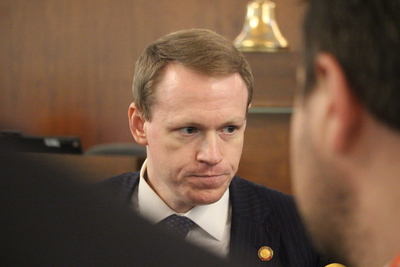
“I understand under the various court rulings that we’ve seen in the last couple of years, there’s prohibitions on never-residents voting anyway,” Hall said Wednesday. “It’s a complicated issue of, there’s court decisions out there, do we take action? Is it a good or bad thing to do to put it into statute if it’s a court decision? Just stuff that takes time for folks to work out. But we’ll get an elections bill passed.”
Separate from the state board’s audit requirement, another section of the bill authorizes the state auditor to conduct regular post-election audits, requiring each county board of elections to be audited at least once every six years. Those audits may only take place once the election has been certified, and cannot be used to challenge the final election results.
However, that provision was also changed in response to critics’ concerns. An earlier version of the bill would have allowed the auditor to select the counties he wants to audit. The new version requires them to be randomly chosen.
The most vocal backlash to the bill on Wednesday came in response to a provision that remained in the bill requiring military and overseas voters to include photo ID when they mail their ballots — a key dispute in the challenge to the 2024 North Carolina Supreme Court election — or an affidavit explaining why they cannot provide one.
Opponents of the bill say it will prevent members of the military from casting ballots in the country they are sworn to defend.
Melissa Price Kromm, executive director of voting rights group North Carolina For The People, said her daughter was among the overseas voters whose ballots were challenged in Griffin’s lawsuit. She said there is a reason the state’s original voter ID bill exempted these individuals from its requirements.
“It’s challenging for some types of military individuals who may be in the field, but not carrying their own personal documents. It may be especially challenging for missionary individuals, because they’ll go into an area, but they’ll leave all their documents 100 miles away,” said Price Kromm. “We really should consider the consequences of what this will take on individuals who are doing good work abroad.”
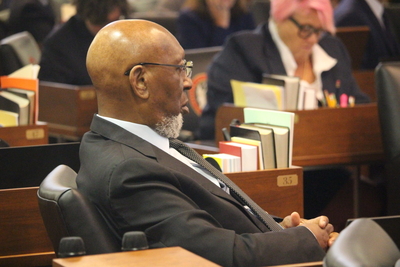
Rep. Shelly Willingham (D-Edgecombe), who had previously said he was willing to support the bill, told his fellow lawmakers that calls from constituents concerned about barriers to voting for military and overseas voters were enough to change his mind.
“Normally, when I decide something, I stay with what I said, period, but again, it moved me with the people that I’ve heard from, especially the military folks,” Willingham said. “I heard from people I haven’t seen or heard from in 30 years, so evidently that must be really deep.”
The bill’s opposition did not just come from Democrats. Rep. Tricia Cotham (R-Mecklenburg) was one of several members to vote against the bill in the House Rules Committee, a rare GOP defection within that panel. And Rep. Carla Cunningham (U-Mecklenburg) also opposed its passage, saying voters are becoming confused by “constantly changing” election laws.
“I have grave concerns about that, because we have been picking and picking and picking at it to where right now, most people are probably nervous and scared and saying, ‘What am I going to have to do next?’” Cunningham said. “The public can’t keep up because we’re moving so fast.”
Opposition from those members would be enough to uphold an expected veto from Gov. Josh Stein, if they held firm on their votes, although Republicans were able to override other vetoes from the governor on Wednesday because Willingham and Cunningham chose not to attend the voting session.
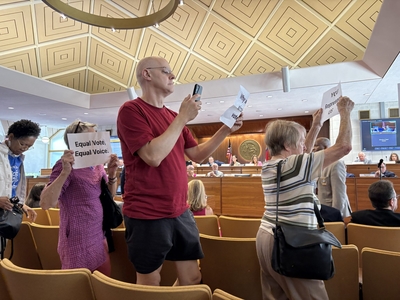
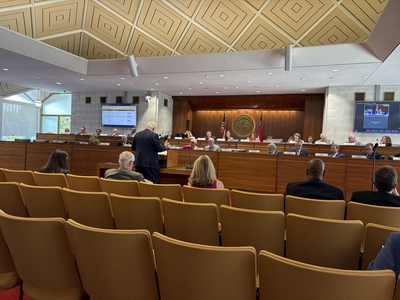
As lawmakers on the Rules Committee began debate on H958 Wednesday, a small group of protesters rose and chanted “Shame!” Several held signs with slogans like “Free and Democratic Elections” and “Why are you afraid of voters?”
Chairman Rep. John Bell (R-Wayne) promptly ordered all members of the public to be ejected from the committee room, after which the committee continued its debate and ultimately voted to advance the bill.
One of the ejected protesters, Kathleen Rickert of Durham, said all the different versions of the bill have made it challenging to know what the requirements will actually be for voters. “I’m a firm believer in free and fair elections, and this bill is making it very, very confusing,” she told NC Newsline.
Rickert, who held a sign reading “Equal Vote, Equal Voice” at the hearing, said she was most concerned by the prospect of military and overseas voters being disenfranchised.
“Asking first for photo IDs from those people — which I had thought it was illegal to send those by the mail — and there’s just not enough turnaround time by the time that those votes get processed,” she said. “They question those overseas ballots and by the time they get overseas and then get mailed back again, it just seems like there’s just not enough time.”
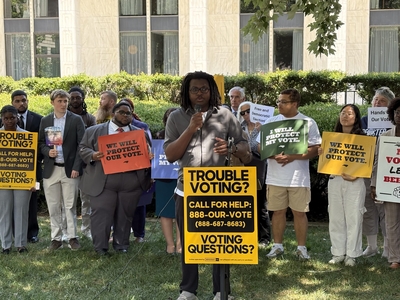
At the same time as the committee hearing, student activists gathered outside the General Assembly for a press conference defending voting rights. They condemned election officials for pulling polling sites off of university campuses.
NC State student Jaden Foy, who writes for the school’s historically Black student newspaper, the Nubian Message, said the removal of the early voting site at Talley Student Union is a huge blow to student voter participation.
The early voting site was moved to NC State’s Business Center, which is located at the edge of campus in an area most students don’t frequent.
“Hundreds of students and hundreds of potential voters are going to be disenfranchised, right? This is completely unacceptable,” Foy said.
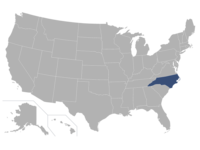
Raleigh, NC