Gun policy emerges as an early flashpoint in Florida governor’s race
Aug 27, 2026 | 5:35 pm ET
Description
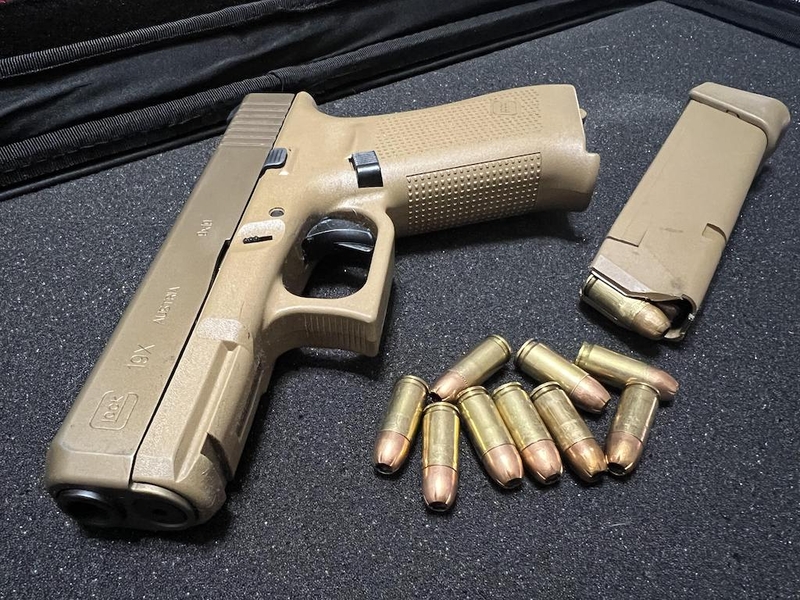
An unloaded Glock 19X handgun sits next to a magazine and 9 mm ammunition at a gun range. Several states have enacted laws that allow judges to temporarily remove guns from people in crisis, but a growing number of states are banning the measures. (Photo by Amanda Watford/Stateline)
Byron Donalds says that the choice between himself and David Jolly for Florida governor “could not be clearer,” and that’s certainly the case when it comes to comparing the two major candidates positions regarding the regulation of guns and the people who use them.
Jolly is running on a gun safety platform that includes four tenets: He wants to ban the sale of assault weapons, require universal and comprehensive background checks on gun purchases, explore licensing for firearm ownership, and preserve and expand the “red flag” laws passed in the wake of the 2018 school shooting massacre at Marjory Stoneman Douglas Public High School in Parkland.
Those red flag laws are officially called Risk Protection Orders (RPO). In Florida, only law enforcement officers or agencies can file an RPO petition in civil court which alleges that the respondent poses a significant danger of causing personal injury to him or herself others by having a firearm or ammunition in their custody.
That law was part of the Marjory Stoneman Douglas Public High School Safety Act passed by the Florida Legislature and signed into law by then Republican Gov. Rick Scott less than a month after the Parkland tragedy.
Donalds says that he is considering repealing that and other provisions of the law if elected in November.
The GOP gubernatorial candidate has proudly told audiences on the campaign trail for more than a year that he was one of the minority of Republicans in the Florida House who opposed the 2018 law. The measure includes a multitude of provisions: It raised the minimum age to buy a rifle or long from 18 to 21. The law also banned bump stocks; required a three-day waiting period for gun purchases; and created those risk protection orders.
When it comes to restricting the purchase of long guns to those 21 and over, Donalds says that “it’s gotta go.”
“We’re going to remove that provision,” he told the Phoenix on Tuesday night.
Senate a bulwark on 2018 gun law
However, the governor of Florida doesn’t have the ability to make that change on his or her own. Ron DeSantis has also been on the record supporting repeal of the measure, and the Florida House passed legislation that would do just that (HB 133) for the fourth straight year in January.
But it failed for the fourth straight year because Senate President Ben Albritton —just like his predecessor, Kathleen Passidomo — didn’t support the legislation.
The incoming Senate president is Manatee County Republican Jim Boyd. He did not respond to a request for comment.
“The Parkland gun safety law was bipartisan, it’s supported by law enforcement, and it should stay in place,” Jolly told the Phoenix.
Regarding repealing red-flag laws/risk protection orders, Donalds said Tuesday night that “we want to make sure without a shadow of doubt that constitutional rights are protected. So that’s what we’re going to aim for.”
In a video posted by earlier this month by Luis Valdes, the Florida state director with Gun Owners of America, Donalds vowed “we’re going to get those provisions undone in Florida.”
While Florida Republicans have passed legislation in the House to repeal the age limit on purchasing a long gun, this past session was the first time that a lawmaker filed legislation attempting to revoke the state’s red flag law. It never received a hearing.
Law enforcement’s concerns
A major factor holding off any repeals of the Marjory Stoneman Douglas Public Safety Act has been the opposition of law enforcement.
Pinellas County Sheriff Bob Gualtieri just finished his role in chairing the Marjory Stoneman Douglas High School Public Safety Commission, which ended its work last month. He is supporting Donalds, and introduced him at a campaign event in St. Petersburg on Tuesday night.
He declined to respond to a request for comment on the Republican gubernatorial remarks regarding repealing provisions of the 2018 law.
Opposition by law enforcement isn’t bulletproof, however.
For years, the Florida Sheriffs Association fought against allowing for the open carrying of firearms, and that opposition compelled previous Florida Republican leaders to oppose the measure. Albritton told reporters shortly after taking office as Senate president in December of 2024 that he had supported law enforcement his entire life and “I stand with them today in opposition” to open carry.
That opposition didn’t matter however after a three-judge panel of the Florida First District Court of Appeal ruled that the state’s ban on open carry was unconstitutional, a decision that Donalds celebrates.
“We now are essentially an open carry state because of the ruling,” Donalds said.
Yet the Florida Legislature never codified open carry into legislation during the 2026 regular legislative session.
Broward County Rep. Christine Hunschofsky, the incoming Democratic Leader in the Florida House, filed a measure last session that she said would have closed a perceived loophole in the current law by clarifying that all firearms remain prohibited in sensitive government and community spaces.
“I actually privately received a lot of support from the other side of the aisle and from law enforcement,” she said about the proposal, which never received a hearing in committee.
Uthmeier has already indicated that he wouldn’t defend Florida’s law banning individuals under the age of 21 from purchasing a long gun. Hunschofsky says that’s unfortunate.
“Last time I checked the role of the attorney general was to defend the laws of the state of Florida,” she says. “It wasn’t his job to decide which laws he felt were worth defending and which weren’t.”
Uthmeier has also intervened in several other cases involving the use of firearms during his short tenure as the state’s attorney general where he unilaterally declared that current state gun laws are unconstitutional.
Tallahassee, FL