Missouri governor places tax overhaul, initiative petition limits on August ballot
May 22, 2026 | 2:13 pm ET
Description
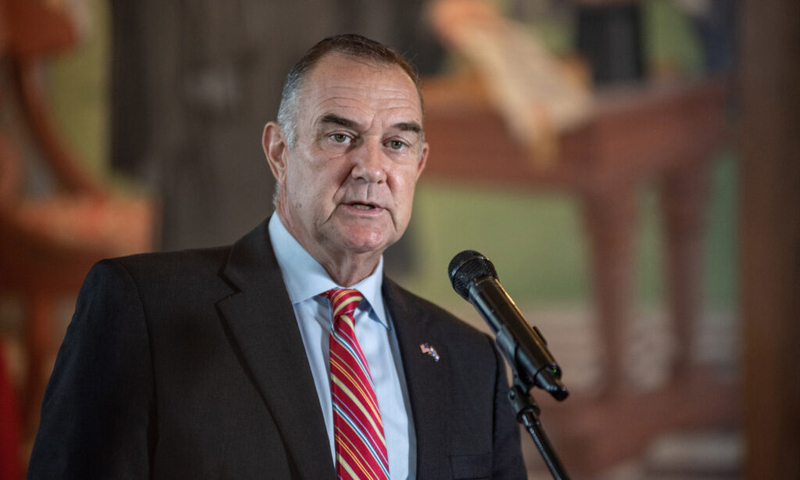
Missouri Gov. Mike Kehoe speaks to reporters on May 27, 2025 (Annelise Hanshaw/Missouri Independent).
Gov. Mike Kehoe will ask Missouri voters in August to decide whether lawmakers should have new power to expand sales taxes to replace the income tax and whether citizen-led constitutional amendments should face a higher bar for passage.
Kehoe moved four proposed constitutional amendments to the Aug. 4 primary ballot: Amendment 1, renewing a sales tax for state parks and soil conservation; Amendment 2, requiring direct election of county assessors; Amendment 4, changing the threshold for constitutional amendments proposed by initiative petition; and Amendment 5, authorizing lawmakers to expand sales taxes as part of an effort to eliminate the state income tax.
In a statement Friday, Kehoe defended the August timing on Amendment 5 by pointing to the work lawmakers would face if it passes.
“Modernizing Missouri’s outdated tax code, specifically, will be a momentous task for the Missouri General Assembly, and placing the measure to phase out Missouri’s income tax on the August ballot gives lawmakers additional time to prepare for the next phase of implementation,” Kehoe said.
The governor did not address why Amendment 4, the initiative petition measure, was also placed on the August ballot rather than November.
Gov. Mike Kehoe’s decision on ballot timing could shape Missouri’s 2026 elections
The decision places two of the year’s most consequential measures before a smaller, historically more Republican-leaning electorate than the November general election.
Major ballot measures have historically driven up Missouri primary turnout, particularly among voters taking Democratic ballots. But the August electorate still skews more conservative than November’s, and Kehoe’s choice keeps Amendment 4 and Amendment 5 off a fall ballot already expected to include fights over abortion rights and Missouri’s congressional map.
Scott Charton, who speaks for the campaign committees opposing both Amendment 4 and Amendment 5, called the August placement of the two measures “the most brazen power grab from our citizens on a single ballot in Missouri history.”
“The common thread between the amendments is luring Missouri citizens to surrender long-held constitutional power and freedom, and giving that power to politicians to use unchecked,” said Charton, whose groups are funded by the Missouri Association of Realtors.
Amendment 5 was Kehoe’s top priority during this year’s legislative session. If approved, it would allow lawmakers to apply sales taxes to transactions not currently taxed, with any new sales-tax revenue tied to cuts in the top state income tax rate, currently 4.7%. Lawmakers would have five years to redefine what is subject to sales tax.
Supporters argue the proposal would make Missouri more economically competitive by moving the state away from income taxes. Opponents warn it gives lawmakers broad authority to tax services and consumer purchases that are not currently subject to sales taxes, shifting more of the state’s tax burden onto working families.
Charton said the proposal is too vague for voters to know what they are being asked to approve. He also pointed to the state auditor’s fiscal note, which says the General Assembly already has the power to reduce the state’s income tax by statute.
“The real agenda behind Amendment 5 is to trick voters into giving politicians a license to ignore current constitutional taxpayer protections approved by the people,” Charton said.
Amendment 5 would also allow lawmakers to override three prior voter-approved laws, Charton said, pointing to a 2010 amendment banning real estate transfer taxes, a 2016 amendment prohibiting new sales taxes on services and the 1980 Hancock Amendment, which requires significant tax increases to be approved by voters.
A lawsuit filed in Cole County argues Amendment 5 should be removed from the ballot because it contains too many subjects and because the ballot language written by lawmakers is misleading. If the measure remains on the August ballot, the legal fight could continue on a compressed timeline as election officials prepare ballots for military and overseas voters by the June 19 mailing deadline.
Amendment 4 would change how constitutional amendments proposed by initiative petition are approved.
Instead of requiring a simple majority of votes cast statewide, citizen-sponsored constitutional amendments would need to win a majority in every congressional district. That means voters in one congressional district could defeat an amendment even if it wins statewide.
The proposal has been a priority for Republican lawmakers after Missouri voters used the initiative process in recent years to legalize marijuana, expand Medicaid eligibility, raise the minimum wage and protect abortion rights. Initiative campaigns have increasingly proposed constitutional amendments rather than state laws to make it harder for lawmakers to revise or repeal voter-approved measures.
Amendment 4 would apply only to constitutional amendments proposed by initiative petition. Constitutional amendments placed on the ballot by lawmakers would continue to require a statewide majority for passage. The measure would also add prohibitions on foreign donations to ballot campaigns and signature fraud to the Missouri Constitution, though both are already addressed in state law.
“Amendment 4 effectively kills the IP process for citizens, while empowering the Legislature, which can still propose amendments for the ballot with simple majority votes in each chamber,” Charton said.
Missouri voters could face as many as nine ballot measures in 2026
A legislative proposal that would repeal Missouri’s 2024 abortion rights amendment will remain on the November ballot. That measure would ban abortion except in medical emergencies and in cases of rape or incest during the first 12 weeks of pregnancy. It would also place Missouri’s ban on gender-affirming treatments for minors in the state Constitution.
A possible referendum on the gerrymandered congressional map passed by lawmakers last year is also expected to appear in November if Secretary of State Denny Hoskins certifies that supporters collected enough valid signatures and that the referendum is legal. The map was drawn to help Republicans flip the 5th Congressional District, held by Democratic U.S. Rep. Emanuel Cleaver of Kansas City, and give the GOP seven of Missouri’s eight U.S. House seats.
The August ballot will also include Amendment 1, a 10-year extension of the one-tenth of 1% sales tax split between state parks and soil and water conservation programs. The tax raised about $140 million in fiscal 2025 and has been renewed by voters three times since it was first approved in 1984.
Amendment 2 would require every Missouri county to directly elect its assessor. Jackson County is currently the only county without an elected assessor.
The four measures Kehoe moved to August will appear in an election where the highest-profile candidate races are competitive Republican primaries in the 5th and 6th Congressional Districts and several state Senate districts.
The only statewide candidate race this year is for state auditor. Republican incumbent Scott Fitzpatrick is expected to easily win renomination in August before facing a Democratic challenger in November.
Jefferson City, MO