A BEAD on Nebraska broadband: State reopens provider applications with over $300M still in limbo
May 22, 2026 | 2:52 pm ET
Description
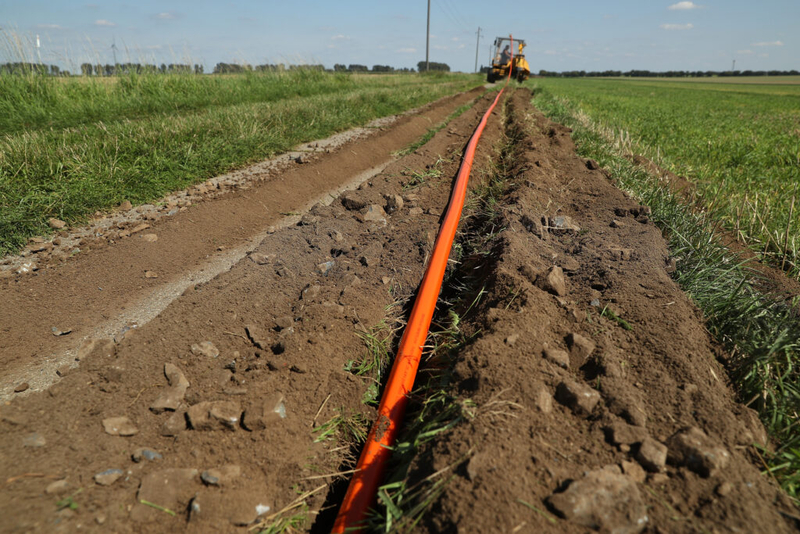
The need for rural broadband connections is nearly universal, though the decision of whether to lay fiber optic cable like this or to connect people in rural places wirelessly or by satellite continues to stir debate. (Sean Gallup/Getty Images)
LINCOLN — As Nebraska establishes its first broadband connections through the federal Broadband Equity, Access and Deployment (BEAD) Program, the future of more than $300 million in allocated-but-unspent funds remains up in the air.
At an event earlier this month in Ogallala, Gov. Jim Pillen, alongside U.S. Assistant Secretary of Commerce and Communications and Information Arielle Roth, celebrated the state’s first household internet connection facilitated through the BEAD program.
This marked a milestone for a federal program Nebraska first joined in 2023. In the ensuing three years, the program itself saw a massive restructuring following a change in presidential administrations, which led to a near 90% reduction in the funds Congress allocated for Nebraska to use for broadband expansion.
In late 2025, state lawmakers learned of changes coming to BEAD through President Donald Trump’s “Benefit of the Bargain” initiative. The update came a day after Pillen announced that Nebraska had planned to use just $44.5 million of the $405 million the state was initially awarded through BEAD to connect unserved Nebraska locations to broadband.
According to Roth, the original BEAD program “never got off the ground” due to burdensome regulations under the Biden administration, which she said Trump course-corrected. A big part of that was opening the door to technologies other than fiber — often referred to as the “gold standard” of internet technologies among advocates.
Roth argued that Biden had a “thumb on the scale” for one method — fiber — which was a cause for the slower progress. Pillen called the perception that fiber internet is the gold standard of internet connections outdated. He said it ignores rapid advancements in other technologies like satellite and cable. He said the internet speeds established in Nebraska’s first connection were “off the charts.”
“What makes Nebraskans great is we don’t settle for mediocre,” Pillen said in a press release from the Nebraska Broadband Office (NBO). “And through this process we found a group of providers that will meet the high standards we have for connectivity.”
However, not all broadband advocates buy the governor’s story. Gage County farmer Emily Haxby, said it feels like Pillen is trying to justify the major changes his team implemented — changes that she’s uncertain will work out for Nebraskans in the long run.
Fiber vs. everything else
Haxby acknowledged that fiber internet wouldn’t be feasible for all of Nebraska. Because fiber optic cables are typically buried underground, she said the option wouldn’t work in rocky terrains.
However, she argued that no other technologies compare to fiber’s scalability and reliability when establishing internet connections. Haxby has been a vocal critic of Nebraska reducing its request for BEAD funds for broadband expansion, arguing that the state could have accomplished more by using more of the set aside funding.
“You try to get the best solution out as far as you can first,” Haxby said.
According to information Haxby said she received from the National Telecommunications and Information Administration (NTIA), Nebraska ranks dead last in granting BEAD funds for fiber internet, at about 9%. Haxby said the national average was about 62%.
Oliver Borchers-Williams, director of broadband development for the Southeast Nebraska Development District, compared fiber internet to a highway where every lane is an expressway. That doesn’t mean that other methods can’t reach the same speeds, but he said there are more limitations on other methods compared to fiber’s unlimited speed and performance.
Borchers-Williams also acknowledged that fiber is one of the most expensive internet options and agreed there have been incredible advancements in other technologies within the last five years. He said debate over the merits of other methods compared to fiber has been prevalent within the broadband world since BEAD was restructured.
Pillen said prior to the restructuring, BEAD regulations in areas like labor and climate change discouraged participation from some companies. Vistabeam, the company that connected the Ogallala household via a wireless tower, would be shut out under the Biden administration’s version of the program, he said.
Haxby said Vistabeam is a good company, and she’s glad the state is working with them but reiterated that fiber internet is still a more reliable method. She said the locations farther away from the wireless tower may face higher risk of slower internet speeds.
To connect the remaining unserved or underserved locations in Nebraska, Pillen said the state will need about 75 wireless towers. Nebraska currently has 40. Pillen said he hopes to have the remaining locations connected within two years, although he later noted that his preferred timeline may not be feasible.
Companies backing out
As the state moves forward in establishing broadband connections through BEAD, several companies that initially wanted to participate in Nebraska have backed out.
NBO confirmed in a written statement to the Examiner that three companies did not sign their subgrants due to changes in their business plans. The office declined to name the companies that did not sign.
On Friday, NBO announced the seven companies that did sign subgrants, following three weeks of repeated questions from the Examiner about the contracts. The press release notes that the seven companies will connect 88% of the roughly 14,000 BEAD eligible locations in the state.
The press release made no mention of the three companies that did not sign their subgrants but hinted at where some might have worked by noting that NBO is opening a new round of applications to serve the state’s remaining 12% of eligible locations.
“Throughout each application round, we’ve gained valuable insight into how project areas can be structured more effectively,” said NBO Deputy Director Patrick Redmond. “By refining project areas based on real-world lessons learned, we expect to improve efficiency, reduce overall program costs and create a smoother process for applicants.”
What about the leftover funding?
Subtracting the $44.5 million Nebraska received for BEAD broadband expansion, that leaves about $360 million in federal funds not yet steered. State officials have given varying estimates of how much of that amount the state could receive.
Pillen said he was looking for ways to invest $350 million in leftover funds, noting technological support for precision agriculture as a top preference for him. The NBO statement said the NTIA is evaluating uses of non-deployment funds that could bring $317 million of the funds into Nebraska.
These funds could be used for “any use determined necessary by the assistant secretary to facilitate the goals of (BEAD),” according to the statement. Borchers-Williams said NTIA officials had said they would issue this guidance by March 11 — two months ago — but he has yet to receive word.
Borchers-Williams said using the leftover dollars for precision agriculture, as the governor suggested, would be a good option. He warned against other potential uses for the funding, such as artificial intelligence data centers, which he believes would be a waste of money.
Pillen said it is a misconception to think that Nebraska gave up $350 million of its BEAD allocation, arguing the state didn’t need that much money for broadband expansion. He said he is confident that state officials can bring the rest home.
For Haxby, she said she hopes the state can hold on to the remaining funds, but she said she wishes officials had used the money for its original purpose. She works on fostering broadband connections in Gage County and said there are households in her area that will be left without stable internet due to the changes.
“Now these people — and some of them are in my district — I have to tell them, ‘I’m sorry, I can’t get you internet anymore, because [of] the state,’” Haxby said.
Lincoln, NE