Missouri AG bars St. Louis company from kratom sales as federal 7-OH ban looms
Aug 07, 2026 | 2:38 pm ET
Description
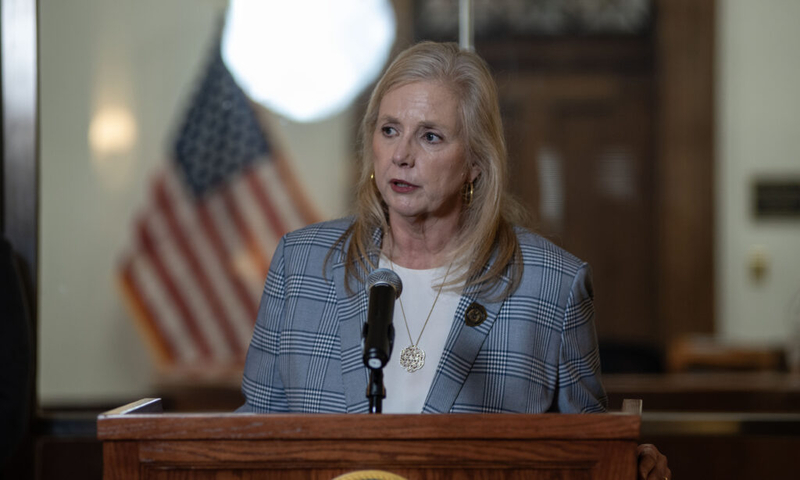
Missouri Attorney General Catherine Hanaway announces the state's lawsuit against American Shaman in a press conference outside her office March 31, 2026 (Annelise Hanshaw/Missouri Independent).
An agreement with Missouri Attorney General Catherine Hanaway will bar the owners of St. Louis-based Green Dragon from selling kratom products in the state, the latest development in her office’s crackdown on 7-OH and related substances.
Under the agreement announced Thursday, Green Dragon and owners David and Matthew Jadwin cannot own, operate or hold a financial interest in a Missouri business that markets, advertises or sells 7-OH or other kratom products to consumers or distributors.
The company must also remove the products from its Missouri stores and stop selling, distributing or advertising them in the state.
The Independent was unable to reach the Jadwins for comment.
7-OH, short for 7-hydroxymitragynine, is an opioid-like compound found naturally in trace amounts in kratom. Concentrated products containing much higher levels of the compound are commonly manufactured by chemically converting mitragynine, another kratom alkaloid.
The products are sold as gummies, liquid shots, tablets, powders and other forms in smoke shops, gas stations, convenience stores and online.
The agreement is similar to those Hanaway has made with other 7-OH distributors, including Kansas-City based companies American Shaman and Relax Relief Rejuvenate Trading LLC.
“These unregulated, highly addictive drugs have taken lives and fueled addiction across our state. This resolution is another decisive step to protect Missouri families from the deadly impact of gas‑station opioids,” Hanaway said in a press release. “Our office will continue pursuing any distributor or retailer that puts Missourians in jeopardy.”
The Green Dragon agreement goes further than some of Hanaway’s previous settlements because it restricts the owners from having a financial interest in businesses selling kratom products in Missouri.
It comes as federal officials are moving toward temporarily placing concentrated 7-OH and three related substances in Schedule I of the Controlled Substances Act.
The U.S. Drug Enforcement Administration announced July 1 that it intends to temporarily schedule 7-OH above specified concentration thresholds, along with mitragynine pseudoindoxyl, MGM-15 and MGM-16. The action would not apply to natural kratom containing only trace amounts of 7-OH.
Schedule I is the federal government’s most restrictive category for controlled substances and includes heroin.
The DEA proposal would generally cover processed or synthetic products containing more than 0.05% 7-OH or more than 1 milligram of the compound per article, along with botanical kratom containing more than 0.05% 7-OH by dry weight.
The Department of Health and Human Services separately sought public comment on the proposed threshold, with the comment period ending July 31. The more than 11,000 comments are to be provided to federal officials for consideration before the temporary scheduling order is issued.
The DEA was required to wait at least 30 days after publication of its July notices before issuing the order. The agency said it intended to act “as soon as possible” after that period expired. The temporary designation would last two years and could be extended for another year while federal officials consider permanent scheduling.
It is unclear when the DEA will issue the order.
The federal effort has also become entangled in a new congressional inquiry into the kratom industry’s ties to the Trump administration.
The U.S. Senate Committee on Finance’s ranking member, Sen. Ron Wyden, D-Ore., has called for an investigation into an alleged conflict of interest related to Secretary of Homeland Security Markwayne Mullin’s advocacy for restrictions on 7-OH. Wyden is requiring information be provided to the committee by the end of the month, related to Mullin allegedly holding a financial stake in Oklahoma-based Botanic Tonics — a competitor of 7-OH products — reportedly worth as much as $1 million.
If the DEA issues its temporary scheduling order, Missouri Department of Health and Senior Services spokeswoman Lisa Cox said the state would then file an emergency rule reflecting the order that would be effective in less than 10 days.
Hanaway applauded the proposed federal restrictions, saying Thursday that 7-OH products are “synthetic, addictive opioids that carry grave risks.”
Her office has meanwhile pursued the products under existing Missouri consumer protection laws.
Under the Green Dragon agreement, the company must remove the products subject to the agreement from its Missouri retail premises, and cease sales, distribution, offering, transfer, delivery, marketing and advertising to any consumer or distributor located in the State of Missouri.
Additionally, Green Dragon agreed not to sell any dietary supplement without first obtaining a scientific analysis of its active ingredients to ensure that consumers are not exposed to dangerous substances like 7-OH without their knowledge.
The Green Dragon agreement, filed in Cole County Circuit Court as an assurance of voluntary compliance, ends the attorney general’s investigation of the company, which began in November. It does not include an admission of liability, and no court found Green Dragon or its owners liable.
Jefferson City, MO