Judge: Shenandoah School Board violated students’ civil rights by reinstating Confederate names
Aug 07, 2026 | 10:32 am ET
Description
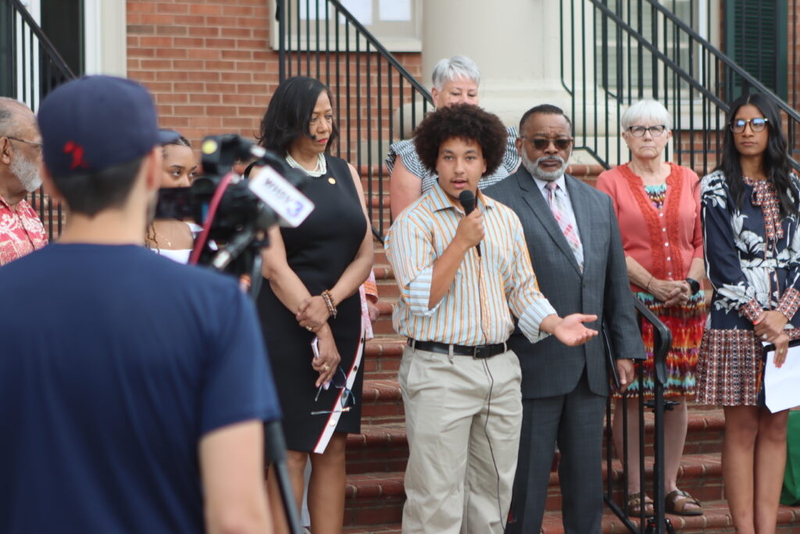
AD Carter, a former Shenandoah County Public Schools student, speaks in front of the Shenandoah County Circuit Court on June 11, 2024. Carter and other students sued the school board for reinstating Confederate names on several schools. (Photo by Nathaniel Cline/Virginia Mercury)
A federal judge ruled Thursday evening that the Shenandoah County School Board broke federal civil rights laws when it brought back Confederate school names two years ago, and ordered the monikers be removed promptly.
The Virginia State Conference of the NAACP and families of six students had challenged the school board for renaming two schools after Confederate Gens. Turner Ashby, Robert E. Lee and Thomas “Stonewall” Jackson in 2024. The schools had been rebranded in 2021 to strip the Confederate names.
The Confederates seceded from the United States during the Civil War and fought to preserve Southerners’ rights to enslave Black people.
Judge weighs future of Confederate-linked school names in Shenandoah County
Last September, U.S. District Court Judge Michael F. Urbanski sided with the students, writing that the board violated students’ First Amendment rights and that Jackson’s name “is expressive as a symbol of racial exclusion in public schools.”
On Thursday, Urbanski said the school board also broke civil rights laws, including the 14th Amendment, the Civil Rights Act, and the Equal Educational Opportunities Act. He ordered the board to remove the names and adopt new ones on a “racially nondiscriminatory basis” to be completed “with all deliberate speed.”
“The decision to rename the schools after Confederate leaders cannot be divorced from racial discrimination,” Urbanski wrote. “Lee, Jackson, and Ashby fought to preserve a political system that enslaved Blacks, and their legacy was used as a tool to fight school desegregation. Had the Confederate cause succeeded, the United States would look much different today, and the plaintiffs may not have the very rights exercised in this lawsuit to petition the government to redress grievances.”
Urbanski stated that renaming the schools after Confederates put an unfair burden on Black students, causing them harm that white students did not face. He also said the board failed to remove the traces of segregation as the law requires.
He determined that race played a role in the board’s decision, as the schools were first named in 1959 and 1974 to resist federal rules requiring integration.
Urbanski concluded that the board’s stated reason for changing the school names in 2024 was not genuine, because the issue had already gone through a fair process in 2022.
At a June 1, 2022 special meeting, three of the six board members indicated that they no longer wished to proceed with a survey regarding the name change. Despite that decision, the board chair later introduced a motion at the June 9, 2022 regular business meeting to restore the original names.
The judge also said it was troubling that the board replaced its legal counsel just to help bring back the Confederate names, showing an improper motive.
The Washington Lawyers’ Committee, Covington & Burling LLP, and Holland & Knight LLP represent the NAACP’s Virginia chapter and students’ families.
“One after another, students presented heartfelt and unwavering testimony, describing how Confederate school names make them feel unwelcome, devalued and ultimately inferior to their white peers,” said Kaitlin Banner, deputy legal director at the Washington Lawyers’ Committee for Civil Rights and Urban Affairs, in a statement.
“The court acknowledged that such names inflict real, racially disproportionate harm. Just as the court found in Brown v. Board of Education, reinstating these names sends a message to Black students that they are not valued and diminishes their educational opportunities,” Banner continued.
Li Reed of Covington & Burling added that “Equal educational opportunity is not an aspiration; it is a legal right.”
“We commend our student plaintiffs whose tenacity has helped safeguard not only their own rights, but also the rights of the students who follow them,” Reed said.
The legal team representing the school board could not be reached for comment. The board is scheduled to tour the Charterhouse School in Edinburg on Wednesday at 6 p.m. and hold its closed session and business meeting starting at 5 p.m. on Thursday.
This is a developing story that will be updated.
Richmond, VA