New Mexico attorney general lauds ‘historic’ victory over Meta despite antiquated laws
Aug 07, 2026 | 2:56 pm ET
Description
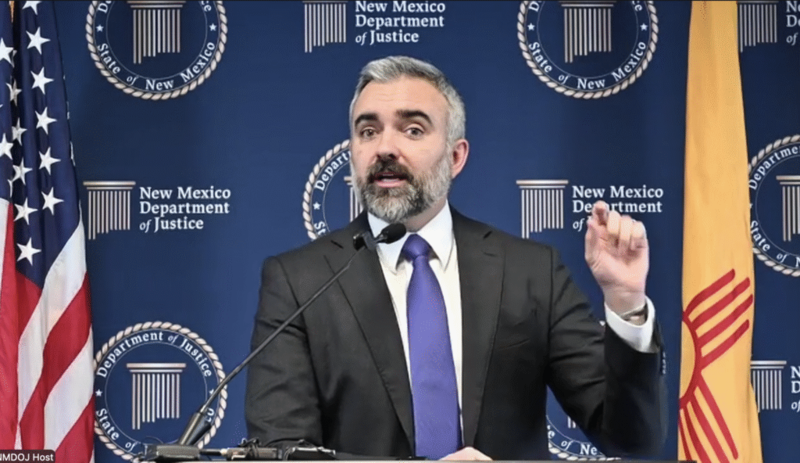
New Mexico Attorney General Raúl Torrez on Aug. 7, 2026, lauded a $567 million judgment against Meta Platforms Inc. as “historic” and wide-ranging, but also railed against decades-old laws that he said continue to limit his office’s ability to protect kids online.
New Mexico Attorney General Raúl Torrez on Friday lauded this week’s $567 million judgment against Meta Platforms Inc. as “historic” and wide-ranging, but also railed against decades-old laws that he said continue to limit his office’s ability to protect kids online.
New Mexico First Judicial District Judge Bryan Biedscheid late Thursday issued a 68-page ruling that ordered the social media giant to pay for an abatement fund to address the harms it has caused to the state’s youth through its online platforms, particularly Instagram.
In ordering the fund’s creation, Biedscheid agreed with plaintiffs that Meta was creating a “public nuisance” in the state by creating addictive algorithms and an online environment that facilitated connections between kids and child predators. Of the $567 million the judge ordered Meta to pay, $420 million is designated for “treatment” of harms the platform caused.
A Meta spokesperson told Source NM that the company would appeal the ruling. Torrez said Friday that the appeal process could take “months, if not years” to play out. The attorney general said he will urge Biedscheid to order the company to pay the judgment while litigation resumes regarding other changes the judge ordered the company to make.
The ruling marks the end of the second closely watched trial New Mexico brought against Meta. In March, a jury ordered Meta to pay $375 million after agreeing with Torrez’s office that the company had violated state consumer protection laws.
Torrez, in a news conference Friday, said the combined $942 million in judgments against Meta should send a message to the world that “companies of this size and scale can actually be held accountable.”
But he also said laws his office sued under are woefully outdated in confronting the modern internet and a 2026 economy that is largely shaped by giant tech companies. For example, the state’s consumer protection act has not been updated since 1970, he said.
“Why does that matter? It matters because that statute was built for a totally different world,” he said. “It was built for a totally different economy, and it didn’t conceive of or understand or anticipate companies of this size and scale, or the business practices that they engage in.”
New Mexico Department of Justice rests case in second phase of Meta child safety lawsuit
Other laws that Torrez cited as antiquated include Section 230, a provision in a 1996 federal law that protects companies like Meta from being liable for content their users publish on their platforms and a 1998 law that prohibits platforms from collecting data on children under age 13 without their parents’ permission.
The judge repeatedly cited Section 230 and the First Amendment as reasons he could not order Meta to make changes to its algorithm, as well as rein in potentially addictive features like “infinite scroll” and videos automatically playing when they arrive in users’ feeds.
The judge also said the Child’s Online Privacy Act of 1998 — another law Torrez said was outdated — meant he could not legally order Meta to impose stricter age verification for young children seeking to use the platforms.
The state’s lawsuit had urged the court to order Meta to greatly strengthen the steps it takes to verify users’ ages, including with the help of artificial intelligence and other tools. Biedscheid ruled that the state’s hopes rested on “unproven technology” and, if implemented, would unfairly disadvantage Meta versus other similar social media companies.
Because of the 1998 law, he wrote, “It is the Court’s conclusion that it cannot order Meta to request children to submit personal data or be passively tracked online, even for age-verification purposes.”
Biedscheid further wrote that it is beyond his court’s jurisdiction to impose the age-verification requirements, writing that “regulatory solutions to these problems lie in the executive and legislative branches and not with this Court.”
While Torrez said he believes the judge’s ruling on the matter was a “misapplication” of federal law, he agreed that the next steps required to protect children online lie outside of the courts.
The ruling marks “an opportunity to rely on and incorporate rapidly advancing and evolving technology into a proposed legislative solution, which my office will be presenting to the New Mexico Legislature in the coming weeks,” Torrez said.
He also called on Congress to heed what he said is growing discontentment from social media users about the outsized role companies like Meta play in influencing policy and daily life.
“If Congress woke up and did its job and passed and updated a refreshed version based on the world we live in now and not the world we had in the 1990s, we could address these issues,” he said. “We can’t address them as long as Congress and legislative bodies are sitting on the sidelines.”
Santa Fe, NM