Minnesota’s candidates for governor make their case to farmers, ag industry pros
Aug 05, 2026 | 6:26 pm ET
Description
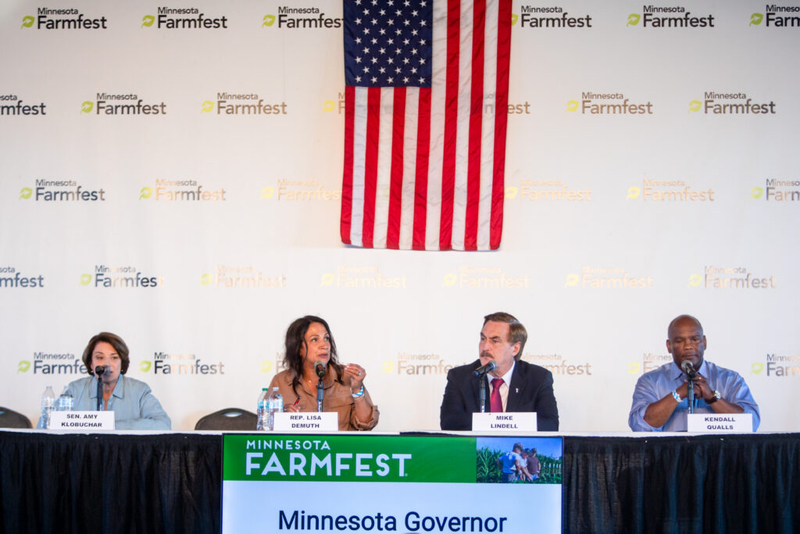
From left, Sen. Amy Klobuchar, Rep. Lisa Demuth, Mike Lindell, and Kendall Qualls answer questions during the candidate forum for Minnesota governor at Farmfest in Morgan, Minnesota on Wednesday, Aug. 5, 2026. (Photo by Nicole Neri/Minnesota Reformer)
MORGAN, REDWOOD COUNTY — Minnesota’s candidates for governor fielded questions on farming regulations, rising rural healthcare costs and fraud in Minnesota’s public programs Wednesday as they made their case to farmers.
It was the first and last time U.S. Sen. Amy Klobuchar, the presumptive Democratic-Farmer-Labor nominee for governor, got on stage with the three GOP candidates for governor: businessman Kendall Qualls, House Speaker Lisa Demuth and pillow mogul Mike Lindell.
Minnesota Republicans will decide Tuesday which of the three candidates will run against Klobuchar in November. Lindell was endorsed by President Donald Trump last month and led the field in a July KSTP/SurveyUSA poll, followed by Demuth and Qualls, who appears to be the least popular of the three despite receiving his party’s convention endorsement. Whoever wins will be fighting an uphill battle in a state that hasn’t voted for a Republican governor in two decades.
At the forum held at Farmfest, the summertime farm industry convention in Redwood County, Klobuchar highlighted her agriculture policy knowledge from serving on the Senate’s ag committee, while Demuth touted her own legislative record as speaker of the Minnesota House, which is divided between Democrats and Republicans.
Lindell cited his connection to Trump and bemoaned America’s growing godlessness. Qualls reiterated his party endorsement and business experience, for the most part without directly addressing agriculture-related questions.

Demuth and Qualls both advocated for a smaller government and less regulation on agriculture.
“Government doesn’t stabilize anything. If anything, they need to get off the backs of the people that are doing work,” Qualls said in response to a question on how Minnesota can help stabilize animal agriculture.
Trump’s on-again, off-again tariffs — thus ensuing retaliatory tariffs and trade policies from foreign countries — and his war in Iran have driven up input costs and decreased sales for farmers. His approval rating among rural Americans dropped from 60% at the beginning of his second term to a new low of 50% in June, according to a Reuters/Ipsos poll.
As has become standard practice among Republicans, the three candidates have declined to criticize Trump’s policies, including his tariffs or the U.S.-Iran war, which Klobuchar pointed out in her closing statement.
“We do not need a governor who is a rubber stamp of Donald Trump,” Klobuchar said.
Here are some of the key issues that arose during the forum:
Farming regulation, biofuels
Businesses have said that Minnesota’s environmental permitting process, which governments use to enforce air and water regulations, is too unwieldy and inhibits economic growth. In response to a question on how to expedite the process, Demuth said she’d work to reduce the regulatory authority of the Minnesota Pollution Control Agency.
Klobuchar said she’d support a deadline for responding to permit applications. She also touted her work on a bipartisan housing bill in Congress that streamlines environmental review; she’s proposed building 100,000 homes if she’s elected governor.

Qualls and Lindell gave less specific answers along the similar lines.
“That’s going to be one of my priorities, is getting rid of the regulation and getting the speed of things pushed through,” Lindell said.
Qualls took the opportunity to yet again sell himself as a political outsider businessman who will bring about “radical change,” though he has offered few specifics on what that radical change would be.
All four candidates spoke glowingly of Minnesota’s biofuel industry, which is largely corn-based ethanol, an industry that crafts an image of being “greener” than traditional fuels.
“I’ll make the case because it’s good for our national security and brings costs down at the pump. As we can see what happened with the closing of the Strait of Hormuz, we need more biofuels, not less,” Klobuchar said, referencing the soaring cost of gas resulting from Trump’s war in Iran.
Many scientists and economists who have studied the issue, however, say that crop-based ethanol may actually be worse for the climate than regular gasoline, upon a full accounting of emissions associated with ethanol production. Roughly 5% of the total surface area of Minnesota is used to grow corn for ethanol production.
Healthcare
Cuts in the GOP megalaw known as the One Big Beautiful Bill Act will reduce Medicaid funding for rural hospitals, a negative impact only partly mitigated by another stipulation in the law to fund rural health. Republicans in Congress also let federal subsidies for Affordable Care Act enrollees expire, making health care premiums more expensive for a projected 89,000 Minnesotans.
Klobuchar promised to bring down health insurance premiums on the state level if the federal subsidies are not reinstated. She also talked about her plan to add 10,000 more apprenticeships, which she said would help build the healthcare workforce in rural Minnesota.
Demuth blamed rising healthcare costs on the Affordable Care Act, also known as Obamacare, and “unfunded mandates, or business mandates” such as paid leave.
Lindell advocated for direct primary care, a financial model where people can purchase memberships instead of insurance to cover primary care services. It’s unclear whether he’s in favor of requiring this model for all primary care in the state, or just for increasing access to it.
Qualls offered little in concrete health policy changes, leading with his reiterated but vague criticism of the political establishment: “We are in this situation in health care because of what politicians have done and what politicians haven’t done.”
Immigration
Klobuchar, who was generally warmly received by the ag and rural crowd, said she’d redirect the additional $70 billion ICE received in June toward healthcare. She was met with both applause and jeers from the apparently politically diverse audience.
One pocket of onlookers booed the senator for mentioning the killings of Renee Good and Alex Pretti during the Trump administration’s crackdown on the Twin Cities, yelling that the two were “terrorists.”
ICE wouldn’t have had to go “door to door” during Trump’s Operation Metro Surge, Lindell said, if Minneapolis cooperated with the federal government. The Trump-backed candidate singled out the city’s protest movement — where residents observed and disrupted federal immigration enforcement and tens of thousands rallied against ICE — and said he would enforce “strict protest laws” as governor.
Lindell and Qualls both painted pictures of undocumented immigrants taking medical and other government benefits from citizens, though undocumented immigrants are not eligible for Medicaid or food stamps. Undocumented children are eligible for MinnesotaCare, a public health insurance program for the working poor. As House speaker, Demuth negotiated with Democrats to make undocumented adults ineligible for the program.
Demuth said she will support federal immigration laws regardless of who is in office, but expects them to “do their jobs and make meaningful changes that will make people safer.”
Luther Ranheim, 52, a philanthropy advisor in attendance, said the debate over federal immigration enforcement can be linked to the urban-rural divide.
“Those of us who lived in the cities experienced that in a different way than people in greater Minnesota,” Ranheim said of Operation Metro Surge.
Fraud
Fraud has been a top talking point for Republicans, and DFL candidates up and down the ballot have continued to distance themselves from fraud in safety net programs under the administration of Democratic Gov. Tim Walz.
Klobuchar, who released an anti-fraud proposal in May, heralded her relationship with Andrew Luger, the former U.S. attorney and prosecutor who indicted 70 people in connection to fraud. She was met again with a mix of cheers and boos — with one audience member yelling, “You did nothing!”
The three Republican candidates regularly referenced the issue.
“Fraud is the biggest blessing our state has ever had because it’s opened our eyes to get rid of the current government,” Lindell said. As governor, he said, he’d do a “deep dive” into state government.
“Call it Minnesota DOGE,” he said, in reference to Elon Musk’s Department of Government Efficiency that failed to execute its promises to save $2 trillion. (Federal spending actually rose in 2025, and DOGE closed up shop.)
Demuth pointed to her own legislative legacy, including the creation of a House fraud committee, and blamed fraud on “incompetent Democrat control.”
Qualls spoke against the mega spending bills that often pass the Legislature. Slimmer, single-topic bills will prevent fraud and promote accountability for Republicans who vote for government spending. He also reiterated his business experience.
“We know what’s happening every quarter because of our financials, where the money’s coming in or it’s going out. We know if there’s a discrepancy, an unusual discrepancy in the first quarter and second quarter,” Qualls said.
His financial accounting solution may prove harder than expected. Many of the providers who offer Medicaid services deemed high-risk to fraud, waste and abuse are privately held, and, despite receiving public dollars, do not need to publicly report their finances.

Saint Paul, MN