More Utah forests are burning than ever before. Here’s why that matters
Aug 05, 2026 | 6:54 pm ET
Description
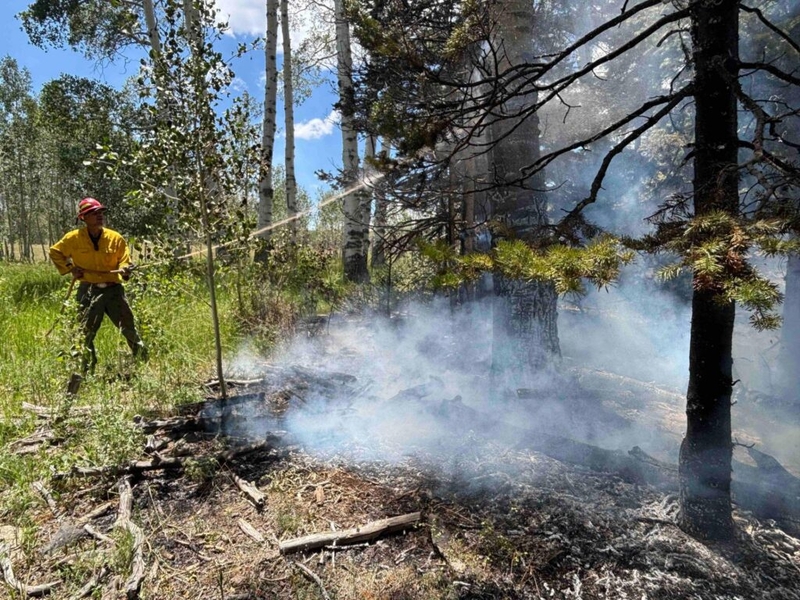
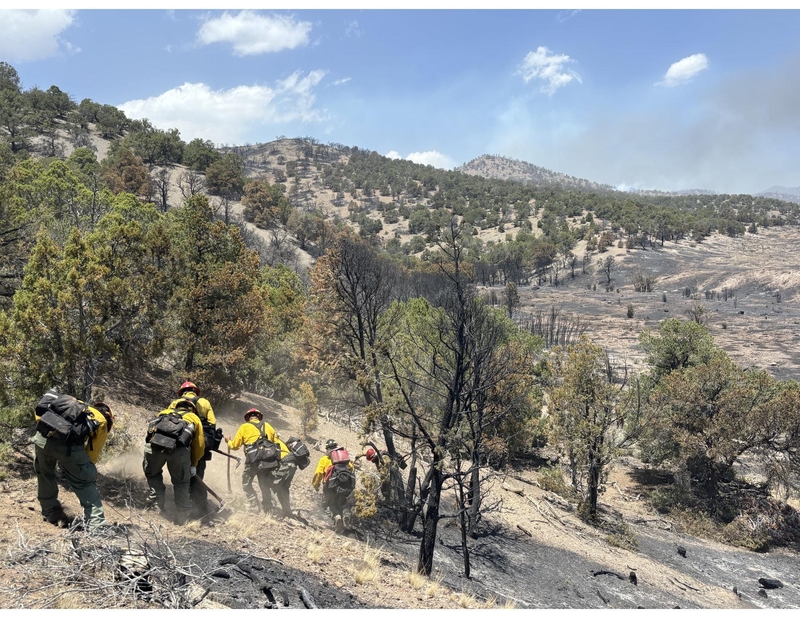
A firefighter mops up on the southern flank of the Cottonwood Fire near Beaver, Utah, in a photo shared on Saturday, June 28, 2026. (Photo courtesy of U.S. Forest Service)
New research shows Utah, though it’s only halfway through its wildfire season, is seeing unprecedented burns in woodland and forest areas — and that trend poses “concerning” economic and ecological threats.
That’s according to Phil Dennison, a professor in the University of Utah’s School of Environment, Society and Sustainability, who detailed his ongoing research in a virtual news conference Wednesday.
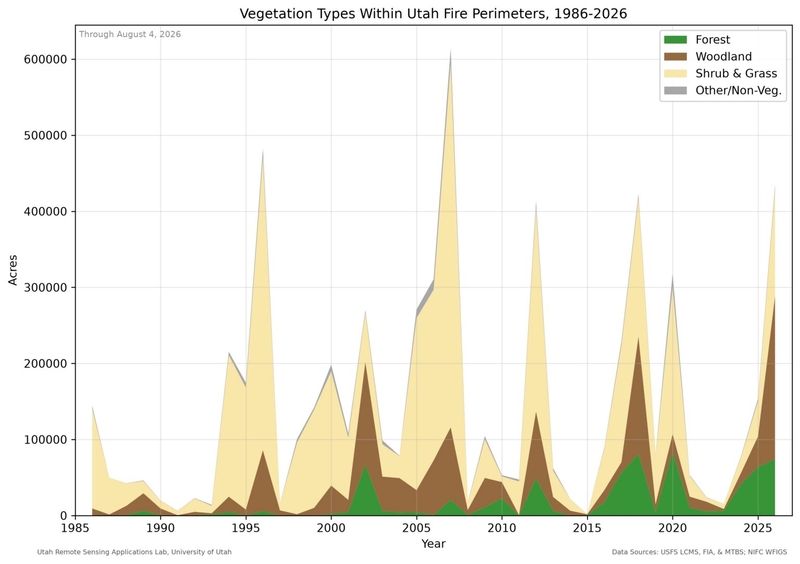
This year, Utah has already broken its record for wooded and forested areas burned in a single year. So far in 2026, wildfires have engulfed a record 285,000 acres of woodland and forest areas, according to an analysis by University of Utah geographers.
The Widemouth 2 Fire, sparked by lightning last week near Kanosh in Millard County, spread to nearly 85,000 acres as of Tuesday, according to the Western Fire Chief’s Association’s website.
While 2007 still holds Utah’s record for the number of acres burned across the state, 2026’s wildfires this year have already consumed an unprecedented area of Utah’s trees compared to past years, Dennison said.
“While we haven’t reached a record yet in the total number of acres burned, for the first time Utah has had three fires that have burned more than 80,000 acres of vegetation,” Dennison told reporters.
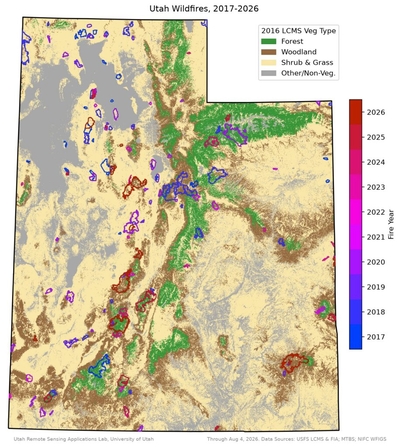
He pointed to the more than 107,000-acre Babylon Fire in San Juan County, the over 97,000-acre Cottonwood Fire in Beaver County, as well as the Widemouth 2 Fire, which he said have each burned more than 60,000 acres of trees in woodland and forest areas.
“That’s something that’s never happened before going back all the way to 1986,” he said.
In that time span, he said a total of only 10 fires have burned that much vegetation in the state.
“What’s even more important,” he added, “is where this year’s fires are burning. This year’s fires have really had an unprecedented impact on Utah’s trees.”
Woodland areas are characterized by shorter trees like junipers or pinyon pines, while forests have taller trees like aspens, firs and pines.
This year’s wildfires have “far eclipsed the record” for woodland areas burned, Dennison said, while Utah is “approaching” setting a record for forest acres burned.
“We’re not there yet,” Dennison said, noting that 2020 and 2018 still hold records for the most forest acres burned, “but we’re already at almost 75,000 acres of forest burned.”
Another important finding of this research, Dennison said, is that Utah has seen a “big increase” in fire over the past decade, especially when it comes to forest fires, with seven of the 10 largest fires since 1986 happening within the last 10 years.
The statistic that “really surprised us,” he said, is that a total of 10% of Utah’s high elevation forest area has burned in the last 10 years, a trend that has accelerated in the last three years, with 27% of all the forest area burned since 1986 has burned in just the last three years.
“The fact that we’re seeing such a big increase in woodland and forest burned in recent years has important economic and ecosystem impacts,” Dennison said, “and these trends are quite concerning.”
Dennison presented his research the day before state leaders including Gov. Spencer Cox and House Speaker Mike Schultz were scheduled to tour areas impacted by the Cottonwood and Widemouth 2 fires
Economic and ecological threats
The most obvious and immediate dangers wildfires bring are threats to people and structures, Dennison said. But beyond those immediate threats, the trend of increased woodland and forest burns can be far reaching.
“We’ve noticed over the past few years how frequently our neighbors are being asked to evacuate, and how many structures are being destroyed by wildfire, and how we’re having after fire these continuing effects multiple years after fire like flash flooding,” Dennison said. “These are going to continue to be issues as long as we have large areas of forest and woodland being burned.”
Why else does it matter that more trees have been burning in Utah? Dennison said trees have “immense importance for ecosystems and Utah’s economy.”
“The forest and woodlands of Utah, at higher elevation, are where a lot of our drinking water comes from,” Dennison said, noting that it’s also where important habitat and recreational opportunities are concentrated in the state.
Whether its ski areas or hiking destinations, “they’re certainly one of the big draws to either living in Utah or vacationing in Utah,” he said.
Dennison noted he’s not an economist, and he hasn’t researched the specific economic impact of forest loss, but “losing trees in these areas diminishes, at least temporarily, the recreational value of these areas.”
Dennison pointed to the Cottonwood Fire, which led to the closure of Eagle Point Resort for the upcoming ski season. In a social media post, the resort said the wildfire burned about 300 acres of ski terrain, damaged four chairlifts, destroyed a lodge and “forever changed parts of our mountain community.”
“We’ll continue to see these effects at high elevation as these forests and woodlands continue to burn this year and into the future,” Dennison said.
As seen in the wake of the Cottonwood Fire, Dennison said flooding and mudslides can follow. So can “massive sediment loads” in reservoirs and drinking water systems, which can affect water quality.
After fire and flooding, Cox declares a state of emergency in 3 Utah counties
Additionally, woodland and forest areas provide important habitat for fish and wildlife, and fires can bring lasting ecological damage, depending on the area.
“It’s important to note that Utah has really diverse ecosystems, and they respond to fire differently,” he said. “Fires in our rangelands might destroy sagebrush, and it can take a long time for sagebrush to re-enter those fire scars. And that burning of sagebrush might benefit invasive grasses … which could lead to more fire.”
Threat to the Wasatch
Dennison also said the trend indicates that higher-elevation areas that are typically resilient to fires, including in the Wasatch, might be at higher risk of burning than ever before.
“It’s something that really concerns me,” he said, noting that Wasatch forests “have this reputation for not really burning. (But) my biggest concern is that we’re moving into a dryer, hotter future where that may no longer be true.”
Will fires actually hit higher-elevation forests in the Wasatch?
“I don’t have an answer to that,” he said, “but it’s certainly concerning given the trends we’ve seen over the last 41 years.”
Is forest management to blame?
Utah’s historic wildfire season is largely driven by a megadrought that has lasted 25 years, driven by higher temperatures and low snowpack.
The growing wildfires in woodland and forest areas also indicate “we need to be doing more in terms of forest management,” Dennison said.
“But even in some of our best-managed forests, we’re seeing that this big increase has occurred,” he added.
Dennison pointed to the Monroe Canyon Fire from last year, which happened in an area that he described as the “shining example of fuels treatment” in not just Utah, but the entire western U.S. “where they’ve aggressively gone in and treated fuels with prescribed burning and done tens of thousands of acres.”
And yet, “you still had over 30,000 acres of forests burn on Monroe Mountain,” he said, “and it burned around a lot of areas that were treated with prescribed fire.”
“So it’s really an order of magnitude issue,” he said, “where our ability to treat fuels through thinning or prescribed fire is treating thousands of acres at a time, or tens of thousands of acres per year.”
But recent wildfires have ripped through hundreds of thousands of acres — far more acreage than what prescribed burns or thinning has been able to manage.
“There’s just not enough … that we’re doing to keep up with the fire issue,” he said, “to really make a sizable dent in the number of acres burned per year.”
He also noted that forest management is often concentrated on forest areas, but “no one’s talking about going out and treating junipers and pinyon pines” in woodland areas.
“There’s not really an economic gain, except for potentially reducing fire, (in woodland areas),” Dennison said, but “it’s important to remember how much of Utah is covered by woodlands.” He said it might be worth discussing more wildfire prevention and forest management efforts in woodland areas.
But while better forest management can help the issue, Dennison said the sheer size of the issue indicates drought and heat are the major factors adding fuel to the fire.
“Really, the scale of this says that it’s the contributions of drought and higher temperatures that are really driving these (wildfires) across the state,” he said.
Salt Lake City, UT