Michigan U.S. Senate primary tightens as McMorrow, El-Sayed outpace Stevens in Q1 fundraising
Apr 28, 2026 | 6:30 am ET
Description
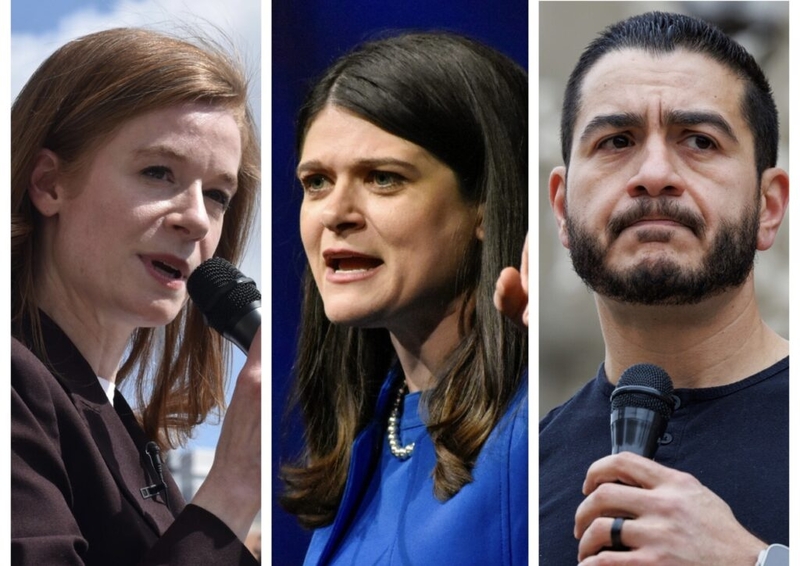
Democratic U.S. Senate candidates (L-R) Mallory McMorrow, Haley Stevens and Abdul El-Sayed. | Andrew Roth and Ben Solis photos/Michigan Advance
Newly released campaign finance reports show growing enthusiasm around Michigan Democratic U.S. Senate primary candidates Mallory McMorrow and Abdul El-Sayed, as both did demonstrably better in the first quarter of 2026 than sitting U.S. Rep. Haley Stevens.
Stevens, who is likely recovering from a rough showing at the April 19 Michigan Democratic Party spring endorsement convention, is still in a strong position money-wise and has the most cash on hand of the three candidates.
But the tide could be turning on Stevens’ candidacy as McMorrow, a state senator from Royal Oak, and El-Sayed, a former health official from Ann Arbor, continue to draw in more small-dollar donations and potentially outraise her as the race barrels quickly toward August.
Still, Adrian Hemond with the Grassroots Midwest consulting firm, told Michigan Advance that “all three candidates in the race are doing fine.”
“The sitting member of Congress is going to have more institutional donors and fewer small dollar donors,” Hemond said. “The two candidates that are social media stars are going to raise more money online through small dollar donors. Fundamentally, I think Stevens is still the favorite, but I’d say a little less favorite than she was before.”
That said, Hemond noted that despite McMorrow’s apparent momentum, the one thing that has changed is that El-Sayed appears positioned to work himself into potentially second place.
Other than that, the dynamics have all been fundamentally the same, with each candidate locked in a dead head with plenty of undecideds left to pull from.
Fundraising reports show a tightening three-way race
Campaign finance reports filed with the Federal Election Commission for the first quarter of 2026, covering January 1 to March 31, show that McMorrow raised the most of the three candidates, netting $2.96 million while spending $1.22 million — considerably less than her two rivals — ending the quarter with $3.69 million in cash on hand.
McMorrow has raised a total of $8.6 million over the course of her campaign, outpacing both of her primary opponents.
El-Sayed was not far behind, netting $2.27 million. His team spent $1.72 million between January and March and had $2.52 million cash on hand.
Another good showing for the progressive candidate is the fact that El-Sayed has raised $7.62 million throughout the cycle.
Stevens’ numbers in that timeframe paled slightly in comparison.
The representative netted $1.86 million, and spent $1.62 million, leaving her with $3.38 million cash on hand.
Stevens was the only Democratic candidate in the race to have money transferred into her coffers from other authorized committees, like her former congressional campaign, in the first quarter of 2026. She moved $76,000 in from those committees.
These candidates can damage each other pretty significantly, and you can end up with a wounded nominee at the end of the process.
Either way, all three candidates appear to still be running strong campaigns based on strong enthusiasm among Democratic voters eager for change.
Hemond said that can be both a blessing and a curse, because Democrats, on one hand, want their people to be fired up, but on the other hand, a grueling primary process can take some of the air out of that enthusiasm and potential party unity.
“Sometimes these primary fights can be a little bit more protracted,” Hemond added. “The important thing for any party that’s in that situation is that you get candidates through those primaries who can actually win a competitive general election. And I think that applies to at least two out of the three candidates in this race.”
Hemond did not say which of the three he believed might have an issue winning in November.
Neil Thanedar with the Michigan Campaign Finance Network also told the Advance that the candidates appear to have strong national bases of funding that are unique to each campaign. Although these early figures show all three candidates have strength going into the summer campaign season, the money faucet might really kick in during the last few weeks of the primary cycle.
“We could expect to see millions of dollars per week in those last four to eight weeks,” Thanedar said. “That’s really where a lot of the actual movement will happen.”
Candidates clash over corporate PAC funding
Much talk has been placed on McMorrow’s and El-Sayed’s individual donor contributions as the main source of their campaign funding. First quarter reports in 2026 show that McMorrow netted $2.95 million from individual donors, and El-Sayed was not far behind with $2.27 million from individual contributions. Stevens had just $1.73 million from individual donors.
ActBlue, a major PAC conduit for individual donors that gets funneled to campaigns, is often seen as a measure of actual and engaged voter support for any given candidate, although some quarrel with that argument. By that logic, McMorrow and El-Sayed were sailing with small-dollar donors and voters.
McMorrow netted an aggregated $2.22 million from ActBlue and El-Sayed received $1.9 million from the committee. Stevens received $788,496 through ActBlue during the same period.
Hemond said the small dollar and ActBlue numbers can be a red herring.
“Small dollar donors are not indicative of much, other than you have more money to spend on paid jobs,” he said. “Especially because a lot of the way these small dollar donations work is that some of them are from Michigan, but a lot of them aren’t. I don’t put a lot of stock in small dollar fundraising figures like that, other than the absolute dollars that you’re raising.”
Setting small-dollar donations aside, FEC reports show that political action committees still helped fund each campaign.
Stevens received $154,000 from PACs in the first quarter of the year, while McMorrow had $24,569 in support from PACs. El-Sayed raked in just $7,000 from PAC contributions.
At least $28,000 of Stevens’ PAC funding haul came from corporate committees, including from Bank of America and BlackRock.
Both El-Sayed and McMorrow have eschewed corporate PAC money in their respective U.S. Senate campaigns, but El-Sayed has been particularly critical of Stevens for taking money from DTE Energy. He has also more recently wrapped McMorrow into that line of attack.
In March, El-Sayed told a crowd at an Indivisible District 7 meeting that the company was “supporting the candidates I am running against in this election.” That was the first time that El-Sayed publicly attacked both McMorrow and Stevens on corporate PAC money.
The seeds of that attack, however, were planted in February when, on an organizing call, El-Sayed accused McMorrow and Stevens of voting to give data centers tax breaks in 2024. He then went on to accuse McMorrow of flip-flopping on her support for data centers, even as she aims to take a pragmatic approach to data centers that also criticizes them when planned at scale.
McMorrow and Stevens, meanwhile, have both criticized DTE for raising rates on their customers, despite their previous campaigns being funded in part by the company’s PAC money.
In her 2022 state Senate reelection campaign, DTE was McMorrow’s top donor, donating close to $10,000. Republican operatives, who view McMorrow as a potential successor to Stevens’ frontrunner status and a tough candidate to beat in the November general election, have placed emphasis on her votes to give data centers tax breaks in Michigan.
At the same time, McMorrow’s state Senate leadership PAC, A More Perfect Michigan, received $1,500 from DTE in 2024. A year later, she would announce her U.S. Senate campaign and shortly thereafter disavowed taking corporate PAC money.
El-Sayed’s camp has called that a sign of hypocrisy, and so have the Republicans who view her as a threat. Republicans, however, have boosted the attack from El-Sayed, as aggregate polling suggests that he is the easier candidate to beat in November as opposed to McMorrow or even Stevens.
In that vein, Stevens has also received a steady flow of cash from DTE starting in her first U.S. House reelection campaign in 2020, a total of $45,000 across multiple committees. DTE continued to funnel donations to her U.S. House leadership PAC and her congressional campaign as recently as last year, the last donation coming to her HMS SCRAP PAC in September 2025. Her Senate campaign received a direct donation in March 2025, a contribution of $2,500.
Stevens, like El-Sayed and McMorrow, has also been critical of DTE’s rate hikes, calling them out of control and outrageous.
As the attacks fly across the bow regarding campaign cash and where it came from, El-Sayed has followed the Bernie Sanders mantra of attacking corporate wealth and has garnered just as many supporters as he has enemies in the corporate wealth world in the process.
While both El-Sayed and McMorrow position themselves as champions of the middle class and affordability for average Michiganders, they might potentially be millionaires.
Financial disclosures filed in 2025 with the U.S. Senate showed that McMorrow estimated her net worth between $588,041 and $1.87 million, much of that money coming from diversified investment accounts, many of which are associated with her husband, Ray Wert.
The same disclosures filed by El-Sayed show that he estimated his net worth between $586,022 and $1.66 million, which includes two rental properties valued, respectively, up to an estimated $250,000 and $500,000, each.
Despite the flak Stevens has received for her corporate donations, personal finance disclosures show her net worth actually shrank during her time in Congress. In 2024, Stevens’ personal net worth was estimated as being nearly $380,000 in debt or up to $176,998 in assets. Her debt appears to come from a mortgage on a home purchased in 2021 with a value estimated up to $500,000. When she entered Congress in 2018, her net worth was estimated between $44,018 and $312,000.
Tensions come into view at party convention
The fight to damage one another is becoming more palpable as El-Sayed, McMorrow and Stevens see the August primary in their sights.
The Michigan Democratic Party nominating convention certainly didn’t help those divisions, however.
@michiganadvance U.S. Senate candidate Haley Stevens received a less-than-welcoming greeting from delegates at the Michigan Democratic Party Endorsement Convention in Detroit. #haleystevens ♬ original sound – Michigan Advance
El-Sayed showed up with a large crowd of energized supporters who followed the candidate around as he made stump speeches in the lobby of the Huntington Center, and cheered him wildly when he took the convention stage to address the crowd.
McMorrow’s reception was also energetic, but in a different way. Her team went for more flash with a marching band and big signs of McMorrow’s face, complete with a jovial expression, which were paraded around the convention while McMorrow danced at the center of the fanfare.
Stevens, who also had a coterie of supporters, was nonetheless noisily booed when she addressed the crowd on stage, something that El-Sayed eventually said wasn’t appropriate — even as those optics gave his campaign a big boost.
A tough primary with some bruises might have some Democrats worried about how the party might fare once August comes and goes, but Hemond said a tough primary like the one playing out in the U.S. Senate race could sharpen their iron.
“It’s impossible to say which way that’s going to go. Enthusiasm is great, but it can also get the better of you sometimes,” he said. “A protracted primary … gives them an opportunity to get reps before the big game,” he said. “That’s certainly one thing that can happen. Also, these candidates can damage each other pretty significantly, and you can end up with a wounded nominee at the end of the process.”
Lansing, MI