As Michigan preps for new Medicaid requirements, leaders and advocates push for dedicated funding
Apr 28, 2026 | 5:29 pm ET
Description
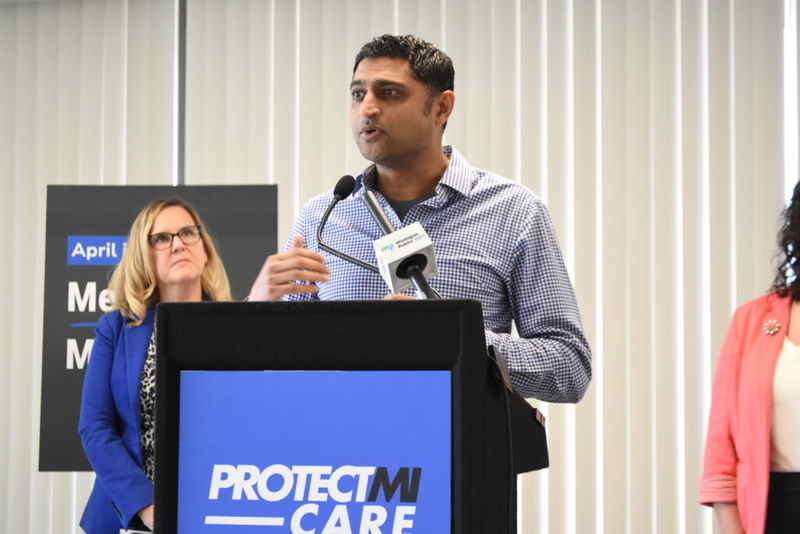
Dr. Farhan Bhatti, CEO of Care Free Medical in Lansing, explains the harms of cuts to Medicaid under new federal legislation. April 28, 2026. | Photo by Katherine Dailey/Michigan Advance.
The Michigan Department of Health and Human Services will have to meet new federal mandates for Medicaid, including work requirements for most Medicaid recipients to be working 80 hours per month to qualify for benefits.
Those changes, created under H.R. 1, better known as the “One Big Beautiful Bill,” will add a significant burden to Medicaid recipients, who will also have to reapply for Medicaid every six months as opposed to annually.
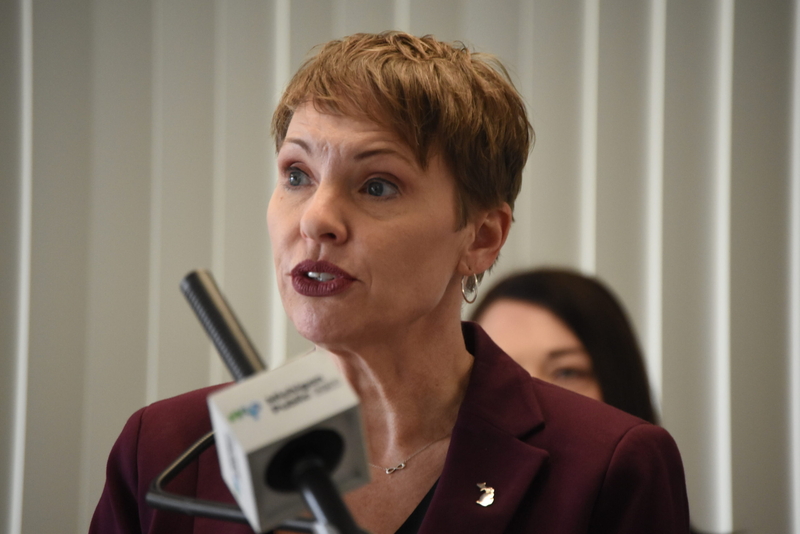
Elizabeth Hertel, the director of the Michigan Department of Health and Human Services, estimated in a press conference hosted by the Protect MI Care coalition that hundreds of thousands of Michigan residents might lose their health care over the next few years because of the changes.
“That’s hundreds of thousands of our friends, our family members and our neighbors who could be without health care coverage,” she said. “Medicaid’s positive impact only solidifies that we must protect and strengthen our Medicaid program now and for future generations.”
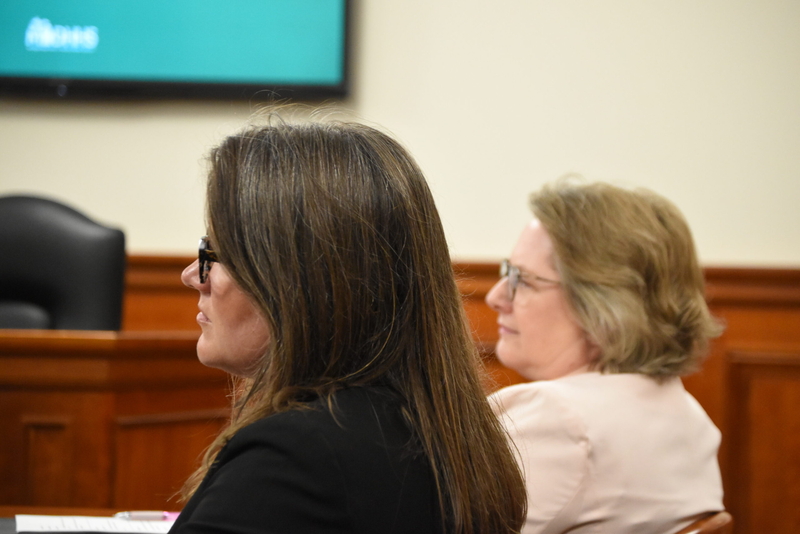
But new federal rules will also add significant burdens to Department of Health and Human Services staff, as two leaders at the department — Meghan Groen, the senior chief deputy director of health services, and Erin Frisch, the senior deputy director of economic stability administration — testified to the Michigan House Appropriations Subcommittee on Medicaid and Behavioral Health on Tuesday.
Gov. Gretchen Whitmer’s executive budget recommendation includes 589 additional full-time positions in the department in order to meet these greater needs, which Frisch estimated would include 700,000 additional processing hours annually for caseworkers in the department.
“While we’re always doing things to streamline the work to make ourselves more effective and efficient,” she said, “the reality is the capacity right now will not hold the additional work needed.”
Whitmer’s budget proposal would have fully funded Medicaid at a state level, filling the gap left by federal cuts, including through a new cigarette and vaping tax that Monique Stanton, president and CEO of the Michigan League for Public Policy, celebrated at the Protect MI Care press conference. But budgets put forward by the House and Senate did not include the same level of funding, to which Hertel noted the department would “continue to advocate for dedicated funding.”
“Cuts made at that federal level have forced Michigan into an impossible position. Do we raise new revenue? Do we cut the program, or do we do both?” Stanton added. “Every option has real consequences for real people all across our state and here in Lansing, we need our Legislature to act. The Michigan budget currently being negotiated must fully fund Medicaid, not partially, not with one time patches, but in full. A budget that shortchanges Medicaid is a budget that shortchanges Michigan families.”
Healthcare professionals like Dr. Farhan Bhatti, CEO of Care Free Medical, a nonprofit in Lansing that provides care largely to low-income individuals, expressed concern about the lasting effects of cuts and work requirements attached to Medicaid, as well as similar work requirements being attached to the Supplemental Nutrition Assistance Program, or SNAP, especially if the state does not step up to fill the funding gap.
“We were fortunate in the current fiscal year that the state Legislature was able to restore the funding that was cut federally,” Bhatti said. “But we’re nervous. I’m certainly nervous that the state Legislature might not be able to continue to do that year in and year out. And so those potential cuts to Medicaid are real, and my patients are scared, quite frankly.”
Groen testified to the House committee that final federal guidance from the Centers for Medicare and Medicaid Services will not be issued until June 1, and as such the Department of Health and Human Services is also waiting to issue finalized state-level guidance on how to manage the new requirements.
She added that Michigan is on track to be ready by the point in 2027 when these requirements will go into effect, and is meeting biweekly with the Centers for Medicare and Medicaid Services as well as coordinated state planning alongside the Department of Labor and Economic Opportunity, the Department of Technology, Management and Budget, and the State Budget Office.
But even as state agencies prepare to implement the new federal rules, advocates like Joshua Traylor, executive director of the Center for Health and Research Transformation, emphasized that there will still be harmful impacts on the Michigan residents who rely on Medicaid.
“This is not only bad for individuals, but this puts a great deal of strain on health systems and clinics,” he said. “We understand that there is value in Medicaid, and it is measurable. It has been a driving force behind the progress we’ve seen in the state over the last 16 years. It’s a foundational part of healthcare access for low income Michiganders.”
Traylor noted at the press conference that almost one in four people in Michigan, including children and seniors, receive some part of their healthcare through Medicaid.
“People work when they’re healthy,” he continued. “People are not healthy because they are working.”
Lansing, MI