Michigan falling short of ‘Sixty by 30’ college goal, but it remains a rallying cry
Mar 05, 2026 | 3:55 pm ET
Description
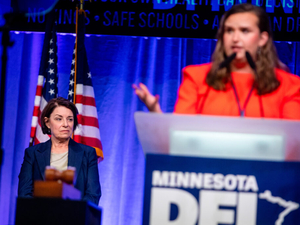
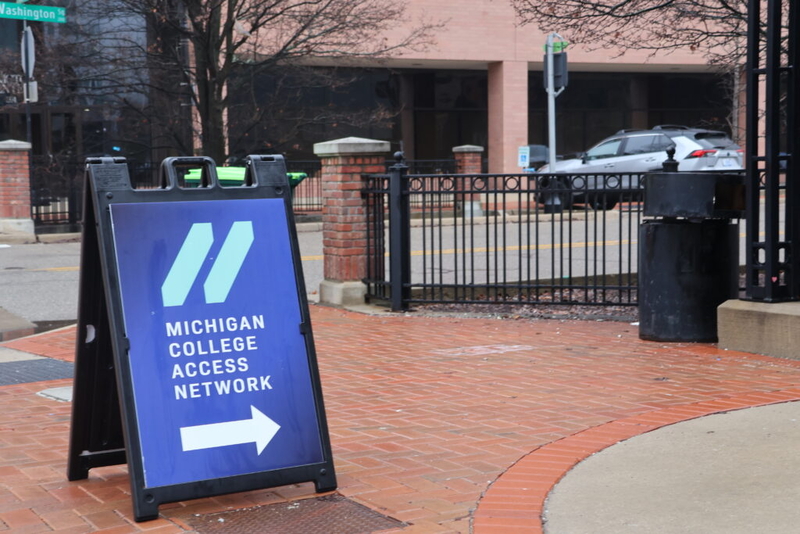
A sign in downtown Lansing directing attendees to the Michigan College Access Network's 2026 College Attainment Advocacy Day. March 5, 2026. | Photo by Kyle Davidson/Michigan Advance
During her first year in office Michigan Gov. Gretchen Whitmer set a goal, referred to as Sixty by 30, of boosting Michigan’s post-secondary education attainment, aiming for 60% of the state’s population to hold a college degree or skill certificate by 2030.
Over the past 7 years, her administration has worked to boost college attainment on several fronts, including the Michigan Achievement Scholarship, free in-district community college for students graduating in 2023 and beyond, as well as adults 25 and older.
According to the Michigan College Access Network, 47.5% of Michigan adults have received either a degree or certificate, compared to 44.8% in 2019. However, if the current trend in postsecondary education holds, the state will reach 53.5% attainment by 2030, the network warns, falling well short of the goal.
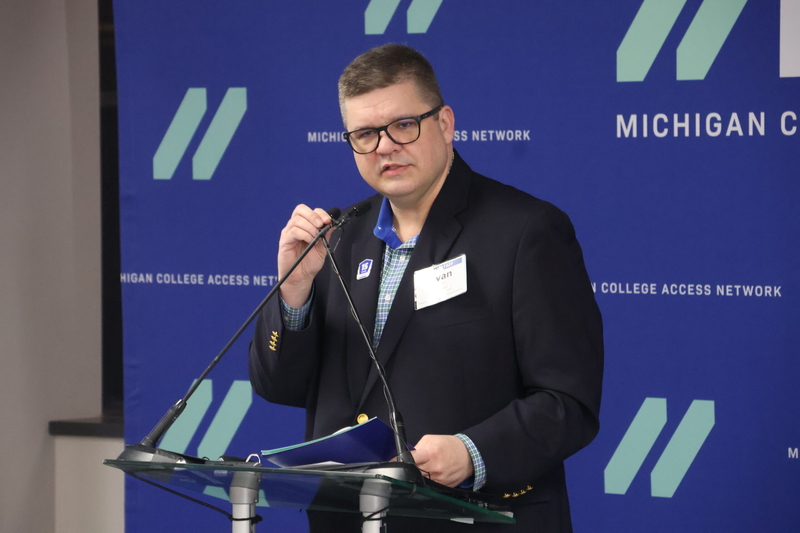
During the network’s annual College Access Advocacy day, Executive Director Ryan Fewins-Bliss emphasized that college matters, noting that claims to the contrary have been a major challenge to boosting educational attainment.
“There is a real belief, if you grab Joe Blow off the street, that they would tell you, college is too expensive,” Fewins-Bliss told Michigan Advance on Thursday. “College isn’t necessary anymore. There’s no return on investment. Everyone’s graduating with millions of dollars in debt.”
While you can find outliers that prove the point, the facts ultimately don’t back up these claims, Fewins-Bliss explained.
Dispelling the myth involves both advocating for programs that remove barriers to college and showing students the realities of higher education and the workforce, Fewins-Bliss said.
According to the U.S. Bureau of Labor Statistics, people with some college earn higher weekly median wages and face lower unemployment than those with only a high school diploma, with graduate degree holders seeing the highest earnings and lowest unemployment.
There’s another myth that asks students whether they’ll be starting their career or going to college, Fewins-Bliss noted, even though most careers require training or education.
“What is the amount of education you’re going to need to get you where you want to be?” Fewins-Bliss said. “If that’s a welder, there’s education. If that’s an engineer, there’s education. If that’s a medical doctor, there’s education. Everybody’s got a piece of paper they’re going to need after high school, to help them get to that livable wage which will allow them to be successful and comfortable and not have a life of struggle.”
According to a report from the Georgetown University Center on Education and the Workforce, more than 69% of all jobs in the state will require postsecondary education or credentials by 2031.
When looking at the governor’s approach to improving college access, Fewins-Bliss said the efforts have paid off, with the state providing support to a variety of age groups. The Michigan Achievement Scholarship and Community College Guarantee both provide support to new high school graduates, while the Michigan Reconnect Program offers assistance to adults 25 and older, with Whitmer aiming to lower the eligible age to 21 through this year’s budget process.
The state could also improve its funding for dual enrollment in K-12 schools, Fewins-Bliss said, pointing to $20 million included in the governor’s Fiscal Year 2027 budget recommendation.
“Right now, the way that the state has it structured is, if you are a K-12 student and you want to dual enroll at your local community college – meaning get credit at high school and community college – your high school has to pay the community college out of the money they get per-student to go to K-12,” Fewins-Bliss explained. “That is a disincentive for our K-12 friends to say a bunch of our students should do dual enrollment, because it takes money out of their much-needed coffers.”
The $20 million in the governor’s budget proposal would be used to reimburse districts for dual enrollment costs.
Looking forward to 2030, Fewins-Bliss said one of the challenges in tracking progress on the state’s goal is the lag in data on college completion. The network measures college completion in six-year increments, he explained, allowing four-year students six years to complete their program.
“So we won’t actually know the 2030 data until like 2036 in completion,” He explained. “That’s unhelpful in terms of the goal.”
Instead, the 60 by 30 goal serves as a rallying cry as the economy demands more individuals with associates degrees, certificates, bachelor’s degree and beyond, Fewins-Bliss said.
With 2026 marking Whitmer’s last years in office, it’s possible the new governor may conduct a new economic scan and find greater demand for students with postsecondary credentials, Fewins-Bliss said. Though that goal may change, the focus is really about bringing businesses, philanthropic groups, government, K-12 and higher education and the nonprofit sector together to work on improving educational attainment, he said.
Magnus Noble, midwest policy fellow for the National College Access Network said Michigan has been well-served by both the Michigan College Access Network, and the Whitmer administration’s efforts to boost higher education. However, consistency in those efforts is key, Noble noted, questioning whether Whitmer’s successor will match her efforts in supporting higher education.
“Michigan is one of the thought leaders in the space,” Noble said. “They’re doing all the right things. They have ideas for more great things, but the work is nowhere near finished, if it ever will be.”
Jenison High School students point to cost as a barrier for college access
Jenny Riha, a school counselor at Jenison High School, said the cost of college has been the biggest barrier she’s heard when discussing post-secondary education options with students.
Because Ottawa County lacks an in-district community college, students cannot fully use the state’s community college guarantee, though they can still attend at reduced cost.
As a result, the school district is trying to think out of the box to provide students with opportunities to earn college credit or credentials while they’re still in school, Riha said, helping reduce their college costs and giving them a head start on certifications.
“Ottawa County has a great tech center, but then many high schools will have their own CTE or career technical education programs,” Riha said. “And so ours, for example, our students are earning college credit and credentials in things like our wood shop class.”
Providing students with hands-on experience has also sparked interest among students who previously had no plans for education beyond high school, Riha said. However, connecting students with those experiences can take one-on-one conversations.
In the 2023-2024 school year, student to teacher ratios were two to three times higher than national recommendations, according to a report developed by the Michigan Health Council alongside the Michigan Department of Education.
Riha also pointed to the state’s Tuition Incentive Program as a game changer for students who do not think they can afford it. The program provides tuition support for students who were on medicaid for at least two years between age 9 and their high school graduation.
“To have students in my office, when I look at them and say, ‘You can get an associate’s degree for free,’ and they’re like, you can see the stress melt off them,” Riha said.
Lansing, MI