MD lawmaker’s historic journey unfolds in book that’s part autobiography, part political memoir
Jul 01, 2026 | 5:20 am ET
Description
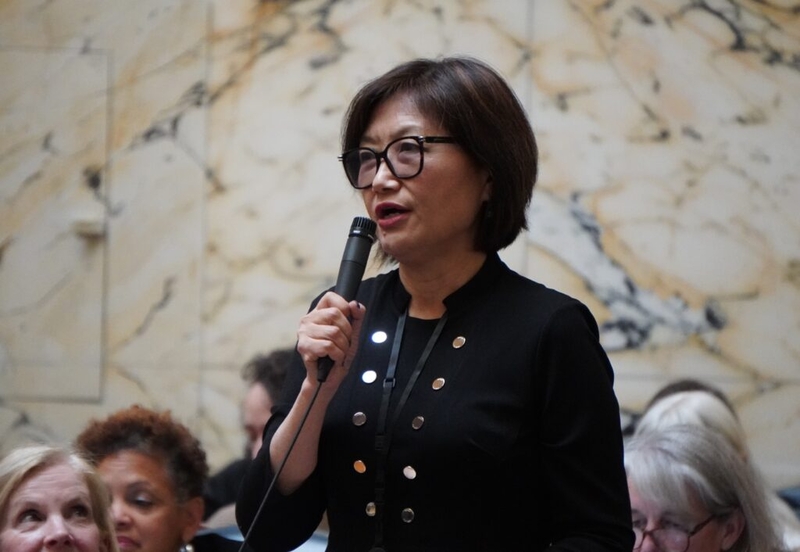
Del. Lily Qi (D-Montgomery) on the House of Delegates floor Feb. 7, 2025. Qi's autobiography “Elected American: From Red China to Blue Maryland” has just been published. (Photo by William J. Ford/Maryland Matters)
Every political leader has their own journey and public story, mixing the personal and political.
Del. Lily Qi’s journey has been especially long and arduous — and is utterly unique.
Now, just in time for America’s 250th birthday, the Montgomery County Democrat is out with a remarkable book that is part autobiography and part political memoir, and is also a meditation on the parallel tracks the U.S. and the People’s Republic of China have been on for the past half century, from a perspective that very few people possess. Qi, in 2018, became the first native of Communist China to be elected to a state legislature in the United States.
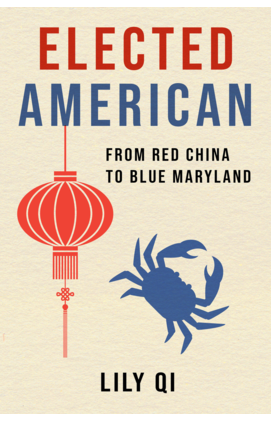
“Elected American: From Red China to Blue Maryland” (Temple University Press, $35) starts with Qi’s childhood in Shanghai under Chairman Mao’s regime in the 1960s and ‘70s, then takes us to her decision to study in the U.S. when she was in her early 20’s — and her decision to stay. The reader is led through Qi’s personal and professional evolution and political awakenings, and her move to the Washington, D.C., area. The book crescendos with her improbable election to the House of Delegates, and her first few years in Annapolis — a period that coincided with the COVID pandemic, which made relations between the U.S. and China more fraught than ever.
Qi is now starting to promote the book with appearances and interviews throughout the DMV — and excerpts of “Elected American” will soon appear in Washingtonian magazine and elsewhere.
Many stories in one
In a legislature with its share of political grandstanders, Qi, 62, is a serious lawmaker who puts her head down, works her priorities smartly, and tries to deliver for her district, which is partly suburban and partly rural. She has been unafraid to stray from Democratic orthodoxy at times, making business development and free market capitalism hallmarks of her political agenda.
That’s a throughline that emerges everywhere in her story, born from the rigidity, oppression and state economy she lived through under Mao.
Qi’s tale is tinged with irony and regret and an immigrant’s inevitable personal sorrow of what’s been left behind, propelled by the knowledge that China over time has largely overtaken the U.S. in business innovation, technological advances and entrepreneurialism. She also brings a singular perspective on America’s fraying democracy, with its disquieting reminders of home.
Throughout the book, Qi describes the loneliness of feeling like an outsider with no role models as she journeys through life, outlining in painful detail the mistakes she might have avoided if mentors had been available to her.
“We had no one to stop us from making stupid choices,” she writes of one of the many crossroads she and her Chinese-born husband Phil faced early in their time in America.
“Being an immigrant,” she also observes, “doesn’t come with a manual.”
“Elected American” unfolds in alternating chapters: One is part of a fairly standard, chronological autobiography, while the next provides an in-depth look at Qi’s civic engagement and political education and the mechanics of a novice Democratic primary campaign for the legislature. The pattern repeats through 36 chapters. They almost read like separate stories — except for the common protagonist and unifying themes.
Qi’s political campaign is an odyssey as tortuous and at times as painful as her own journey to become an American. She faces skepticism and hostility from fellow Chinese residents of Montgomery County, many of whom lean to the right politically. She’s surprised at how little her Asian-American friends seem to know about American government and politics.
Both of Qi’s parents worked, as educators and musicians — a rarity for the time. Qi’s mother was a music teacher who came from a long line of musicians; her father was a translator who loved Western music and Western culture, which he passed along to his two children. This was unusual during Mao’s Cultural Revolution. He also read banned books.
When Americans look back at that era, they often think of uneducated Chinese peasants, leading a rural existence. Qi acknowledges that her parents’ level of education and exposure to foreign cultures gave her certain advantages as she was growing up and contemplating her future, but it also, she writes, made her feel “unsettled,” at a time when the government demanded fealty and uniformity.
Students in Shanghai began learning English when Qi was in the 4th grade, and Mao’s death in 1976 was a pivot point for the entire country, including for her family. Under Deng Xiaoping and his successors, who fast-tracked a free market economy, Chinese people could begin contemplating lives outside their long-confined circumstances.
Qi continued studying English and became an English teacher and tutor in China after graduating from college. That’s how she met her future husband, a promising musician named Peng Yu (he chose the name Phil after the couple moved to America).
Qi later served as a translator for a visiting professor from Manchester College in Indiana, who encouraged her to study in the U.S. Despite lucrative job offers, the call of America was hard to resist.
Qi arrived in the U.S. on George Washington’s birthday in 1989, with $300 in her pocket, to attend Manchester, and Phil would soon follow. That kicked off a long stretch of studies and work in academic settings — from the small Manchester campus, to Ohio University, West Virginia University and ultimately to American University in D.C.
These years, as Qi so poignantly describes them, are filled with loneliness, culture shock, long stretches of privation, and deep doubts. But also, she recounts, “I was a sponge” — taking in so many aspects of U.S. pluralism that seemed inconceivable back home in China.
Their son Andrew is born in Ohio, and Qi’s mother journeys from Shanghai to help with his care for a few months — and eventually, temporarily, brings him back to China while Qi and Phil attempt to make their way.
Qi says her young family often depended on the kindness of American strangers and the vitality of social safety net programs to get by. They took advantage of Planned Parenthood for prenatal care, relied on Medicaid to pay the $4,000 bill for the birth of their son and his extended hospital stay, and eventually were aided by a free childcare program in D.C.
One of the most dramatic and heart-wrenching chapters in the book, “Should I Go Back to China?” has the couple weighing the pros and cons of where to spend the rest of their lives. But they cannot turn their back on the sacrifices they’ve made to come to the U.S. and their own pursuit of the American Dream.
Even then, challenges persist, and Qi is plagued with guilt when her mother dies of cancer in 1997 at the age of 58.
After years in academia, Qi lands a job working on community development projects in the administration of transformational D.C. Mayor Anthony Williams, a Democrat,, and she begins to find her true calling. By 2007, she’s doing economic development work for Montgomery County Democratic Executive Ike Leggett, eventually rising to become assistant chief administrative officer in county government.
There is much Qi learns during the Leggett administration, about governing, about politics — and about herself. She also begins to feel, deep in her core, that immigrant communities — especially Chinese-Americans, and Asian-Americans more broadly — are grossly underrepresented in Maryland’s political discourse.
Slowly but surely — slower than it should have been, she later concedes — Qi begins to emerge as a civic leader in her community, and eventually, after Sphinx-like advice from the redoubtable Leggett, begins to imagine herself as an elected official.
Qi’s political campaign is an odyssey as tortuous and at times as painful as her own journey to become an American. She faces skepticism and hostility from fellow Chinese residents of Montgomery County, many of whom lean to the right politically. She’s surprised at how little her Asian-American friends seem to know about American government and politics.
But at the same time, she faces a different type of skepticism from Democratic activists, union leaders and advocacy groups who find some of her long-held positions too moderate to merit their support. It’s a conundrum that vexes her throughout the campaign — and continues to this day.
Now skating toward a third term in the House and serving in Annapolis with Del. Chao Wu (D-Howard and Montgomery), who also grew up in mainland China, Qi offers her book as a primer for immigrants who want to get involved in the political process — dispensing advice she wished she had when she was younger. And she provides insights into the value — and values — immigrants bring to the political process.
“Immigrants will continue to surprise us with their innocent questions, outsider perspectives, and pragmatic approaches to America and its politics,” she writes. “It’s not their problem that they don’t conform to preconceived expectations for minorities. It’s our problem if we don’t know how to turn them into our best assets.”
Del. Lily Qi and Josh Kurtz will be discussing “Elected American” on Sunday, July 12 at 5 p.m., at Politics & Prose bookstore, 5015 Connecticut Ave. NW, in Washington, D.C. Click here for further details.
— This story was updated on Monday, July 6, to correct the professions of Qi’s parents.

Annapolis, MD