McKee picks up steam in new UNH poll, but Foulkes still Democratic front-runner
Jul 01, 2026 | 1:42 pm ET
Description
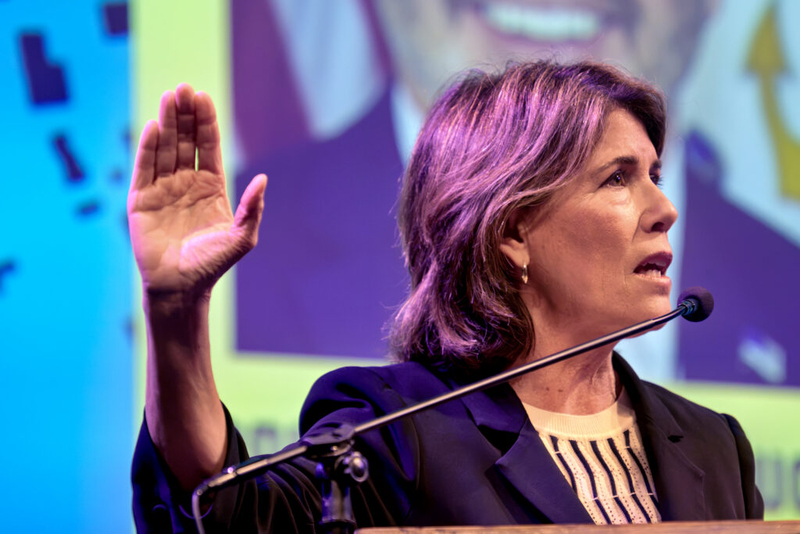
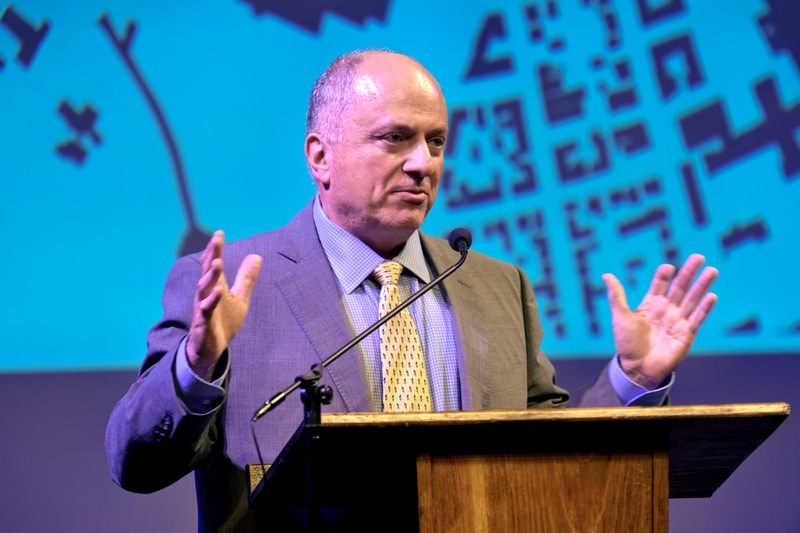
Democrat Helena Foulkes, shown at Grow Smart Rhode Island's 2026 Power of Place summit gubernatorial forum on June 26, 2026, has a 20-point lead in Rhode Island's Democratic gubernatorial primary race, with 42% support over McKee’s 22% in a new poll. (Photo by Michael Salerno/Rhode Island Current)
Gov. Dan McKee’s dim reelection prospects have brightened slightly, though Democratic challenger Helena Buonanno Foulkes still has a double-digit lead over the incumbent, according to a new University of New Hampshire (UNH) poll published Tuesday.
The survey of 337 likely Democratic primary voters showed Foulkes leading a Democratic gubernatorial primary, with 42% support, over McKee’s 22%. Another 31% of prospective Democratic primary voters were undecided, while the remainder preferred another candidate.
Foulkes’ lead, well outside the 5% margin of error for the online survey conducted June 18 to June 23, follows a series of other public polls, including prior editions of UNH’s survey, showing the former CVS executive with a sizable advantage over McKee. Yet, McKee, 75, has closed the gap in the two months since UNH last measured results of a Democratic gubernatorial primary, doubling his support among prospective voters since the April 23 poll.
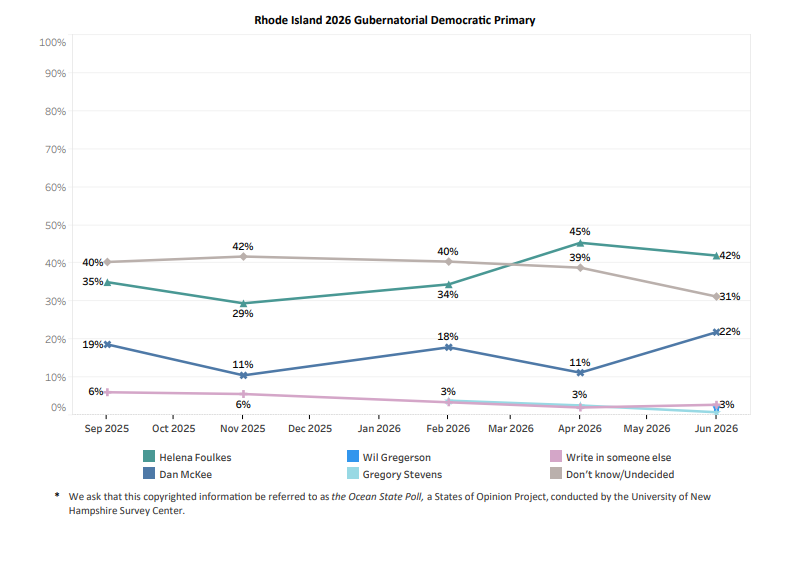
Foulkes’ support dropped three percentage points from April to June, while the share of undecided voters shrank by eight percentage points, indicating McKee’s gains come mostly from previously undecided voters.
But McKee’s campaign described his improved poll performance as a sign that voters are turning against 61-year-old Foulkes.
“The more Rhode Islanders learn about Helena Foulkes — a corporate executive who built her career on cutting healthcare access and fueling the opioid crisis — the more they want no part of her empty promises,” Sophie Mestas, a spokesperson for McKee’s campaign, said in an emailed response Wednesday. More Rhode Islanders now view her unfavorably than favorably, and it’s not hard to see why.”
McKee’s campaign has continued to attack Foulkes for decisions made by her former employer, CVS Health, though some of its claims center on events that occurred outside the window in which Foulkes led the retail pharmacy division.
Foulkes’ campaign in turn has framed her as a more capable alternative focused on in-state issues and taking on the Trump administration.
“This poll shows too many Rhode Islanders feel like the state government isn’t working for them anymore,” Angelika Pelligrino, a spokesperson for Foulkes, said in an emailed response Wednesday. “Helena’s running for governor to strengthen public education, create good-paying jobs and make it easier for families to live and thrive in Rhode Island.”
In addition to more favorable polling, Foulkes has maintained a significant cash advantage over McKee, while picking up endorsements from 13 municipal Democratic committees, compared with McKee’s three. McKee most recently picked up the East Providence Democratic City Committee endorsement on Monday, having already received support from Pawtucket and North Providence.
Unpopularity contest
Yet both Democratic frontrunners remain unpopular with Democratic primary voters, according to UNH’s poll. More than half of survey participants view McKee in an unfavorable light, compared with just 18% who favor the governor, and 18% who are neutral. A separate survey question on McKee’s job performance reveals even more negative sentiment toward the incumbent. More than three-quarters of the 664 survey takers across party lines disapprove of McKee’s handling of the executive office, including more than six in 10 registered Democrats.
Foulkes also came out with a net negative favorability rating (-2) among prospective Democratic primary voters, though far less severe than McKee’s net rating of -38. Nearly one-third of voters did not have a positive or negative opinion about her.
The survey also took the pulse of 145 Republican primary voters in a three-way gubernatorial contest between Aaron Guckian, Elaine Pelino and Robert Raimondo, though Raimondo has since withdrawn. Pelino, a former comedian and first-time candidate, was backed by more than four in 10 primary voters, while Guckian, the state GOP’s endorsed candidate, received 17% support. Another four in 10 Republican primary voters were undecided, according to the survey. The margin of error for questions specific to Republican primary voters was 8.1%.
Guckian, 49, dismissed the survey results, noting that it was conducted before the Republican Party convention last week.
“The biggest poll, and the first step, is to get the endorsement,” Guckian said in an interview Wednesday. He also attacked Pelino for “running a Facebook campaign,” noting her lack of experience.
“People know me,” said Guckian, who served as an aide to former Gov. Don Carcieri, and also ran for lieutenant governor in 2022. “She’s new to the scene.”
Pelino, 72, acknowledged requests for comment but did not provide a response.
Looking ahead to the Nov. 3 general election, independent gubernatorial candidate Ken Block remains a strong contender, especially if McKee wins the Democratic primary. In a hypothetical three-way race between McKee, Block and an unidentified Republican nominee, McKee and Block each received support from 27% of survey participants, while another 21% were undecided.
‘There’s definitely a path with both of them’
Block’s chances are more challenging if Foulkes wins the Democratic primary, with Foulkes maintaining a 19 percentage point lead over Block in a three-way race with an unnamed Republican nominee. In that hypothetical matchup, one in five voters were undecided.
Block, 60, who has run for governor twice before, as a moderate and a Republican, said he expects to close the gap “substantially” as he launches a print and digital media campaign in the next week.
“It may be harder with Helena because the gap is smaller with McKee, but there’s definitely a path with both of them,” Block said of his chances.
The survey did not include questions about the outcome of a general election race with specific Republican candidates in the interest of survey length, Andrew Smith, UNH Survey Center director, said in an email. Smith also said the intent of the general election questions was to gauge the effect of a third-party candidate on the race.
In the U.S. Senate race, five-term incumbent Jack Reed maintains a commanding lead over primary challenger Connor Burbridge, with more than six in 10 prospective primary voters backing Reed. However, Burbridge has picked up support since the survey was conducted in April, now polling at 25% in the September primary compared with 15% in April. The share of undecided voters in the U.S. Senate race shrank from 20% to 12% between the two survey editions.
The survey was conducted online from June 18 to June 23. Nearly half of participants were unaffiliated voters, with 36% registered Democrats and 15% registered Republicans — nearly identical to the split among Rhode Island’s 704,636 registered voters.
Survey respondents were equally split between men and women, reflecting a variety of age ranges, education levels and locations across the state.
A total of 19 candidates have pulled papers with the Rhode Island Department of State for the governor’s race, although they must submit nomination papers by July 10 with at least 1,000 registered voters signatures to qualify for the ballot.
Other candidates who filed declaration forms to run include Democrats Gregory Stevens, Wil Gregerson, and Jonathan Coker; Republicans Emmanuel Adjei, Amy Ferreira and Frank Gallucci; and independents Jasjit Gotra, Robert J. Carr, Richard S. Spinney, Julian J. Smith, Paul Rianna, and David Rocha.
Early voting begins Aug. 20, with primaries on Wednesday, Sept. 9
Providence, RI