Corruption Defendants, If Convicted, Could Lose Half Their Pensions
Aug 05, 2026 | 6:01 am ET
Description
Photo courtesy of Honolulu Civil Beat
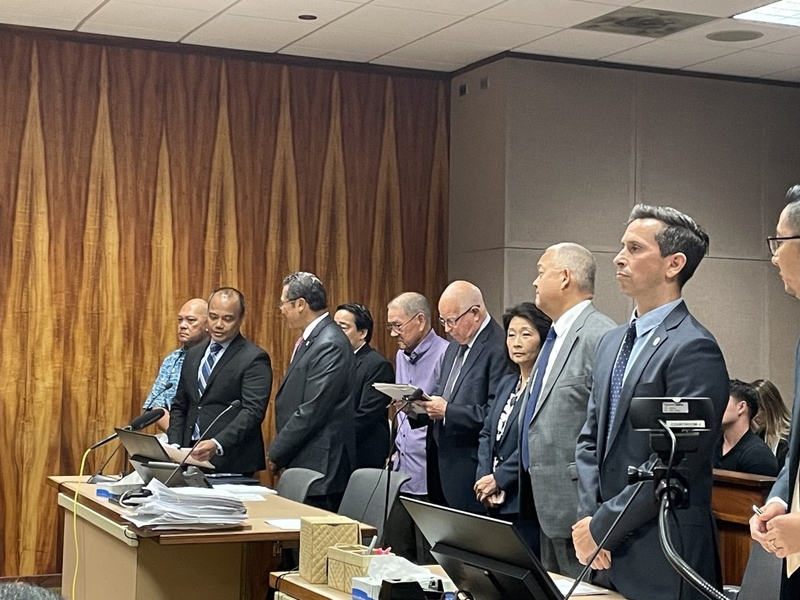
Lt. Gov. Sylvia Luke, ex-state Rep. Ryan Yamane and two other Hawaiʻi officials facing charges in an alleged bribery scheme have collectively worked for the state for decades, entitling them to pension benefits for life when they retire.
But if they’re convicted, they stand to lose a large chunk of that income.
Under a 2021 law, a judge can order the forfeiture of up to one half of a person’s state pension if they are convicted of a felony related to their state employment. The law specifically lists bribery as one of the charges that can cause a person to lose the right to their full pension.
If the defendants in the bribery case are convicted, they could be the first public officials at risk of losing pension benefits under the new law.
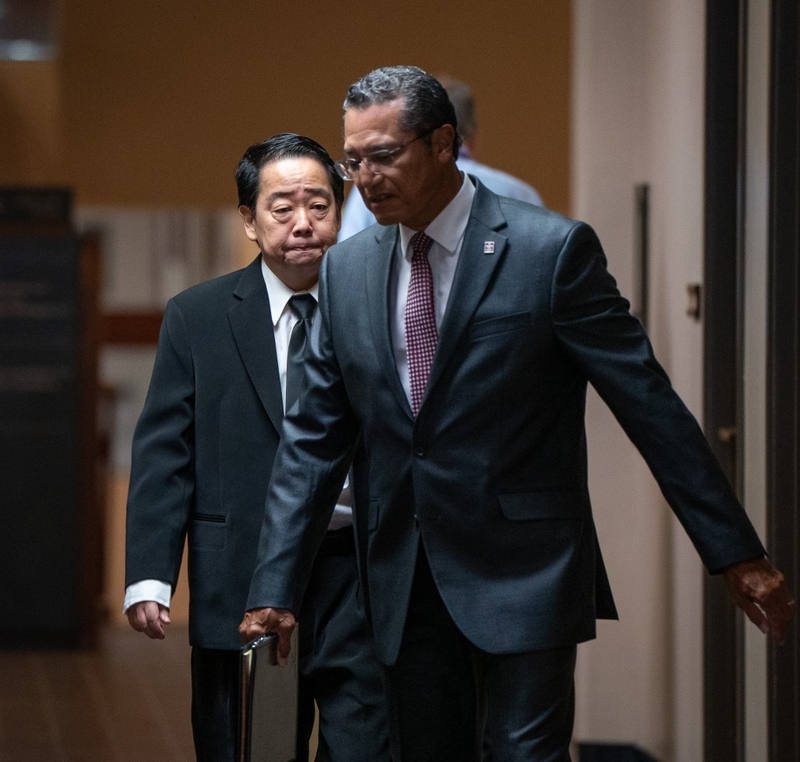
A total of five defendants are facing charges in the major public corruption scandal involving alleged bribes and lucrative government contracts for Covid-19 testing. Luke and Yamane are charged alongside Ford Fuchigami, airport administrator of the Department of Transportation and former member of the state Senate’s budget staff, and Leo Asuncion, a state planning official, former chair of the Public Utilities Commission and Luke’s former campaign treasurer.
Tobi Solidum, a businessman and lobbyist, is also charged in the alleged conspiracy but was not a state employee and therefore not eligible for a state pension.
Luke, who formerly served as a state representative and chair of the House Finance Committee, is charged with bribery for actions she took to arrange state money for a Covid-19 testing effort run by Solidum, according to a 30-page indictment filed late last month by state prosecutors. The indictment says Solidum promised to give her $35,000 in campaign donations, part of a total of $70,000 he said would come later. It's unclear from the indictment whether she ever actually received that money.
Solidum is also accused of bribing Yamane with about $4,500 in cash and checks in an effort to influence legislative bills. Prosecutors say Solidum gave Fuchigami a $7,000 check to spur him to act on budget appropriations. At the time, Fuchigami was working for the Senate Ways and Means Committee, chaired by Sen. Donovan Dela Cruz.
Luke and Asuncion are also charged with filing false campaign finance reports that failed to disclose $10,000 Luke received from Solidum and his stepdaughter during a dinner in 2022 while Luke was running for lieutenant governor.
All the defendants, except for Solidum, have pleaded not guilty. Solidum is believed to be living in the Philippines and was not present for his arraignment.
The pension forfeiture law applies only to felonies. If any defendants end up pleading guilty to a misdemeanor, their pension would be safe.
The law was inspired in part by disgraced Honolulu police chief Louis Kealoha, who, despite serving prison time for corruption, still receives a $150,000 annual pension.
State Sen. Karl Rhoads, who was chair of the Judiciary Committee at the time of the pension forfeiture bill’s passage, said he’s glad the state now has a mechanism for clawing back pensions of those who use their public office to commit crimes.
“I do think that elected officials, and just people who work for the government in general, should hold themselves to a higher standard,” he said. “And when you don't, then you should expect to pay a price for it.”
Valuable Pensions On The Line
Under the law, an official convicted of bribery could have part of their pension forfeited if a judge orders it. But the penalties range. A judge, for example, could decide to order forfeiture of half of the interest that has accrued on an employee’s account or half of only the employer’s contributions.
The highest penalty would be cutting the person’s entire pension in half.
Exactly how much each defendant's pension is worth is not public information, according to the Hawaiʻi's Employee Retirement System. However, publicly available pension formulas can provide a sense of what the defendants are set to earn in their later years.
Luke, who served as an elected official for 28 years, could expect a full pension as high as $200,000 annually, according to a Civil Beat estimate. She could also receive additional retirement income through an annuity, which is an extra monthly payment available to elected officials based on contributions they made to the system while holding office.

The pension formula for elected officials who started before 2012 is based on the average of their three highest-earning years. As lieutenant governor, Luke made between $183,804 and $216,660, according to Civil Beat’s salary database.
Yamane's last state position was as director of the Department of Human Services, where he was making $206,352 annually. His last salary as a legislator was $62,604. His full pension would be around $50,000, according to Civil Beat’s calculation.
Fuchigami, who has worked for the state for at least 15 years was making between $135,360 and $216,576 as the state's airport administrator, according to state data that provides only a pay range for many employees. His pension could be around $50,000.
Asuncion has worked for the state since 2011, according to his LinkedIn. His salary at the state office of planning was $156,108 of as this year. His pension could be around $46,000.
Convicted Lawmaker Influenced Bill
Hawaiʻi’s pension forfeiture law was a response to the Kealoha scandal. Louis Kealoha and his wife, former prosecutor Katherine Kealoha were accused of abusing their public positions, including Kealoha’s police powers, to frame an innocent man for a crime he didn’t commit.
At the time of their conviction in 2019, Hawaiʻi had no legal mechanism to seize pension benefits. Since his conviction, Louis Kealoha's pension payments have gone toward restitution.
Proposals had been floated and killed for years, but the Kealoha scandal finally spurred the Legislature into action in 2021.

However, the version that passed was largely watered down from the original draft, which was introduced by former state Rep. Mark Nakashima, who died in 2024. The original bill would have allowed a judge to order forfeiture of up to the entire amount of a person’s pension. The law that passed allows forfeiture of up to just half.
The law only applies to crimes that occurred after June 24, 2021. That’s thanks in part to then-Senate Maj. Leader J. Kalani English who served on one of the committees that amended the bill. That effective date preserved English’s own pension.
English, who was a member of the Ways and Means Committee at the time, was then being investigated for bribery, unbeknownst to many of his colleagues. He ultimately pleaded guilty to accepting more than $15,000 in bribes from Milton Choy, a Hawaiʻi wastewater company owner, to influence legislation favorable to Choy’s business. The investigation was not made public until he was charged in February 2022, but court documents show the FBI was investigating him from at least January 2021.
English, who was released from federal prison in 2024, did not return a call seeking comment. Richard Sing, the lawyer who represented him in 2022, also did not respond to requests for comment. Sing is now representing Luke.
Ali Silvert, a former federal public defender who petitioned the state Legislature to investigate the bribery allegations involving Luke and her co-defendants, said legislators should revisit the law and consider whether the penalty should be expanded to allow for forfeiture of up to a full pension.
Silvert said the fact that English could have influenced the outcome of a bill that would have directly affected him while he was under investigation for bribery illustrates the need for more transparency in state government.
“It goes to the argument we’ve been making from day one, which is, we needed an investigation conducted because there could be sitting legislators who we don’t know are under investigation who are voting on bills,” he said. “It directly ties into, we need to understand what happened and who might’ve been involved and freeze them out of voting immediately.”
‘A Good Compromise’
Rhoads said he doesn’t know how much, if any, influence English had on the final version of the bill.
Voting records show English was absent from an April 2021 Ways and Means Committee hearing during which the bill was passed out of committee. He then voted in favor of it on the Senate floor.
Luke and Yamane, who were state representatives at the time, also voted yes on the House floor, as did former Rep. Ty Cullen, who also was under investigation at the time and would later be convicted of accepting more than $23,000 in bribes also from Choy, the wastewater services company owner.
Cullen was never ordered to forfeit his pension. Most of the crimes for which he was convicted occurred before the pension forfeiture law went into effect, though his indictment spans from September 2014 to Oct. 8, 2021 — about three months after the law’s effective date. Neither Cullen, nor his attorney Birney Bervar, responded to requests for comment.
Attorneys representing Fuchigami and Yamane declined to comment.
Rhoads supported giving judges the ability to forfeit a person’s entire pension, but he said there were plenty of counterpoints from other lawmakers who disagreed. A major concern, he said, was that ex-state employees who’d been convicted would come out of prison with very little financial support and could become a burden on the system in other ways.
“You don’t necessarily want to make them homeless,” he said.
Former Sen. Brian Taniguchi, who was then chair of the Labor, Culture and Arts Committee where the bill was also referred, said some committee members were concerned a too-punitive pension clawback measure might negatively impact innocent family members that rely on those benefits.
“There should be some consideration for not just the wrongdoer or the employee but for their families,” he said. “At the time, I thought it was a good compromise.”
The law also has no provision for recouping pension payments made prior to a conviction. Yamane, who stepped down as director of the Department of Human Services in May, could be eligible to start receiving his pension now. Kalbert Young, director of the state retirement system, would not say whether Yamane has applied to start collecting benefits.
At least 30 states have laws allowing some form of pension revocation or forfeiture for public officials or state employees convicted of job-related felonies. In states where pension benefits can be revoked in full, former employees usually are still entitled to a refund of the contributions they made into the system while working. For example, in Connecticut, which allows for full pension forfeiture, the convicted state employee can still receive a refund of his or her contributions without accrued interest.
Rhoads said Hawaiʻi’s law could go further, but he’s glad the law exists.
“It’s a good sign that we’re going to hold people accountable,” he said, “but we aren’t as punitive as might be justified.”
Honolulu, HI