Maine lawmakers pass labor-backed bill to increase child care support for working parents
Mar 05, 2026 | 3:36 pm ET
Description
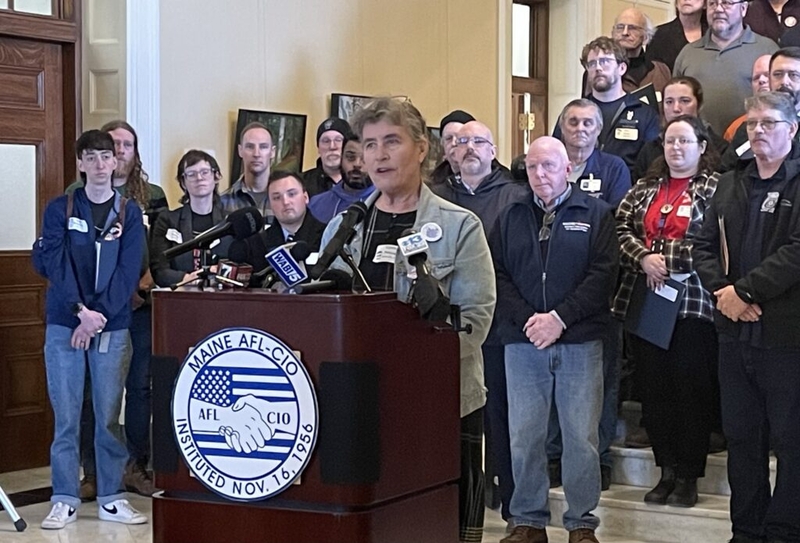
Speaking at a March 5 press conference, Maine AFL-CIO President Cynthia Phinney emphasized how a lack of childcare perpetuates gender imbalances in the work place. “Female workers face severe lifetime earning penalties when they must leave a job that they’d like to keep, to care for their children," she said.
In an effort to reduce the cost of child care for working families, Maine lawmakers have passed legislation to increase state support.
Introduced by Senate President Mattie Daughtry (D-Cumberland), LD 1955 would allocate $15 million for the Child Care Affordability Program in the next fiscal year. The program pays for a portion of childcare costs for working families making 125% or less of the state’s median income.
The bill would also require the Department of Health and Human Services to develop a long-term plan for the financial sustainability of the program, and report to the Maine Legislature by Dec. 15.
While the bill was being debated in the House of Representatives Thursday morning, labor advocates with the Maine AFL-CIO gathered in the Hall of Flags to voice support for the bill.
Cynthia Phinney, president of Maine AFL-CIO, said that many families are now stuck on the waiting list for the Child Care Affordability Program, after funding ran out.
“Many parents end up having to either cut their work hours or leave the workforce entirely due to the exorbitant costs of safe and reliable care for their children,” she said. “Female workers face severe lifetime earning penalties when they must leave a job that they’d like to keep, to care for their children.”
In a statement, Lindsay Hammes, spokesperson for the Maine Department of Health and Human Services, said the Office of Child and Family Services has worked to move children off the waiting list.
“While the waitlist previously had approximately 1,000 children waiting for placements, as of this week, that number is now at 883,” she said. “As funding allows, the Department continues to move children off the waitlist each week.”
Kevin Ready, a postal truck driver with two young kids, said his family was among those that got stuck on the waiting list.
“It was kind of like a rug got pulled out from under us,” Ready said. “Just when it seemed like things were gonna get a little bit better for us. Without that support, we could not afford to send my son to daycare, my wife ended up having to stay home. In the end we were worse off financially, we struggled to pay bills and continue to do so.”
Meg Sinclair, a nurse at Maine Medical Center in Portland, said she had to reduce her hours to work part-time after she couldn’t find childcare for her nine-month-old son.
“And there are dozens of mothers to young children that I work with in the emergency room, I can’t think of one of them who has not had to reduce their hours since becoming a parent,” Sinclair said.
Those sentiments were echoed by supporters in the House, like Rep. Cheryl Golek (D-District 99). Golek said as a single mother herself, she would not be in her current position without childcare support.
“When we’re talking about a population that needs help with childcare, we are almost always talking about a lower income population of people that we supposedly have a ladder to help them climb up,” Golek said. “This bill helps fix one of those broken steps in the ladder. And will help people continue to climb to where they deserve to be able to be.”
But House Republicans raised objections, arguing that it’s not the state’s place to pay for child care.
“I oppose this bill because I am under the belief that we are personally responsible for the child care of our children,” said Rep. Michael Lemelin (R-District 53).
“I believe that parents need to go back to the old way where you had family members care for them or one of the parents would work,” he added, “you just worked it out.”
Lemelin said there are already programs in place for extreme situations that require assistance.
Rep. Laurel Libby (R-District 90) said she would rather see the state reduce regulations to encourage growth in child care options.
“Putting lifestyle choices aside, it’s not the proper role of the government to throw money at this solution,” she said.
On a roll call vote, the House passed the bill 72-68 and passed the Senate last week without a roll call
The legislation is among a handful of bills that passed last session but were never signed by the governor and eventually recalled from her desk for more work. It will now head back to Gov. Janet Mills to determine if it becomes law.
- March 6, 202611:42 amThis story was updated to include a statement from the Maine Department of Health and Human Services on the child care waitlist.

Augusta, ME