Louisiana elected officials helped fund PAC that sent anti-LGBTQ+ texts to voters
Jan 24, 2024 | 6:01 am ET
Description
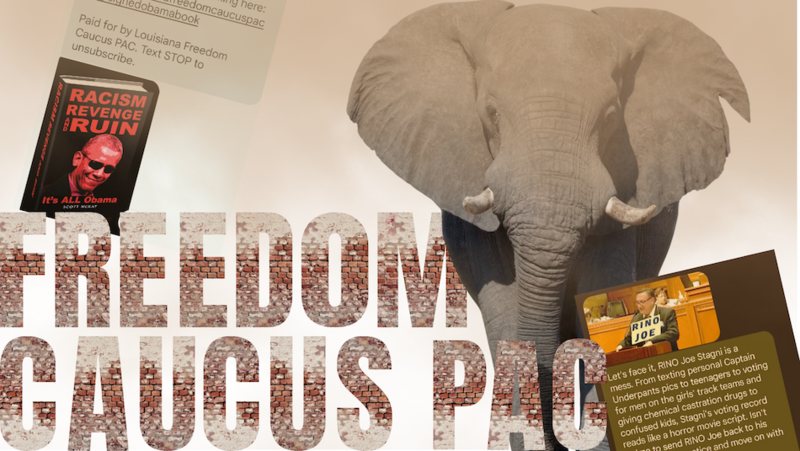
Louisiana Illuminator illustration
Rep. Joe Stagni handily won reelection to his state House seat representing Jefferson Parish in October. The moderate Republican walloped fellow GOP candidate Mike Sigur to claim 70% of the vote.
But as Stagni coasted to victory, conservatives decided to take a shot at the two-term incumbent.
On Election Day, a political action committee sent a text to voters in his district falsely alleging, among other things, that Stagni had made sexual advances toward teenagers.
“From texting personal Captain Underpants pics to teenagers to voting for men on girls track teams and giving chemical castration drugs to confused kids, Stagni’s voting record reads like a horror script,” read the text.
While it might have been expected, the source of the assault frustrated Stagni.
His colleagues in Louisiana Legislature helped set up and fund the Louisiana Freedom Caucus political action committee (PAC) responsible for distributing the text attacking him.
“Unfortunately, in politics, you have the right to say anything you want,” Stagni said. “They should be held more accountable.”
Stagni has never been publicly accused of an inappropriate relationship with a teenager.
He faced sexual harassment allegations when he was a member of the Kenner City Council in 2011, but the accusations involved an adult woman working in city government. At the time, he said the relationship with her was consensual.
The Election Day text appeared to conflate Stagni’s scandal — which involved Stagni sending a photo of himself in his underwear to the city employee — with that of a different Italian-American politician from Kenner, former Jefferson Parish President Mike Yenni.
Yenni allegedly purchased designer underwear for a teenager he met at the boy’s high school graduation.
Still, the attack on Stagni isn’t surprising. A Democrat-turned-Republican, he has taken stances controversial with the GOP. Stagni has been reluctant to support, and often votes against, state restrictions on transgender children.
The mass text’s references to “men on girls track teams” and “chemical castration” are an extreme right-wing interpretation — one Stagni would say is twisted and full of misinformation — about his perspective on LGBTQ+ rights.
Lawmakers provide PAC seed money
A small group of conservative legislators last year started the Louisiana Freedom Caucus. It’s modeled after the Congressional Freedom Caucus, a divisive organization that has thrown the U.S. House Speaker selection process into turmoil twice in the last year.
Like its national counterpart, the Louisiana Freedom Caucus doesn’t disclose its members without their permission or even release the number of members in the group. Lawmakers can only join by invitation, said Rep. Beryl Amedee, R-Gray, who became its leader earlier this month.
The group also helped set up the Louisiana Freedom Caucus PAC in April last year, just a few weeks after the Louisiana Freedom Caucus was formed.
Among its first contributors were four conservative Republican legislators — Sen. Alan Seabaugh and Reps. Danny McCormick, Kathy Edmonston and Charles Owen — who each gave the PAC $5,000 last April, according to campaign finance reports.
Later in 2023, Reps. Julie Emerson ($5,000), Phillip Tarver ($2,500), Dodie Horton ($1,000) and Kellee Hennessey Dickerson ($1,885) also made contributions.
But the caucus members insist they had nothing to do with the PAC’s attacks on Stagni and others.
“We set up seed money but made no decisions about who to support,” said Seabaugh, who was head of the caucus last year and a founding member as a state representative.
“No one consulted me about how to spend a dime,” Seabaugh added.
The PAC’s board and chair decided which candidates to endorse and how to spend the money it raised, according to Seabaugh. No legislators were on the board, so none of the Freedom Caucus members were involved in the PAC’s management.
“We will be working something out where we get legislators on the board or we will completely disassociate (from the PAC),” Seabaugh said.
A few other legislators who have publicly joined the Freedom Caucus echoed Seabaugh’s comments. They also reiterated that caucus members and the PAC don’t have much contact.
“There’s no real communication,” said Rep. Raymond Crews, R-Bossier City, caucus vice chairman.
Stagni said legislators involved with the Freedom Caucus can’t wash their hands of the PAC.
“They may not be the officers. They may not be on the board of directors, but they certainly lend their name to raise the money,” he said.
More anti-LGBTQ+ messaging
Besides Stagni, the Louisiana Freedom Caucus PAC put out a negative text about the only openly gay Republican candidate who ran for the legislature last year.
Aaron Moak, a Baton Rouge Metro Council member, was campaigning to represent the city of Central in the Louisiana House when a text went out on Election Day implying his sexuality made him unfit for the office. He lost in the primary race, though his campaign doesn’t believe the text message prevented him from making the runoff election.
“Woke Aaron Moak is a big name in House District 65, but he’s wrong for one of the most conservative districts in the state,” read the message sent to voters in his district. “You don’t want to give a promotion to the man responsible for bringing the Gay Pride parade to Baton Rouge do you?”
Baton Rouge does not have a gay pride parade. Moak was the grand marshal of Baton Rouge’s gay pride festival in 2019, but he is not an organizer or founder of the event.
Scott McKay, chairperson of the Freedom Caucus PAC, defended the organization’s decision to target Moak’s sexual orientation in a recent post on his conservative website, The Hayride. The strategy to attack Moak’s sexuality was about keeping another candidate, Brandon Ivey, the identical twin brother of former Rep. Barry Ivey, from winning the seat, McKay wrote.
“We didn’t think Moak could beat Ivey because the district is based in Central, which is the most bible-belt area of the Baton Rouge market, and we thought the fact Moak is gay was going to be a cudgel that Ivey would knock him out with,” McKay wrote.
“We didn’t have anything against Moak. We wanted to keep Ivey from winning,” he said. “Tactically, and without a big budget, as this wasn’t one of our high-priority races in the primaries, what we did was our only move,” he wrote.
One of the state’s leading LGBTQ+ organizations felt differently. Forum for Equality’s executive director said the state deserves better.
“These tired troupes are maintaining an unsafe and unfair environment in Louisiana,” said SaraJane Guidry, executive director of the organization. “We will continue to fight back, and parade, all across Louisiana, no matter what.”
Brandon Ivey made it into the runoff election but was beaten by Lauren Ventrella, a Republican the Freedom Caucus PAC endorsed.
Gov. Landry, AG Murrill among contributors
The Freedom Caucus PAC raised a little over $150,000 from April to December. A large share of that funding came from political donations of $1,000 or less.
The PAC’s two biggest benefactors make up half of the organization’s board, according to a review of campaign finance reports. Barry Hugghins, a former member of the West Baton Rouge Parish Council, donated $27,800 and Jon Khachaturian, a professional engineer from the New Orleans area, contributed $25,000.
Another $10,000 came from Louisiana Majority Makers PAC, a separate group supporting Republican candidates for the Legislature to which Khachaturian gave money.
Republican mega-donors Lane Grigsby and Shane Guidry, one of Gov. Jeff Landry’s close friends, donated $1,800 and $5,000, respectively to the PAC.
Landry himself donated $1,000. Another $5,000 came from the Republican Party of Louisiana’s Governor’s Victory Fund, which Landry’s campaign used to help his election efforts last year.
Republican Attorney General Liz Murrill gave $1,300 to the PAC and was keynote speaker for its endorsement banquet in August. The group charged $150 per person for the event.
Campaign finance records show the banquet and Murrill’s appearance might have brought in as much as $22,000 for the PAC. Murrill’s deputy attorney general, former Republican state Rep. Larry Frieman, also donated $1,000.
Nineteen current state lawmakers made donations that added up to a little over $37,000. Their contributions ranged from $85 to $5,000.
PAC money promotes chairman’s website, book
The Freedom Caucus PAC backed more victors than losers in its first election cycle, with 24 of the 36 candidates it helped winning their races.
Still, most of the PAC’s funding was not spent directly on individual candidates’ election efforts, according to the group’s campaign finance reports.
The PAC’s reports list a little over $57,000 of the $148,000 spent — about 40% — going directly to “independent expenditures” on behalf of people running for office. All of that money was used for text message campaigns directed at potential voters, according to campaign finance reports.
The second largest recipient of the PAC’s money was McKay’s website while McKay was running the PAC. The organization paid The Hayride $22,500 over eight months for use of the site’s email list and online advertising.
McKay hung up on a reporter when contacted by telephone earlier this month. He did not reply directly to an email seeking a request for comment about the PAC’s spending.
Instead, McKay posted a commentary on his website, saying the payments to his website were part of an advertising deal struck with the PAC.
“That way the PAC got a good bit of exposure, particularly for some of its fundraising events and endorsements and so forth,” McKay wrote of the arrangement.
“Is that a conflict? The conflict would have been if I’d taken a fee and THEN sold ads to it,” he said.
In 2019, when former Gov. John Bel Edwards won his second term and before the Freedom Caucus PAC had been formed, The Hayride collected $62,425 directly from political candidates and PACs through digital advertising, sponsorships and event tickets, according to state campaign finance records.
In 2023, campaign finance records show The Hayride brought in less money, $52,600, from those same sources. The compensation that remained includes the Freedom Caucus PAC revenue ($22,500) from the advertising deal, which accounted for 42% of that source of funding for The Hayride last year.
McKay also used the PAC to promote at least one personal project outside of The Hayride.
On Dec. 11, the Freedom Caucus PAC sent a text message to potential voters soliciting $55 donations to the group in exchange for signed copies of McKay’s book, “Racism Revenge and Ruin: It’s All Obama.”
The text message referred to the offer as a “holiday gift opportunity.”
It’s unclear how much the message cost the PAC to send. It isn’t listed on the campaign finance report the PAC submitted at the end of December, which is supposed to reflect charges through Dec. 18.
The state ethics code is also silent about whether a political action committee’s chairman can use the group’s resources to promote his personal work in this manner.
“I don’t have any provision of the statute that explicitly addresses that or an opinion that addresses that,” said Kathleen Allen, administrator for the Louisiana Board of Ethics.
“That is not a question that the board has faced,” she said.
Baton Rouge, LA