Louisiana congressional map boosting Republicans nears final passage
May 28, 2026 | 6:55 pm ET
Description
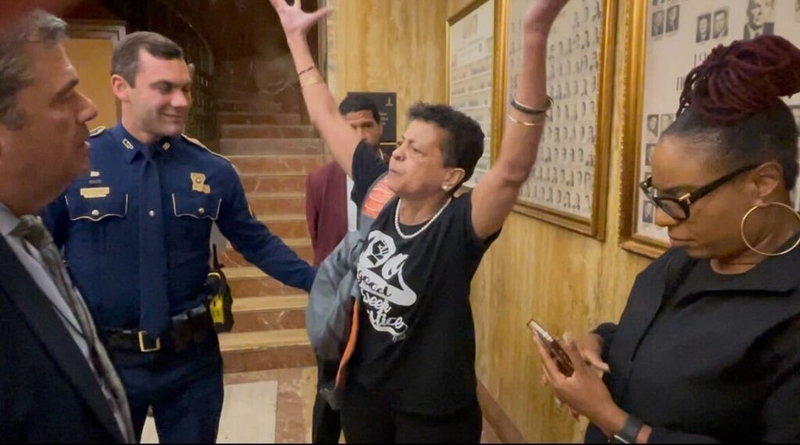
A state trooper and Capitol Security Director Terry Alario escort a woman who would only identify herself as Ms. Pat from the Louisiana House of Representatives after its members voted Thursday, May 28, 2026, to approve a congressional map that removes one of the state’s majority-Black seats in the U.S. House. (Photo by Greg LaRose/Louisiana Illuminator)
The Louisiana House of Representatives approved a congressional redistricting bill Thursday that increases Republican representation in Congress ahead of this year’s midterm election.
On a largely party-line 66-36 vote, the House approved Senate Bill 121 by Sen. Jay Morris, R-West Monroe, which keeps only a single majority-Black district among Louisiana’s six U.S. House seats. By eliminating the second Black district the legislature created two years ago, Republicans would gain another probable win in their bid to maintain control of Congress.
Rep. Robby Carter, D-Amite, voted with Republicans to support the bill.
The majority-Black district retained in Morris’ bill is essentially the same one U.S. Rep. Troy Carter, D-New Orleans, won in 2022. The map removes the Black majority district held by U.S. Rep. Cleo Fields, D-Baton Rouge.
The bill passed after approximately seven hours of debate, including floor speeches from nearly every House Democrat who opposed it.
Rep. Beau Beaullieu, R-New Iberia, authored amendments to the bill that were negotiated between the House and the Senate. Beaullieu said the goal behind Morris’ map is to disregard race and instead focus on party. While racial gerrymandering remains prohibited, partisan redistricting is legal. Beaullieu said his map is designed to maximize Republicans’ advantage.

Several Democrats pushed back on the idea that the bill disregards race, saying race and party are significantly intertwined in Louisiana and across the South, with more than 90% of Louisiana Republicans being white.
“SB 121, in its current posture, is a flagrant effort to consolidate political power in the hands of the white majority, denying Black Louisianans in particular, an equal opportunity,” Rep. Denise Marcelle, D-Baton Rouge, said.
In his floor speech against the bill, House Democratic Caucus chair Rep. Kyle Green of Marrero detailed Louisiana’s history of racial oppression, including slavery and decades where the “oppressed and the oppressor lived as neighbors, generation after generation.”
“Everything we are voting on today sits on the top of that history,” Green said. “SB 121 is asking us to hand a piece of it back, not to history, but the same impulse that broke history.”
Rep. Edmond Jordan, D-Baton Rouge, went a step further, calling voting for the bill a racist act. Jordan said he felt like he is in an abusive relationship with his Republican colleagues in the House.
“How many racist acts can you participate in until you yourself are considered racist?,” Jordan asked House members.
Because the map was amended by the House, it has to go back to the Senate for a final vote to sign off on the changes. Morris said he believed the vote in the Senate will come Friday. The senator said he thinks he’s OK with the changes but needs to dig into the data.
Beaullieu’s changes move some North Louisiana parishes between the 4th and 5th Congressional districts, tweaks Acadiana parishes in the 3rd District and adds the northern part of Pointe Coupee Parish to the Baton Rouge-based 6th District.
The changes to Pointe Coupee Parish could impact the contiguity of the 5th Congressional District. Its representative would likely have to travel through the 6th District or Mississippi to get from their Northern Louisiana parishes to West Feliciana Parish and parts of the district east of it.
Beaullieu said he believes the district is legally contiguous.
While debate over the map was in progress, U.S. Rep. Clay Higgins, R-Lafayette, came out in opposition to Beaullieu’s amendment
“What the hell?” Higgins wrote in a social media post. “This map is the worst I’ve seen yet, and I’ve seen many. This Frankenstein looking thing was NO DOUBT drawn up by a very small handful of guys in a secret room. NOBODY should support this insanely bad map.”
Morris’ bill advanced through the legislature despite several hours of public testimony, including a 10-hour, overnight hearing, in opposition to the proposal.
The plan to maintain one district that favors Democrats has drawn the ire of the white voters whose lawsuit led to the U.S. Supreme Court ruling last month that prompted Republican state lawmakers to redraw Louisiana’s congressional map. The 6-3 decision from conservative justices in Louisiana v. Callais has prompted GOP leaders in other Southern states to adjust their congressional maps as well.
The Callais plaintiffs filed another suit Tuesday that argues the new map also relies on race for the single district that favors Democrats.
The day after the Supreme Court ruling, Republican Gov. Jeff Landry suspended Louisiana’s U.S. House party primaries, which would have taken place May 16, to give lawmakers enough time to adopt new maps for the 2026 midterm elections.
Earlier this month, lawmakers approved a bill to reschedule the primaries for Nov. 3. Instead of holding semi-closed party primaries as originally planned, Louisiana will instead revert to a jungle primary in which candidates of all parties appear on the same ballot. Any runoffs needed would take place Dec. 12.
The qualifying period for the November U.S. House elections is Aug. 5-7, meaning candidates who signed up in February for the May 16 elections will have to qualify again if they still choose to run.
The bill moving the election date to November also voids any ballots already cast in the U.S. House primaries. More than 42,000 people returned absentee ballots before Landry suspended the races. Secretary of State Nancy Landry said she was unable to remove the House races from the ballots for the May 16 election, so tens of thousands of others were able to vote in those elections during the early voting period.
Another provision in the bill will hide the number of voided ballots cast in the House races from public disclosure. Those details were added to the legislation in a closed-door meeting and adopted by both chambers over the course of an hour without an opportunity for public comment.
Baton Rouge, LA