Lancaster County judge hears challenge to Nebraska K-12, collegiate sports ballot measure
Sep 04, 2026 | 6:50 pm ET
Description
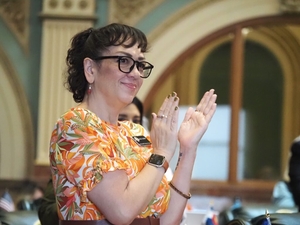
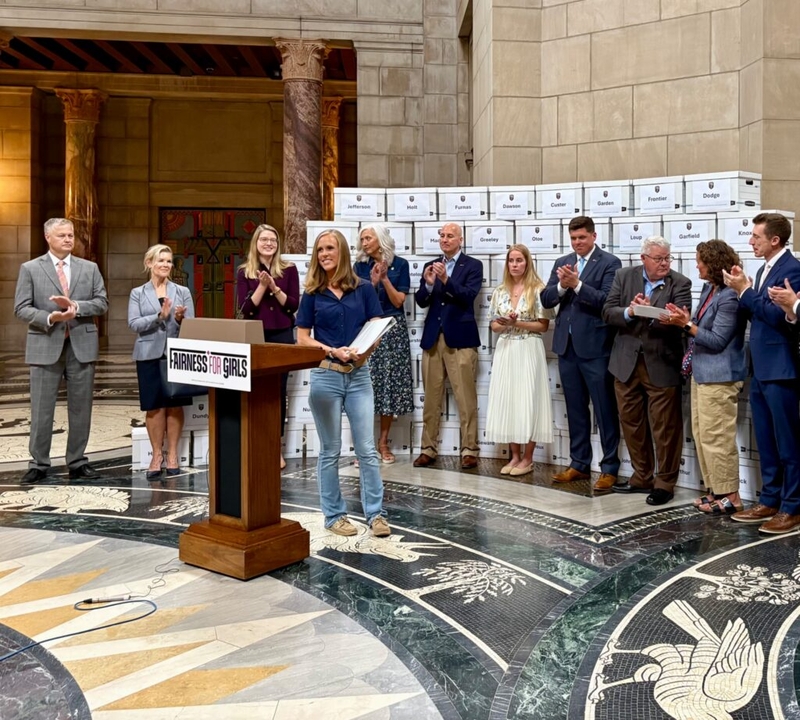
Former State Sen. Julie Slama of Dunbar leads a news conference for the Fairness for Girls campaign that seeks to constitutionally designate sex-separate athletics for K-12 and collegiate sports on June 30, 2026. (Photo courtesy of Julie Slama/Fairness for Girls)
LINCOLN — A Lincoln voter refiled a challenge this week to a ballot measure seeking to cement limits on public school sports participation to student-athletes’ sex at birth after the Nebraska Supreme Court declined to hear the lawsuit.
The case involves the Fairness for Girls campaign and whether language on circulated petitions — the “object statement” — sufficiently conveyed the purpose of the measure to prospective signers. Lincoln voter Cara Ullman asserts the language was too vague — such as not mentioning “schools” — so she signed the measure without fully knowing what it would do.
The challenged statement, which went through the Secretary of State’s Office, reads: “The object of this petition is to amend the Nebraska Constitution to establish constitutional protections for sex-separate athletics to ensure equal access to athletic opportunities for females.”
The Nebraska Supreme Court on Monday declined to take up Ullman’s case.
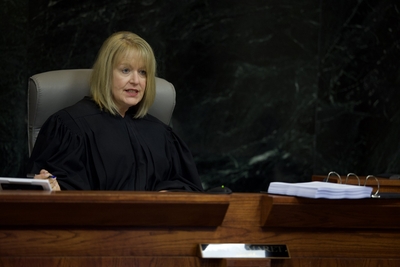
Ullman asks Lancaster County District Judge Lori Maret to prevent Nebraska Secretary of State Bob Evnen from placing the issue on the Nov. 3 ballot. The measure qualified Aug. 28.
The proposal would make permanent part of a 2025 state law requiring public K-12 schools, colleges and universities, and any private schools or colleges in the state playing against those schools, to designate sports and teams as male, female or coed. Male students couldn’t play on female-only teams.
Fairness for Girls would not define “sex” in the constitution. State law defines sex as whether someone “naturally has, had, will or would have, but for a congenital anomaly or intentional or unintentional disruption, the reproductive system that at some point produces, transports and utilizes” either eggs (female) or sperm (male) for fertilization.
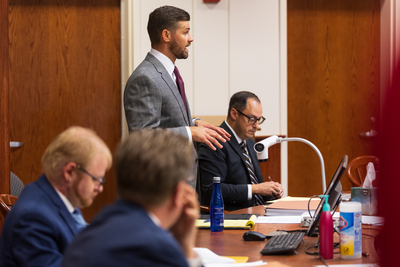
Attorney Sydney Hayes, on behalf of Ullman, told Maret on Friday that object statements and ballot titles are “very similar.” The Nebraska Attorney General’s Office writes the latter — up to 100 words and objectively, according to state law — which go on election ballots.
“These summaries … must contain enough information to sufficiently advise voters of the true contents of the proposed law or constitutional amendment,” Hayes said.
The AG’s Office-approved ballot title would ask voters: “Shall the Nebraska Constitution be amended to provide: (1) Schools must expressly designate each athletic team or sport as one of the following based on biological sex: (a) males, men or boys; (b) females, women or girls; or (c) coed or mixed; and (2) Athletic teams or sports designated for females, women or girls shall not be open to students of the male sex? The amendment would apply to all athletic teams or sports sponsored by public schools or postsecondary educational institutions and private schools or educational institutions whose athletic teams or sports compete against public schools or institutions.”
State Deputy Solicitor General Zach Pohlman, who is defending Evnen, said state law dictates three requirements for object statements, which are different from ballot titles. They must:
- Reveal whether a ballot measure is an initiative seeking to amend the Nebraska Constitution or state law or a referendum seeking to repeal a recently passed state law.
- Assert the object — the purpose, goal or end — sought to be achieved.
- Be concise and printed in large font on each petition page.
“What the object statement is not supposed to be is a recitation or a summary of every provision,” Pohlman said, saying the ballot measure satisfied each requirement.
“The argument that the object statement needs to be at such a granular level of generality to pass muster under [Nebraska Revised Statute] 32-1401 doesn’t make sense,” Pohlman continued. “If a voter wanted to know what the provision did and specifically how before they sign the petition, they could simply flip the petition over and read it for themselves.”
Pohlman cited Nebraska Supreme Court precedent that laws around the people’s “precious” right to initiative should be “liberally” construed. He also said no court has ever withheld a qualifying initiative from the ballot because of a challenge to an object statement.
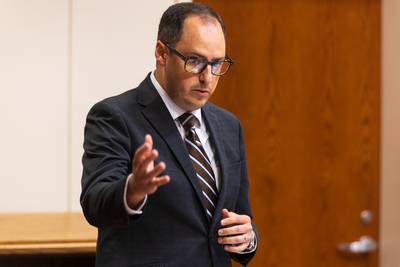
Former state Sen. Andrew La Grone of Dunbar, on behalf of the three sponsors of Fairness for Girls, told Maret that beyond the sponsors’ assertion that they followed the law, they have a First Amendment right to the object statement they supplied. Former state Sen. Julie Slama of Dunbar and University of Nebraska Regent Rob Schafer of Beatrice are two of the sponsors.
“There is no way a state can police the content of that statement,” La Grone said.
Hayes countered that what circulators say to voters after the object statement is not at issue. If La Grone’s proposed subjective standard applied, Hayes said, that could cause issues.
“That creates an open season for vague, incomplete and misleading object statements and makes the initiative less intelligible, not more,” Hayes said.
She said it was “not hard” to imagine hypothetical “simple” object statements, such as to “protect the lives of Nebraskans.” Whether that is for or against abortion or guns, Hayes said, it could be up for interpretation.
She offered a 53-word statement for Fairness for Girls that she said would be better:
“The object of this petition is to amend the Nebraska Constitution to provide that all public schools and postsecondary institutions and private schools and postsecondary institutions that compete against public institutions must designate all athletic teams and sports based on biological sex, and that sports designated for females are not open to males.”
La Grone also argued that under separation of powers, Maret should not insert herself into what is effectively the legislative power of Nebraska voters to amend the Nebraska Constitution.
“The analysis the plaintiff asks this court to undertake is asking the court to determine a political question,” La Grone said.
Maret said she would take the issue under advisement and issue a ruling in writing. Evnen must certify the fall ballot by Friday, Sept. 11.
The general election is Nov. 3.
Lincoln, NE