Alaska appeals court dismisses noncitizen voting case against Whittier woman
Sep 04, 2026 | 6:53 pm ET
Description
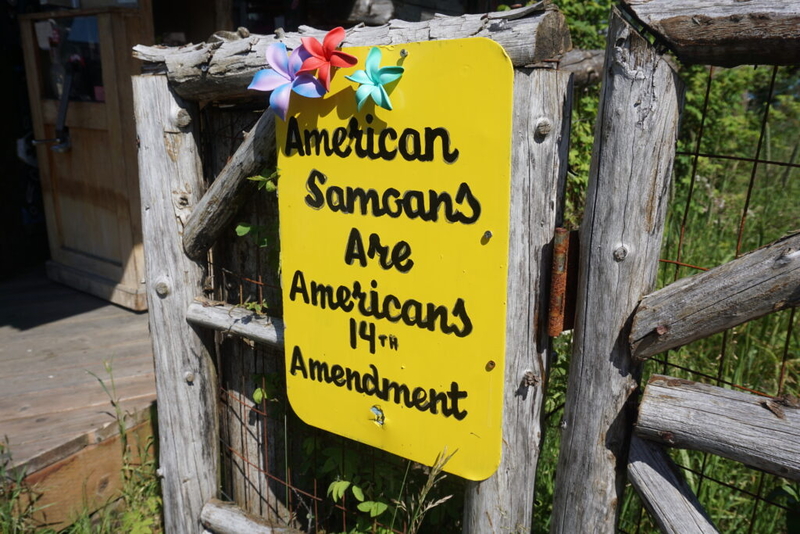
A sign in support of Whittier's Samoan residents is seen outside a harbor on July 17, 2025. (Photo by Yereth Rosen/Alaska Beacon)
A three-judge panel of the Alaska Court of Appeals ruled Friday that state prosecutors misled grand jurors who indicted a Whittier resident for allegedly voting illegally.
Had jurors received accurate information, the court said, “the grand jury likely would have declined to indict.”
Tupe Smith, the plaintiff behind Friday’s decision, is one of 11 people — all American Samoans — whom the state of Alaska has accused of criminally violating state law.
Smith had filed a motion to dismiss the case against her, but a state superior court judge ruled against that motion.
In Friday’s 20-page ruling, the three-judge panel reversed the lower court’s rejection and in the process, it also defined a high standard that prosecutors must meet in order to convict someone of voting illegally in Alaska.
“The state’s prosecution against me and my family has been extremely difficult,” Smith said in a written statement provided by her attorneys on Friday. “I feel vindicated by today’s court decision. But at the same time I worry it will not mean the end of the state’s criminal targeting of the American Samoan community in Whittier.”
A spokesman for the Alaska Department of Law said in a statement that the department is “reviewing the Court’s decision and evaluating our available options for how to proceed.”
That could include an appeal to the Alaska Supreme Court.
If Friday’s ruling stands, it has the potential to affect the cases of the 10 other Whittier residents accused of voting illegally — and any other noncitizen voting cases that arise in Alaska.
People born in the U.S. territory of American Samoa are Americans, but they’re not considered U.S. citizens by law and are thus ineligible to vote in Alaska.
Smith and the other defendants have argued that they were given bad information about whether they could legally vote. As a result, while they intentionally voted, they did not knowingly vote illegally.
Smith ran for and was elected to the local school board in 2022. A subsequent investigation by Alaska State Troopers found she was not a U.S. citizen and thus ineligible to both serve in office and vote in local elections.
Attention on Smith exposed other Whittier residents who had also voted despite being noncitizens.
Smith, who was charged in 2023, was the first defendant to reach trial. The other cases were filed in 2025.
Alaska’s felony voter misconduct law states that someone violates it if they “intentionally” affirm their citizenship falsely. The state’s misdemeanor for the same crime requires “knowingly” making a false statement while applying for voter registration.
State prosecutors argued that “knowingly” and “intentionally” have the same meanings in that context.
Smith’s attorneys argued against that position, saying that “intentionally” requires someone to know that they are wrong and to attempt to deceive officials anyway. Defining the terms differently will prevent people from being prosecuted for innocent mistakes, they argued.
That’s more than a hypothetical.
Since 2022, the Alaska Division of Motor Vehicles has accidentally registered dozens of noncitizens to vote through errors in the state’s motor-voter program.
Some of those people have voted in state and local elections, according to a list obtained by the Alaska Beacon.
If the state’s interpretation of the law was upheld, those Alaskans could also be criminally prosecuted despite believing they were voting legally.
But in Friday’s ruling, the appeals court ruled against the state’s interpretation, writing, “we now hold that ‘intentionally’ for purposes of the voter misconduct statute means something different than ‘knowingly.’”
To make that determination, the appeals court examined related laws that use the two terms for different things going back to 1960, when Alaska lawmakers adopted the original version of the state’s voter-misconduct law.
“Here, the scant legislative history that exists suggests that the legislature intended ‘wilfully . . . swears falsely’ to require purposeful or deliberate action that includes a specific consciousness of wrongdoing,” the court wrote.
In subsequent laws, the 1960 word “wilfully” became “intentionally,” and thus, the court concluded, “the legislature appears to have retained the requirement of a specific consciousness of wrongdoing that is distinguishable from mere knowing conduct.”
Attorney Whitney Brown, who represented Smith in oral arguments in front of the court of appeals, applauded the ruling. “We are delighted for Ms. Smith, whose case has always centered on a simple principle: people should not face felony charges for voter misconduct absent proof that they intended to do something wrong,” she said. “The Alaska Court of Appeals’ opinion faithfully applies the law and provides important guidance on how Alaska’s voter-misconduct statute should be understood in future cases.”
Juneau