Here’s what happened to the late Sen. Graham’s leftover campaign dollars
Sep 04, 2026 | 5:30 pm ET
Description
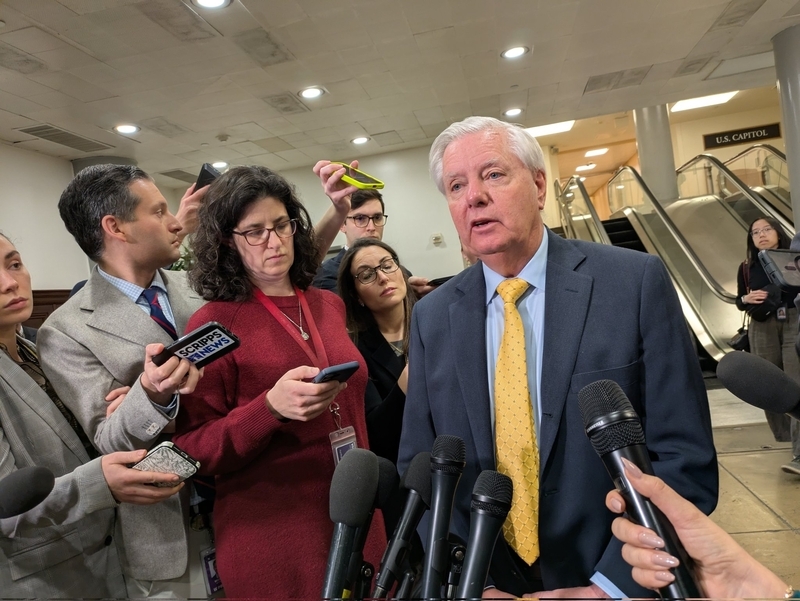
Sen. Lindsey Graham, R-S.C., speaks to reporters at the U.S. Capitol on March 3, 2026. Graham died on July 11, 2026, according to a statement from his office. (Photo by Ashley Murray/States Newsroom)
COLUMBIA — As Sen. Darline Graham prepares to take on Democrat Annie Andrews in November to keep the seat for the next six years, she’ll do so having inherited much of her late brother’s well-funded political machine.
The unexpected death of Sen. Lindsey Graham renewed questions over what happens to candidates’ campaign dollars when they die or drop out of a race.
Following his primary victory over five GOP challengers, his campaign account had $2.3 million available June 30, according to campaign filings with the Federal Election Commission.
His death 11 days later of a ruptured aorta upended all preparations for his re-election to a fifth term and created the first wide-open U.S. Senate contest in South Carolina in 22 years.
On July 24, one week after President Donald Trump publicly urged Darline Graham to enter the race, $500,000 of what was left in her brother’s campaign account was transferred to the National Republican Senatorial Committee, according to its latest filing.
Thanks to a recent Supreme Court decision, that money to the organization committed to electing Republicans to the U.S. Senate is expected to help Darline Graham.
The committee spent one-third of it on her behalf in the first week of her candidacy, as Republicans scrambled to raise money for a special GOP primary held just one month after Lindsey Graham’s death.
She also had the benefit of political action committees long aligned with the late senator, which played a multimillion-dollar role in her ability to secure the GOP nomination, according to political experts.
His fundraising
Over three decades in Washington, D.C., Lindsey Graham rose through the political ranks.
He chaired the powerful Senate Judiciary Committee from 2019 to 2021 and led the Senate Budget Committee from 2025 until his death. And he had the ear of Trump, frequently playing golf with the commander in chief and advising the president on international matters.
“What Lindsey Graham was really good at was reading the political tea leaves,” said Gibbs Knotts, provost and professor of political science at Coastal Carolina University.
Lindsey Graham also showed off his fundraising chops, raking in upwards of $20 million since his previous Senate campaign, according to filings as of June 30. That doesn’t include millions more banked by political action committees prepared to support him through November.
While it’s a fraction of the massive amounts flowing into the top three high-dollar federal races — nearly $90 million total between the Democratic and GOP nominees in Texas, more than $80 million in Georgia and more than $50 million in Ohio — “it’s still a good amount for what had become a pretty safe seat for Lindsey,” Knotts said.
Now, Darline Graham is reaping the benefits, not just in terms of dollars and cents, Knotts said, but of a ready-made campaign and congressional staff that remained intact following her brother’s death, as well as the relationships he built across the state over the years.
A fast-paced election
Following Lindsey Graham’s death July 11, Gov. Henry McMaster appointed Darline Graham to fill out the remainder of her late brother’s fourth term, which ends in January. Then, at Trump‘s urging, she jumped in the race to replace him on the November ballot.
Ten candidates ultimately filed, but they had little time to fundraise or campaign.
As of Aug. 5, a week before the special primary, U.S. Rep. Ralph Norman, ultimately the runner-up, had raised $935,000 — $400,000 of it out of his own pocket — and spent nearly $700,000, election filings show.
U.S. Rep. Russell Fry, who placed third, raised $495,000 but spent little more than $10,000, as of Aug. 5.
Their total fundraising and spending won’t be known until later filings.
Though she was a first-time candidate, Darline Graham didn’t have to start from scratch to take on candidates who’ve been in office for years. Much of Lindsey Graham’s team simply transferred to her campaign, as did many of his backers.
She had access to the $500,000 transferred to the National Republican Senatorial Committee. She also raised $347,000 individually and spent $95,000, filings show.
Filings show the fundraising committee for the Senate Republicans, which is chaired by South Carolina’s now-senior U.S. Sen. Tim Scott, spent $165,000 in coordination with her campaign through the end of July. In addition to the financial support from the committee under his leadership, Scott endorsed Darline Graham ahead of the runoff with Norman.
Darline Graham’s campaign did not respond to questions from the SC Daily Gazette related to this funding.
A change in the law
Under federal law, campaigns can make unlimited transfers to any national, state or local party committee. And thanks to a U.S. Supreme Court ruling last October, party committees can co-spend in coordination with a candidate.
While campaigns could also choose to donate money directly to other federal candidates, those contributions are capped at $2,000 per election. Lindsey Graham’s campaign maxed that out, sending $4,000 total for the special primary and runoff to his sister.
But the high court’s ruling effectively created a workaround to those limits, said Emma Krug, a lawyer with campaign finance watchdog the Campaign Legal Center.
Krug called the Senate race the “first major test of that Supreme Court decision.”
Other options for the money included refunds to donors or donations to charities or nonprofits.
A past example includes U.S. Sen. Jim DeMint, who used his leftover campaign cash to start South Carolina’s Palmetto Promise Institute after he resigned in December 2012 to take the helm of the conservative Heritage Foundation.
Of the millions left in Lindsey Graham’s campaign account, exactly how much is still available to be transferred versus spent on wind-down expenses remains unknown until the next round of quarterly filings.
But there could still be more financial aid to come for Darline Graham leading up to Nov. 3.
As for Andrews, she raised $10.8 million between May 22, 2025, and the end of June. She spent all but $4.1 million of that, according to Federal Election Commission filings.
Outside spending
Darline Graham has benefited from her brother’s fundraising engine in other ways as well.
She took over as sponsor of his leadership political action committee, Fund for America’s Future. And the main super PACs that supported Lindsey Graham quickly pivoted to support his sister.
Darline Graham’s campaign also did not respond to the Gazette’s questions related to PAC funding.
Norman, in his concession speech, lamented the outside dollars that flowed into the race, as well as Trump’s involvement in endorsing Darline Graham.
“We couldn’t come up with that much money,” he told supporters Aug. 25.
The Rock Hill developer entered the Senate race after losing his bid for governor in June, coming in third place for the GOP nomination.
Of the $7.5 million he amassed for that unsuccessful attempt, $5.7 million came from his own pocket, according to campaign filings with the state Ethics Commission.
Over the course of the special primary and runoff, outside groups spent at least $4.9 million to oppose Norman and just $517,000 to support him. Darline Graham, on the other hand, faced just $392,000 in opposition spending and benefited from at least $5 million in outside support, FEC filings show.
“It’s not only about the ability of candidates to raise or spend,” Knotts said. “PACS are another important part of that puzzle.”
Most of the spending — $3.4 million in support of Darline Graham and $4.8 million opposing Norman — came from the Palmetto Action and Security is Strength, which previously spent almost exclusively in support of Lindsey Graham and against his opponents.
Two others, American Mission and Invest in Tomorrow, also were involved to a lesser extent.
Invest in Tomorrow is funded by the clean energy industry and has a history of opposing Republican candidates.
And American Mission’s funding comes largely from artificial intelligence executives.
Trump-aligned MAGA Inc. spent nearly $830,000.
Outside of finances, Norman is trying to distance himself from a suggestion he wanted voters to write in his name on the November ballot.
“Vote for Ralph Norman,” he told reporters Aug. 31 on Capitol Hill, when asked what he would tell an undecided South Carolina voter ahead of November.
Norman’s office later walked back the comment after Republicans blasted the congressman on social media for potentially taking votes away from Graham and helping Andrews flip the seat.
“His remarks the other day were misconstrued after he could not hear the reporter’s question,” a Norman spokesperson told The Post and Courier about the exchange on C-SPAN. “He is not campaigning as a write-in candidate.”
Columbia