Lack of ‘moral outrage’ over Islamophobia is helping normalize religious hate, advocates say
Oct 16, 2026 | 4:41 pm ET
Description
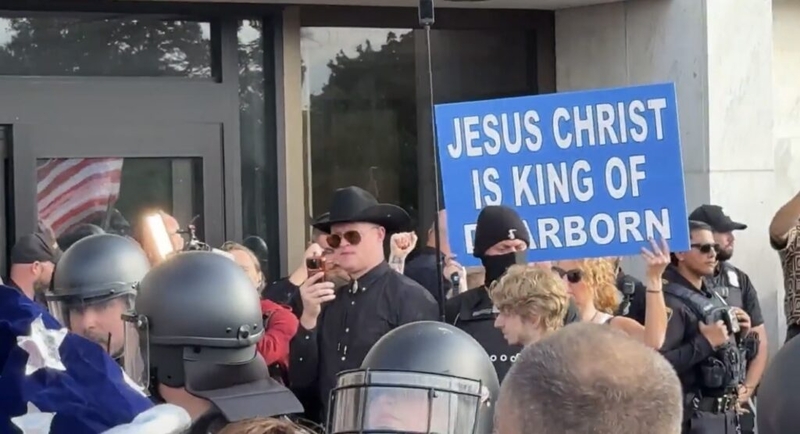
A Christian nationalist protest led by Jan. 6 rioter Jake Lang prompted approximately 2,000 protestors and counterprotesters to gather in front of the Henry Ford Centennial Library in Dearborn on Aug. 18, 2026 (Photo by Tyler Scott/Michigan Advance)
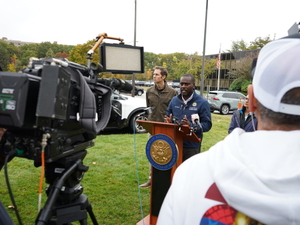
As Democratic U.S. Senate nominee Abdul El-Sayed held a campaign rally in rural Hart, Michigan on the weekend of Oct. 11, he was greeted by interested voters waiting to hear him speak in a part of the state that voted for President Donald Trump in 2024.
Also waiting for him were more than two dozen self-styled Christian “crusaders” carrying crosses, dressed in military garb and calling for El-Sayed to be deported, citing his faith as a Muslim and Egyptian background.
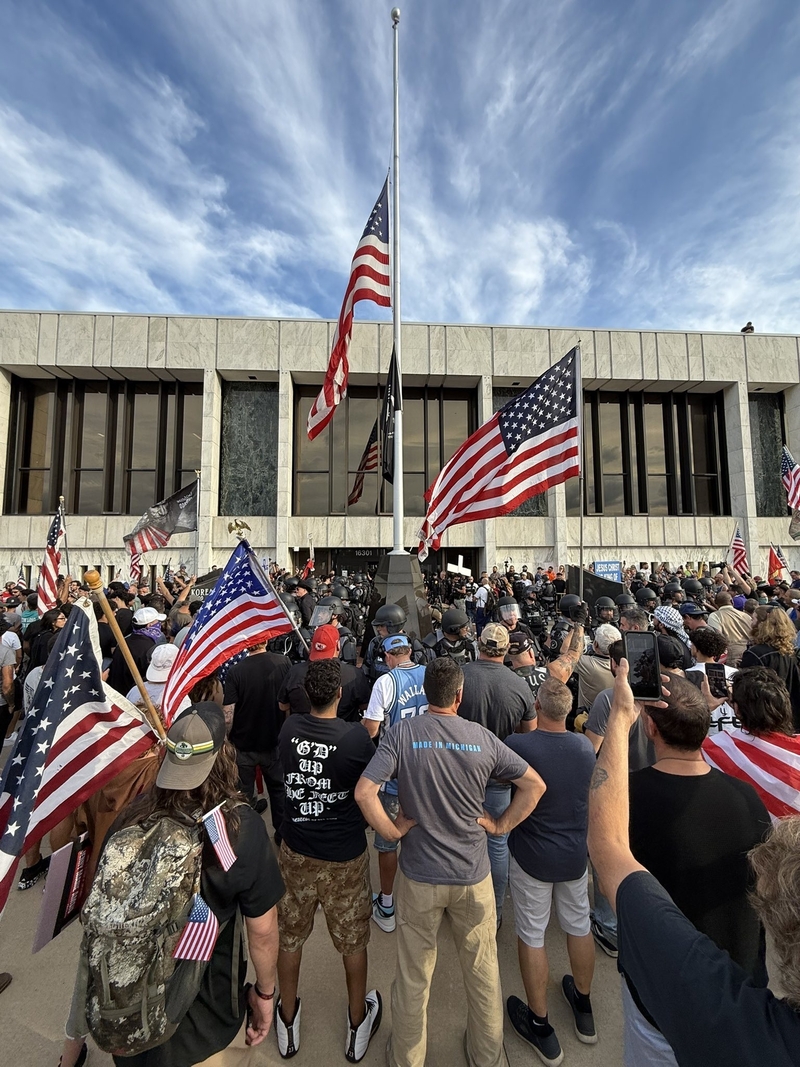
The disruptive protest against El-Sayed was led by far-right agitator Jake Lang, who has organized similar protests, most recently in August with a march in the Muslim-majority city of Dearborn. While Lang’s antics could be characterized as performative activism, several advocates and experts told Michigan Advance that his rhetoric no longer exists in a vacuum of chronically online white nationalist streamers and influencers.
To the contrary, a new wave of Islamophobia has emerged throughout the 2026 campaign cycle from President Donald Trump to sitting lawmakers and candidates. That includes former U.S. Rep. Mike Rogers (R-White Lake), whose campaign has tried to tie him to terrorist movements like the Muslim Brotherhood.
“An organization that supports the Muslim Brotherhood is one of his major funders,” Rogers claimed while speaking to Fox News. “He wrote an op-ed in Arabic a few years back, supporting the Muslim Brotherhood. This guy cannot tell the truth on this.”
Rogers’ campaign surrogates, including the National Republican Senatorial Committee, have repeatedly used El-Sayed’s full name — Abdulrahman Mohamed El-Sayed — in messaging while also circulating reports citing social media posts by El-Sayed’s half-sister in 2012 and 2013 that alleged family ties to the Muslim Brotherhood.
El-Sayed has repeatedly denied those claims, to the Washington Post and most recently to a crowd of supporters in Marquette to “judge me by my actions and my work, but please do not assume that because I might pray differently than anybody who’s ever held this office, that somehow I am not deeply committed to this Constitution,” according to Semafor reporter Nicholas Wu.
“They don’t want to talk about any of the other issues that people are actually experiencing in their lives. They want to talk about me or point to my mom or my sister,” El-Sayed said in Marquette. “My mom and my sister are not running for office. I’m running for office.”
Rogers uses RNC midterm platform to attack El-Sayed as Dems push back against Islamophobic rhetoric
In response to El-Sayed’s comments, and as a reaction to this story, Rogers spokesperson Alyssa Brouillet said that “Mike has been clear: This has nothing to do with how Abdul prays or what his name is–it has everything to do with how extreme his ideologies are.”
“Mike has repeatedly condemned hatred against all religious groups, including against the Muslim community,” Brouillet said. “The same can’t be said about Abdul El-Sayed, who continues to fan the flames of antisemitism, sympathizes with the terrorist attacker who tried to mass murder 140 kids in a Michigan synagogue, and refuses to disavow Hasan Piker, who calls Jews ‘inbred.’’
El-Sayed will be the first Muslim member of the U.S. Senate if he is elected in the November general election. That prospect brings the possibility of historical significance, but with it a deluge of attacks.
In the aftermath of El-Sayed’s win the August primary, the amount of Islamophobic content aimed his way has spiked. The Washington, D.C.-based Center for the Study of Organized Hate found that posts focused on El-Sayed that included anti-Muslim bigotry averaged 155 per day from June 1 to Aug. 3, but then surged to 3,099 a day from Aug. 4 to 10, an increase of 1,900%.

Advocates say Islamophobia has become politically acceptable
For Dawud Walid, the executive director for the Michigan chapter of the Council on American-Islamic Relations, the new turn to what he sees as unchecked Islamophobia is deeply troubling.
“Unfortunately, Islamophobia has become the only socially, politically accepted form of religious bigotry in the United States of America,” Walid told the Advance. “Politicians would be castigated if they made such sweeping generalizations against Christianity or Judaism, but it’s become socially acceptable in America, even to the extent that many Democrats won’t even push back and even speak out against it. It’s not just a Republican issue.”
Yasmin Moll, an associate professor at the University of Michigan specializing in religion, politics and the Middle East, agreed that Islamophobia is a centerpiece of current far-right rhetoric. The left also has a responsibility to push back, she said, if it truly cares about stamping it out.
“We have zero tolerance for anti-Black racism within the Democratic Party, for antisemitism, and that is absolutely as it should be,” Moll said. “And we should have zero-tolerance for Islamophobia. The lack of moral outrage from the opposition is contributing to the normalization of Islamophobia on the right.”
Moll told the Advance that although the current strain of political Islamophobia is alarming, it certainly isn’t new and is a direct evolution of negative media representations for Muslims and people of Middle Eastern and North African descent.
As of 2018, the Pew Research Center reports that there are around 3.5 million Muslim residents in the U.S., about 1.1% of the population. Over the past 50 years, media portrayals of their culture have been largely negative, Moll said, contributing to a predominantly negative image of the minority.
“Oftentimes, the only depiction we see of Muslims in Hollywood films or in TV series is a Muslim who is a terrorist, or a Muslim who is being oppressed, or a Muslim woman who is being oppressed by a Muslim man or a Muslim terrorist,” Moll noted. “Very rarely do we see sort of normal, positive depictions of Muslims as people — complex people. Some are good, some are bad, some are whatever.”
Moll added that when those portrayals become the only information people have about a culture, that lends to a strong bias against them. The same could be said of conservative media transmitting similar messages about political figures or activists, much like El-Sayed, or New York City Mayor Zohran Mamdani and U.S. Rep. Ilhan Omar (D-Minnesota) before him.
Walid said CAIR-MI has tracked polling that shows in 2026, 43% of the American public has negative views of Muslims and Islam. Walid noted that the sentiment saw an almost 20% increase over the past two decades.
What is most troubling for Moll is that the shift in the acceptance of religious bigotry is now coming from the top down.
Following the Sept. 11, 2001, terrorist attacks, Moll said former President George Bush made clear in public remarks that the attackers did not represent Islam or Muslims, and that any military action against the al-Qaida terrorist organization was not a war on Islam.
While that was true, there were instances where others became victims of Islamophobia because they appeared to be Muslims, like Sikhs. Still, many political leaders had been wary to join in the anti-Muslim fervor, Moll said.
A key example of that came during the 2008 presidential election between former President Barack Obama and former U.S. Sen. John McCain (R-Arizona), at a McCain-hosted town hall.
Now, Moll said, it has become mainstream to deploy “a very kind of exclusionary, very dehumanizing rhetoric” and that it wasn’t just coming from “podcasters sitting in their basement.”
“These narratives burrow into and even become unconscious,” Moll said. “People may not even know they’re associating these things, which is why someone like Mike Rogers finds no problem at all releasing political attack ads that very much try to paint Abdul El-Sayed as some sort of dangerous Muslim male.”
On the national scale, U.S. Rep. Randy Fine (R-Florida), who has made Islamophobic remarks from the floor of the U.S. House of Representatives, has called for the deportation of American Muslims.
In the case of Mamdani, during his campaign for mayor in 2025, New York-based politicians on both sides of the aisle used Mamdani’s faith against him as a political cudgel, including Trump but also Mamdani’s independent rival, former New York Gov. Andrew Cuomo.
To Moll’s point, Trump initially framed Mamdani’s progressive policy proposals as coming from “Radical Left Jihadists” without naming him specifically. Trump stopped attacking Mamdani head-on after he met with him in the Oval Office, and the two found common ground on New York issues.
Anti-Muslim activism is finding political allies
With the gate open to accept that type of rhetoric, podcasters and influencers like Lang have found common cause with other political activists with real ties to lawmakers and candidates.
When Lang came to Dearborn earlier this year, he did so in a march co-organized by conservative Pastor Lorenzo Sewell, who is a regular fixture within the Michigan Republican Party. Video taken during that “crusader” march showed Sewell also giving Lang a platform to speak at his church. Lang held a cross as he stood next to Sewell and delivered anti-Muslim invective.
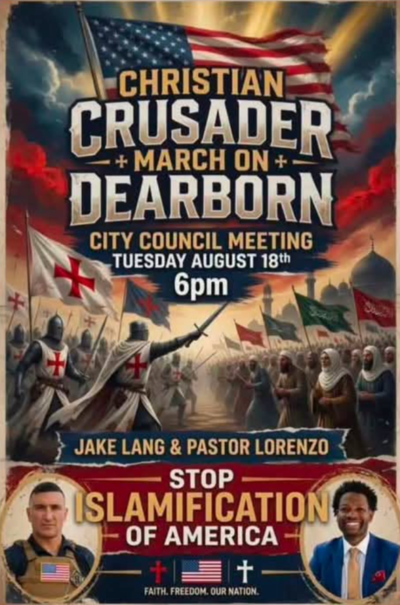
Not only has Sewell given benedictions at Michigan GOP functions, he has also done so at Trump rallies. Some of those rallies have acted as campaign events for candidates like Rogers and U.S. Rep. John James of Shelby Township, the party’s gubernatorial candidate in 2026.
While Rogers’ campaign noted that the GOP nominee condemned Lang’s protest in Dearborn, it has not directly condemned Sewell, who remains a member of Rogers’ Faith Leadership Team.
But it has insisted that El-Sayed’s connections to the Muslim Brotherhood were real based on reporting from the Washington Free Beacon, The Midwesterner, and the New York Post. The campaign has noted that the Free Beacon has reported that his campaign finance records include donations from individuals linked to the Muslim Brotherhood.
Advocates call for a stronger response to religious bigotry
Pamela Shifman is the president of Democracy Alliance, a group of progressive donors focused on building organizing infrastructure for progressive platforms. Shifman has been public in urging progressives to donate to El-Sayed’s campaign. She has also written opinion articles in national publications praising El-Sayed.
Shifman is Jewish, and one of her most recent op-eds was co-authored by Leena Barakat, the Palestinian-American president and CEO of Women Donors Action. Shifman and Barakat wrote that Jews and Muslims need to stand together against antisemitism and Islamophobia, and that El-Sayed’s race was a testing ground.
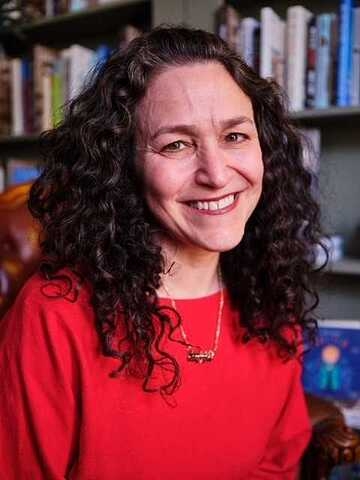
In an interview with the Advance, she agreed with Moll’s assessment that Trump and others, who she deemed White Christian nationalists, have fueled new waves of Islamophobia, but also antisemitism, which she said go hand in hand.
It was her belief that the Republican Party’s turn to Islamophobia was a sign that they have little else to run on other than fear and division.
“Their president is deeply unpopular,” Shifman said. “They have no solutions for the affordability crisis that is facing our country. They have no solutions for the healthcare crisis that is facing our country. They have nothing to offer, so they’re weaponizing Islamophobia because that’s all they have to talk about.”
To the converse, it was Shifman’s belief that El-Sayed, like Mamdani, was running on a much more popular platform, and that the attacks on him being a progressive — with the right trying to paint him as a socialist — and those about his faith were just low-hanging fruit to poke holes in his perceived momentum.
“Discrimination is the oldest trick in the book,” Shifman said. “None of us want this election to be about Abdul’s identity, and we have to forcefully reject hate always, and we have to constantly be calling it out every time it rears its head. Whether it’s anti-Black racism, whether it’s Islamophobia, whether it’s transphobia, whether it’s homophobia, we have to be vigilant about saying this is unacceptable. Full stop.”
Lansing, MI