Unusually high number of independent candidates seek South Dakota legislative seats
Oct 16, 2026 | 6:00 pm ET
Description
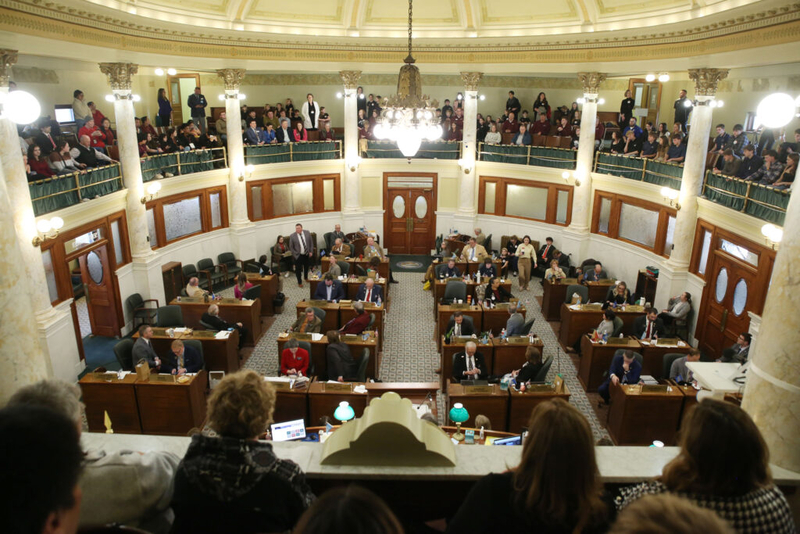
The South Dakota Senate meets on Feb. 11, 2026, at the Capitol in Pierre. (Photo by Makenzie Huber/South Dakota Searchlight)
The Nov. 3 general election could be an independents’ day of sorts for South Dakota.
In addition to independent Brian Bengs challenging incumbent Republican U.S. Sen. Mike Rounds, the state’s legislative contests include 11 independent candidates — the highest number in recent memory.
At least one of those independents is guaranteed a seat in the state House of Representatives. That’s in District 27, a vast area including the Pine Ridge Reservation, where the ballot has four independents and one Republican vying for two House seats.
More than one victory for an independent would mark a historic moment for the South Dakota Legislature.
The last time an independent won a legislative seat in South Dakota was 2010, when Jenna Haggar — who’d later switch to Republican — was elected as a representative for a Sioux Falls-area district.
Prior to that, the last independent to serve was Alfred Burke, a Butte County senator from 1965 to 1972. The last time the Legislature had more than one independent serving at the same time was in the 1920s.
Independent victories this year would further adjust the shape of a Legislature already shaken up by a June primary election that produced the ouster of 16 incumbent Republicans.
The Republican Party will likely remain dominant in Pierre, however.
Fifty-two of the Legislature’s 105 seats are guaranteed to be held by Republicans in 2027, due to a lack of opposition: 21 seats in the Senate and 31 in the House.
In South Dakota, there are more voters registered as independent or “no party affiliation” than as Democrats. Republicans have the highest numbers.
Advance voting is underway for the general election, and the voter registration deadline is Monday.
Partisan divide inspires some candidates
Neal Tapio is a former Republican state senator from Watertown who’s running as an independent to serve the same district as a state representative. Tapio said he still aligns with the Republican Party on most issues, but he’s come to see partisanship as a corrosive force.
“As you go through life, you realize that the country is just going more and more in the wrong direction, and it seems like partisan politics has gotten so bad that Republicans and Democrats don’t even talk to each other,” said Tapio. “The only thing they do is demonize each other.”
Tapio faces Republican incumbent Matt Roby and Republican former Rep. Byron Callies in a race for the district’s two House seats.
Joe Flood, a Massachusetts native who’s lived in Manderson on and off for two decades, is an independent running for a House seat in District 27. That race for two seats includes Flood, Republican incumbent Rep. Liz May of Kyle, and three other independents.
Flood has always been registered as an independent, and said he’s approached politics with an independent mindset. He wants to work for his constituents, he said, not a party, even if party support might offer a hand up in an election.
The Harvard University graduate, author and educator said the major parties have done more to cheapen the discourse than earn his allegiance in recent years.
“I don’t think either party has covered itself in glory,” Flood said.
Path to independence differs
Tapio and Flood are among the independent candidates who told South Dakota Searchlight they’d always planned to run as independents. For others, running as an independent was the byproduct of missing the deadline for certification to appear on the primary ballot. For one, it was the result of a challenge to her nominating petitions. To get on the ballot, prospective legislative candidates need petition signatures from dozens of registered voters in their district, with the exact number depending on the party and the location.
Rep. Peri Pourier, R-Rapid City, who is term-limited in the House, is on the ballot for Senate in District 27 as an independent. She’s running against Democrat Celestine Stadnick and Republican Anthony Kathol.
Democratic voter registration falls behind ‘other’ category in South Dakota
Pourier was serving as a Democrat when she announced her decision to switch to the Republican Party in 2025.
She initially filed to run in the June Republican primary, but filed her petitions late. Pourier ultimately opted to re-collect signatures for the later deadline to run as an independent.
She is still registered as a Republican, and said that if elected she would caucus with that party in the Senate. In a message to Searchlight, Pourier said she wants to be “up front about that,” but added that her status as an independent also reflects how she’d approach the job.
“What I offer is independent judgment, eight years of experience, and relationships that help me get work done,” she wrote.
Pourier’s Republican opponent, Anthony Kathol of Martin, challenged the validity of nominating petitions for Celestine Stadnick in the district’s Senate race and Elizabeth Lone Eagle in the House race.
In arguments that have reached the state Supreme Court, Kathol alleged inconsistencies between the candidates’ addresses as registered voters and those used on their petitions. He also argued some signers of Stadnick’s petition listed their county as “Oglala County” instead of “Oglala Lakota County,” which Kathol said ought to disqualify the signatures.
The secretary of state threw out some signatures, but a circuit court ruled Stadnick, a Democrat, had enough valid signatures; the Supreme Court has yet to rule on Kathol’s appeal in that case.
His challenge to Lone Eagle’s petitions to run as a Democrat, grounded in similar issues, was successful. Lone Eagle was able to regather signatures and submit them to run as an independent. Lone Eagle told Searchlight that she aligns politically with Democrats, and would caucus with them if elected.
Lone Eagle and Evangeline Poor Bear, who told Searchlight she’s a Republican and missed the March 31 filing deadline and therefore decided to run as an independent, are joined by Flood and Jay Yohner as independent candidates for the House seat in District 27.
Rapid City race
Samuel Hare Sr. of Rapid City considered running as a Democrat and said he received encouragement to do so, but decided to stay independent.
Nicole Uhre-Balk, who’s running for reelection as a Democratic representative for District 32, said Hare had suggested he run alongside her as a Democrat this spring, but she said “it becomes a little more challenging to know if we fully align on all the issues” with Hare running as an independent.
“It’s good for voters to have choices,” Uhre-Balk said, but “it’s a crowded race, for sure.”
In 2024 in her race for one of the district’s two House seats, Uhre-Balk asked people to “vote one, vote Nicole, because I was the only Democrat,” but “I’m not doing that this year.”
“There are some people who think that really helped me, there’s some people who think it was all the doors that I knocked on,” Uhre-Balk said.
The other two candidates in the race are Republican Rep. Steve Duffy and Republican Zachary Martin.
Independent in Dell Rapids
Independent Bryan Breitling, like Tapio, has served in the Legislature before.
When he was still living near Miller, Breitling successfully challenged then-Speaker of the House Spencer Gosch in the 2022 Republican Senate primary in District 23.
Republican voters once again opt to oust incumbents from South Dakota Legislature
Breitling began what would become a permanent move to Dell Rapids in 2023, into District 25, before his term had ended. He did not run for reelection in 2024.
District 25 Republican Sen. Tom Pischke took issue with Breitling’s residency prior to the 2024 session, but then-Senate President Pro Tempore Lee Schoenbeck dismissed those concerns, telling the Aberdeen Insider that Breitling “meets the minimum residency requirements.”
Breitling said he’d been encouraged to run against Pischke this spring, but that the window to register for the primary was too short by the time he decided to do so.
“I’m a Republican running as an independent,” said Breitling. “That’s what I tell people when I’m knocking on doors.”
Breitling said his views diverge from Pischke’s on issues like education and economic development, and that he hopes to bring a more moderate, cooperative voice to Pierre.
Pischke had no primary challenger. Shortly after the primary, though, he was charged with two felony counts of filing a forged or false instrument for allegedly signing and submitting candidate nominating petitions for county party precinct positions without those candidates’ knowledge.
The Minnehaha County Republican Party chairman, who’d clashed with Pischke, said he suspects Pischke was trying to add precinct officials to make it more difficult to conduct party business.
Pischke dropped out of the race over the summer.
The county party replaced him with Bart Sample, a former Flandreau City Council member who finished third in a four-way Republican primary race for District 25 House in June.

Pierre, SD