Kansas Democrat’s campaign manager created website with documents used in attack on political rival
May 29, 2026 | 2:57 pm ET

Description
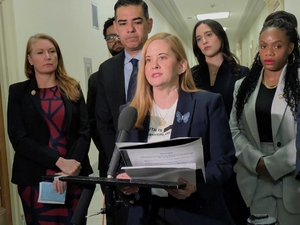
Kansas Sen. Patrick Schmidt, D-Topeka, talks to reporters during a May 27, 2026, news conference at the Statehouse in Topeka. (Photo by Sherman Smith/Kansas Reflector)
TOPEKA — Kansas U.S. Senate candidate Patrick Schmidt’s campaign manager left his digital footprint on documents uploaded to a website that linked a political rival to complaints about how he handled reports of child sex abuse.
The website appeared hours after a similar-looking one featuring Adam Hamilton’s name and photo at the top disappeared, which Schmidt denied being associated with.
Schmidt and Hamilton are among 11 Democrats who have announced a run to secure the nomination to challenge Republican incumbent U.S. Sen. Roger Marshall. Hamilton has been considered the Democratic frontrunner since he declared in early May.
Schmidt, a state Senator from Topeka, went public with accusations Wednesday, calling for Hamilton to withdraw from the race. Schmidt claimed Hamilton, pastor of the Kansas City-area United Methodist Church of the Resurrection, didn’t do enough to protect children who suffered abuse at the hands of a church youth camp volunteer in 2005 and 2006.
A website, corcoverup.com, featured Hamilton’s photo and name, along with case files, trial transcripts, news reports and a timeline of Scott Preston Moore’s abuse beginning in 2005. Following Schmidt’s press conference Wednesday, the website was taken down, and within hours, a new one cropped up, cordocumentsks.com. It contained many of the same documents but did not feature Hamilton’s photo or name.
Upon reviewing metadata contained within the second site’s documents, Kansas Reflector found Schmidt campaign manager Ryon Carey’s name associated with at least seven of the 18 documents, indicating he uploaded those to the site. When reached by text Thursday, Carey said he “created cordocumentsks as a place to house the documents.”
“I broke a few down into smaller pieces so they would upload to the site, and even that wasn’t enough as the site crashed,” Carey said.
The site was offline by Wednesday evening.
Carey and Schmidt’s campaign denied any involvement in the first website. The second website did not appear to feature a “paid for by” disclosure from Schmidt’s campaign. Political committees must under federal election law include a disclaimer in most public communications.
Schmidt’s claims at the Wednesday press conference relied upon a voluminous, decade-old court record about the church’s handling of recurring sexual abuse, but some of Schmidt’s accusations couldn’t be corroborated in court documents.
The court record shows that church officials dismissed teenage boys’ initial complaints about a man who snuck into their cabin rooms at a 2005 church youth camp. Lee Jost, former pastor of student ministries at Church of the Resurrection, gave a sermon at the youth camp that discouraged the boys, without naming them, from discussing their concerns about someone entering their rooms and touching them, according to 2013 court transcripts.
An internal investigation was inconclusive because the boys couldn’t “positively identify” Moore, according to court documents.
Schmidt called the internal investigation by two church leaders “a sham.”
Moore returned as a camp leader in 2006 and again entered teenage boys’ rooms. At that point, the church reported both incidents to law enforcement in Linn County, where the camp was held, according to court documents. The Linn County prosecutor declined to pursue charges against Moore, according to court records.
Tyson Brody, a spokesperson for Hamilton’s campaign, said the church began updating its volunteer and staff policies following the initial incident in 2005.
“In 2006, when students reported another allegation, the church called law enforcement, and Adam was personally in contact with them,” Brody said.
Also in 2006, the church barred Moore from having a role in the church, flagged him to the United Methodist Conference and notified the Boy Scouts of America, where Moore also volunteered, Brody said. Moore had passed the church’s criminal background checks at the time, the campaign said.
A man who had moved away from Kansas visited Hamilton in 2010 upon hearing rumors about Moore’s abuse and shared that Moore sexually abused him as a young child in 1979, court documents said. Hamilton encouraged the man to tell law enforcement, even though the statute of limitations on the case had expired.
Moore was convicted in 2013 in Johnson County of a misdemeanor count of sexual battery for a separate incident, which occurred when his child’s friend was at the Moore house for a sleepover, and the church youth camp incidents were used as evidence in the case. Moore died in 2015, when he was found unconscious in a family member’s home hours after police found him half-naked in the back of a car with a teenage boy.
Brody said the church developed its volunteer and staff screening and training policies over the years, and they eventually became the Safe Gatherings program, a widely used curriculum that requires staff and volunteers to pass multiple criminal background screenings, clear reference checks and undergo a two-hour ethics training.
Schmidt maintains that Hamilton “failed to prioritize the safety of children”
“On his watch, young boys were intimidated into silence. His leadership allowed a known predator, Scott Moore, to return to a position of trust, facilitating subsequent abuse,” the campaign said Thursday in a statement.
Brody declined to comment on whether Hamilton was considering legal action or a federal elections complaint against Schmidt.

Topeka, KS