Litigation looms as Louisiana Legislature approves new congressional map
May 29, 2026 | 2:45 pm ET
Description
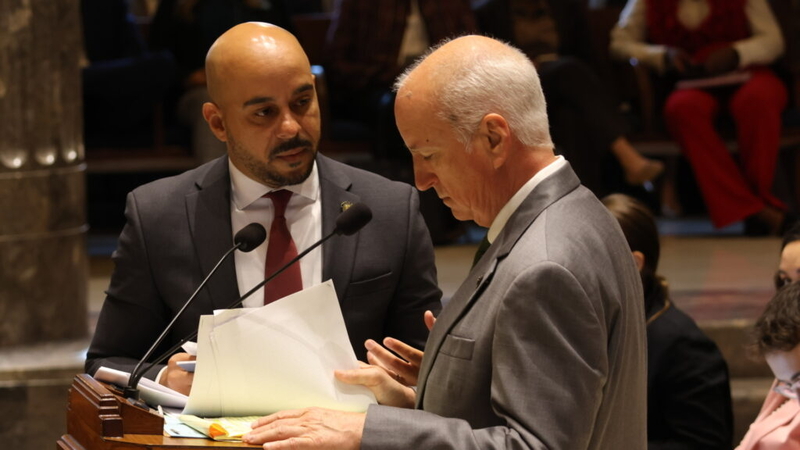
Sen. Royce Duplessis, D-New Orleans, left, questions Sen. Jay Morris, R-West Monroe, in the Louisiana Senate chamber on the congressional redistricting map Morris sponsored to eliminate one of Louisiana's two majority-minority districts in the U.S. House. Republicans in the state Senate approved the bill Thursday, May 14, 2026, in a party-line vote. (Photo by Wes Muller/Louisiana Illuminator)
Louisiana legislators gave their final approval Friday to a congressional redistricting bill that increases the state’s Republican representation in Congress, but litigation from both sides of the aisle is likely imminent.
On a party-line 28-10 vote, the state Senate gave its OK to the final version of Senate Bill 121 by Sen. Jay Morris, R-West Monroe. It keeps only a single majority-Black district among Louisiana’s six U.S. House seats. By eliminating the second Black district the legislature created two years ago, Republicans would gain another probable win in their bid to maintain control of Congress in this fall’s midterm elections.
The majority-Black district retained in Morris’ bill is essentially the same one U.S. Rep. Troy Carter, D-New Orleans, won in 2022. The map removes the Black-majority district U.S. Rep. Cleo Fields, D-Baton Rouge, holds
Gov. Jeff Landry signed the bill into law a few hours after it passed.
Though Republicans in the Louisiana Legislature are largely behind Morris’ bill, the conservative white voters who sued over the 2024 version with two majority-Black congressional districts oppose Morris’ plan, as it keeps one majority-Black seat. They filed another lawsuit Tuesday that argues the new map also relies on race for the lone remaining district that favors Democrats.
Members of the Louisiana Legislative Black Caucus have also indicated they plan to explore litigation against the map, which its members described as racist.
“How many racist acts can you participate in until you yourself are considered racist?,” Louisiana Legislative Black Caucus chair Rep. Edmond Jordan, D-Baton Rouge, asked House members.
Sen. Royce Duplessis, D-New Orleans, said he was frustrated Louisiana would likely continue to spend millions of dollars to defend maps that are likely to be struck down.
“This is a vicious, vicious race to the bottom, and I believe that SB 121 even after these amendments, only accelerates that race to the bottom for us as a country,” Duplessis said.
Throughout the committee and floor debates on the bill, Morris and Rep. Beau Beaullieu, R-New Iberia, who carried the bill in the House, described the map as racially neutral.
Morris and Beaullieu said they disregarded race and only considered party when drawing districts, with the end goal of increasing the state’s Republican representation in Congress. Morris said he did not think it was possible to draw a map that put six Republicans in power because it might result in only four being elected.
Before Friday’s final vote on his bill, Morris faced questions from Democrats who raised concerns that completely ignoring race could lead to an unintentional racial gerrymander.
This penultimate step to overhaul the state’s congressional makeup comes a month after the U.S. Supreme Court declared Louisiana’s existing U.S. House districts an unconstitutional racial gerrymander. The 6-3 decision from conservative justices in the case Louisiana v. Callais has prompted Republican leaders in Southern states to adjust their congressional maps as well.
The day after the Supreme Court ruling, Republican Gov. Jeff Landry suspended Louisiana’s U.S. House party primaries, which would have taken place May 16, to give lawmakers enough time to adopt new maps for the 2026 midterm elections.
Earlier this month, lawmakers approved a bill to reschedule the primaries for Nov. 3. Instead of holding semi-closed party primaries as originally planned, Louisiana will instead revert to a jungle primary in which candidates of all parties appear on the same ballot. Any runoffs needed would take place Dec. 12.
The qualifying period for the November U.S. House elections is Aug. 5-7, meaning candidates who signed up in February for the May 16 elections will have to qualify again if they still choose to run.
The bill moving the election date to November also voids any ballots already cast in the U.S. House primaries. More than 42,000 people returned absentee ballots before Landry suspended the races. Secretary of State Nancy Landry said she was unable to remove the House races from the ballots for the May 16 election, so tens of thousands of others were able to vote in those elections during the early voting period.
Another provision in the bill will hide the number of voided ballots cast in the House races from public disclosure. Those details were added to the legislation in a closed-door meeting and adopted by both chambers over the course of an hour without an opportunity for public comment.
Baton Rouge, LA