Justices consider state Democrats’ challenge of 2025 appointment to WV House seat
Sep 22, 2026 | 3:59 pm ET
Description
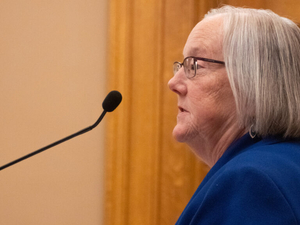
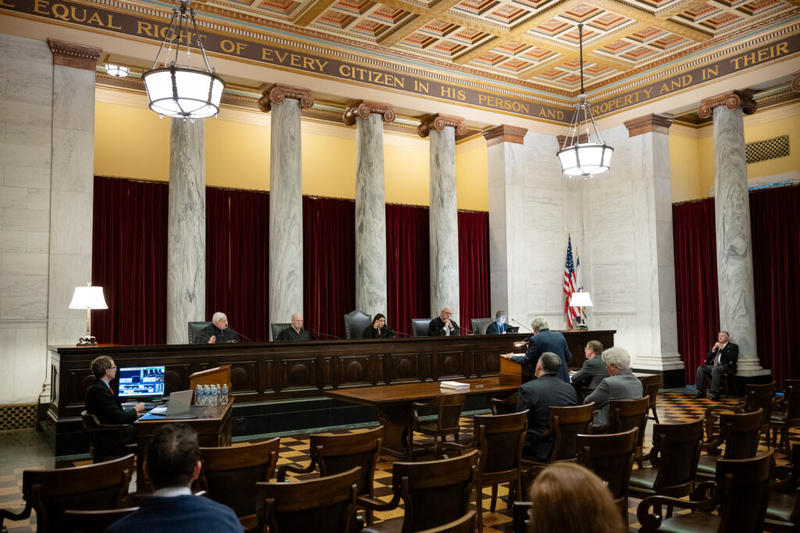
Bob Bastress, an attorney for Democratic Party Chairman Mike Pushkin, makes his case before the West Virginia Supreme Court in Charleston, West Virginia, on Tuesday in Pushkin’s challenge over the appointment of a GOP lawmaker early last year. (Photo by J. Alex Wilson/Supreme Court of Appeals of West Virginia)
Questions from West Virginia Supreme Court justices on Tuesday seemed to indicate that state Democrats face an uphill battle in their challenge of a GOP appointment to the House of Delegates last year to replace the man elected after he was charged with making violent threats towards other members.
The high court has not rendered a decision in the case.
“Counsel, so there is some discussion of whether or not this case is moot,” Chief Justice Haley Bunn asked Bob Bastress, an attorney representing state Democratic Party Chairman Mike Pushkin. “And as we sit here today, we are on the precipice of another election here in a little more than a month. Would an election moot this case? Is it moot already?”
“Well, first we’re not there yet. So my first response on mootness is there’s still time left in the term, which is under dispute in this case,” Bastress replied. “Second, I would say that, particularly on the constitutional question, it is certainly capable of repetition.”
Pushkin, also a delegate, filed the petition in January 2025 against Gov. Patrick Morrisey and House Speaker Roger Hanshaw, R-Clay after Morrisey appointed Del. Ian Masters to fill the 91st House District seat, representing Berkeley County. A previous petition with the same argument was dismissed because the Supreme Court said the Democrats failed to give a 30-day notice of suit required by those who sue a government agency.
Joseph de Soto was elected to the seat as a Republican in the November 2024 election. He was arrested the next month and charged with making threats to harm or kill Republican lawmakers. De Soto switched his party affiliation to Democrat shortly before he was arrested.
The House of Delegates passed a resolution Jan. 8, 2025 vacating de Soto’s seat. The resolution said that de Soto’s status on home confinement and at least two protective orders filed by lawmakers barring him from the state Capitol would make him unable to take the oath of office in the Capitol as required. It referred the appointment to the Berkeley County Republican Executive Committee to submit nominees to Morrisey for the appointment.
In the lawsuit, attorneys for Pushkin questioned whether the House of Delegates acted legally when it vacated de Soto’s seat. They argue that state law at the time required the appointment be made from the Democratic Party because de Soto was a registered Democrat before the vacancy.
Since then, state law about appointments has changed. Lawmakers last year approved Senate Bill 586, Democrat-sponsored legislation that requires that when filling vacancies of state officials, justices, judges and magistrates, appointments be made from the same party that originally held the seat at the time of election, not the party to which the official may have switched to before he or she resigned.
If the Supreme Court were to decide the case Tuesday in Pushkins’ favor, it could lead to the party filling the seat with about three months left in the two-year term. A new candidate will be elected during the November general election, about one month away.
Michael Williams, an attorney representing Morrisey and Hanshaw, argued that state law prohibits the Supreme Court from second-guessing the Legislature about the qualifications of potential lawmakers. Even if the court could review lawmakers’ decision, the governor was right to appoint a Republican, he said.
“Because Mr. de Soto never took the oath, he never held the office,” Williams told justices. “So even under the version of the statute that petitioners rely on, the seat was last held by a Republican, and so the governor was right to fill it with a Republican.”
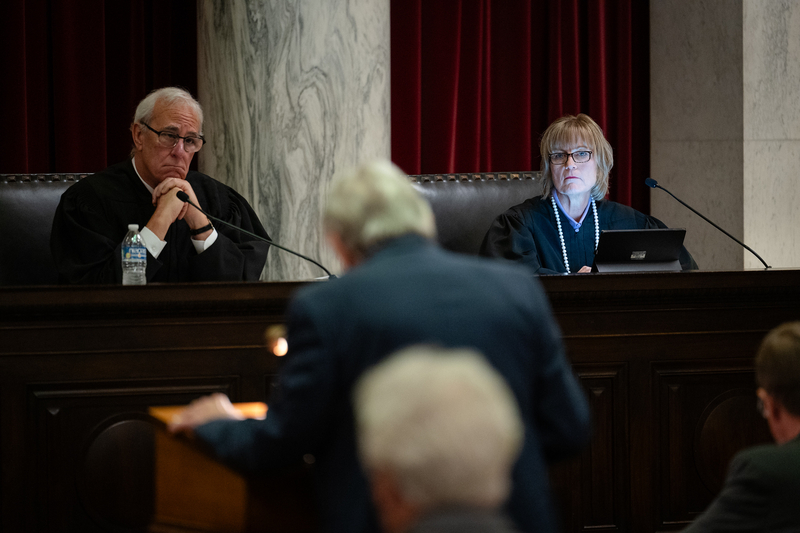
Newly elected Justice Bill Flanigan — who was a Republican delegate when the House approved the resolution removing de Soto from office with a voice voice — recused himself from hearing the case. Retired Justice Beth Walker sat in Flanigan’s place.
Pushkin said Tuesday that Democrats had filed the lawsuit immediately after the “illegal appointment” was made. He said Hanshaw, Morrisey and the Republican supermajority have delayed the case and are now trying to “deny justice to the people in the 91st House district.”
“The point is, there are rules and procedures for removing someone from the Legislature, and they did not follow those rules,” Pushkin said. “They created the vacancy, and they did not follow the rules when they filled the vacancy.”
“The reason (the case) is still important is because of the dangerous precedent that it would set if the Legislature is allowed to illegally create a vacancy through a simple majority vote to overturn the will of the voters,” Pushkin said. “It should require a two-thirds vote, the same as an impeachment.”
Morrisey and Hanshaw did not comment on the case Tuesday.
Charleston, WV