Journalist Georgia Fort, who filmed ICE protest in church, seeks dismissal of federal charges
Aug 06, 2026 | 7:42 pm ET
Description
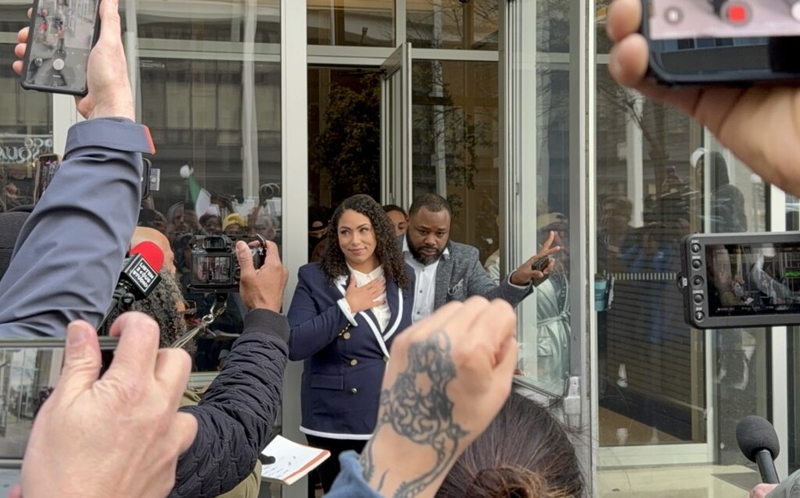
Journalist Georgia Fort leaves the federal courthouse in downtown St. Paul on Feb. 17, 2026 after pleading not guilty to felony charges stemming from her coverage of a protest at a church. (Photo by Max Nesterak/Minnesota Reformer)
Independent journalist Georgia Fort is asking a judge to dismiss the federal charges brought against her after she livestreamed a protest inside a St. Paul church, arguing the prosecution violates her First Amendment rights and accusing the Justice Department of “vindictive prosecution.”
Fort was indicted alongside three other journalists — including former CNN anchor Don Lemon and his producer Michael Beute — and 34 activists for their involvement in a Jan. 18 protest against President Trump’s immigration crackdown inside Cities Church, which employs a pastor who is an official with U.S. Immigration and Customs Enforcement.
The federal government makes no distinction between journalists and protesters in bringing the two charges: felony conspiracy against the right of religious freedom at a place of worship and a misdemeanor count of injuring, intimidating and interfering with the exercise of right of religious freedom at a place of worship.
The federal charges against journalists — sought by the highest ranks of Trump’s Justice Department — represent an attack on the free press that has alarmed journalists nationwide and led a career prosecutor assigned to the case to quit in disgust.
In three motions filed on Thursday, Fort’s attorneys asked a judge to dismiss the charges, arguing that Fort’s actions are protected by the First Amendment; that prosecutors failed to allege any facts that constitute a crime; and that the government has gone to extreme lengths and “manipulated the law” to target her in an illegal act of “vindictive prosecution.”
“All of the evidence in this case points to the government prosecuting Fort precisely because she is a journalist, and in particular because she engaged in that constitutionally sacred work to amplify a message with which the government vehemently disagrees,” Fort’s attorneys write in a motion seeking dismissal.
Fort has spent nearly 20 years as a journalist, winning several awards — including three regional Emmys — for reporting that often focuses on police brutality. She is also the founder of BLCK Press and the Center for Broadcast Journalism, and has press credentials from both state and federal courts.
The church demonstration was organized nearly two weeks after an immigration agent killed Renee Good, leading to widespread protests. The demonstrators took issue with the church employing an ICE official, David Easterwood, because they found ICE’s tactics irreconcilable with Christian teachings.
The demonstration drew the ire of President Trump and then-Attorney General Pam Bondi said, “We are coming after you if you participated in that. I don’t care if you’re a failed CNN journalist, you have no right to do that in this country. We don’t live in a third world country.”
But the Justice Department struggled to bring charges against Fort, Lemon and some of the demonstrators.
U.S. Magistrate Judge Douglas Micko initially rejected charges against Fort, and then-Chief Judge Patrick Schiltz and the 8th Circuit Court of Appeals declined the government’s appeals, leading prosecutors to pursue a series of legal maneuvers to secure grand jury indictments instead.
Fort was not able to turn herself in and instead was arrested by federal agents at her home in front of her children, which she livestreamed.
Fort’s attorneys at Ballard Spahr, including a former federal prosecutor, say allowing the prosecution against her to proceed would have a chilling effect on journalists, noting that Fort has already had to curtail her reporting as she mounts a defense.
Fort’s attorneys suspect federal prosecutors erroneously told the grand jury that Fort participated in protest chants to help secure an indictment. In at least 15 search warrants — including for Fort’s work product — the federal government falsely said she chanted along with protesters despite ample video evidence to the contrary.
Prosecutors later conceded Fort did not chant, and the judge has taken the unusual step of reviewing the grand jury transcript, which is typically sealed.
The case has been beset by a series of errors by prosecutors, detailed by the New York Times, which reported 29 defendants were offered a deal to plead to just one misdemeanor. (Fort was not among those offered a deal, according to her attorney.)
Federal prosecutors allege that Fort, Lemon and his producer stood close to the church pastor “in an attempt to oppress and intimidate him,” and that she blocked a minivan from leaving outside the church as she interviewed Nekima Levy Armstrong, a protester and longtime Twin Cities civil rights activist.
But Fort’s attorneys say video evidence contradicts those claims.
Fort’s interaction with the pastor, Jonathan Parnell, amounted to holding a microphone to his mouth as he answered questions from Lemon about the demonstrations. Video also shows Fort interviewing Armstrong in front of a minivan, but it was able to back out without issue.
In sum, what Fort did was journalism, her attorneys write: “Fort was invited into a space open to the public, observed events, video recorded them, conducted interviews, asked questions of key players, sought to include a range of perspectives, and conveyed the information she gathered to her online audience in real time.”
Fort’s attorneys accuse the federal government of targeting Fort for her perceived viewpoint and the topic of her coverage, noting that some parishioners also broadcast the protest inside the church. They also point to incidents in which the federal government encourages favorable coverage of immigration enforcement, noting that federal law enforcement agents interrupt church services and other church functions.
“If the First Amendment is to mean anything, it must halt the government’s prosecution against Fort for doing precisely what it protects: covering and reporting on newsworthy events,” Fort’s attorneys write.

Saint Paul, MN