Indiana risks missing out on millions in federal mental health funding as deadline nears
Nov 24, 2026 | 3:16 pm ET
Description
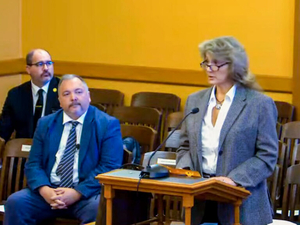
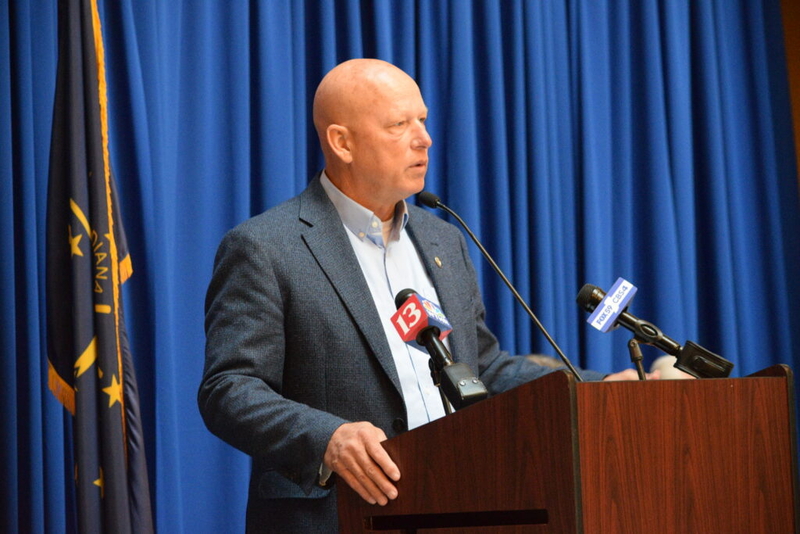
Republican state Sen. Michael Crider, of Greenfield, speaks at the Indiana Statehouse on Tuesday, Nov. 24, 2026, about the need to expand Indiana's Certified Community Behavioral Health Clinic program. (Photo by Casey Smith/Indiana Capital Chronicle)
Indiana mental health providers are urging Gov. Mike Braun to expand a federally backed behavioral health program before a December deadline, warning that the state is already missing out on millions of dollars in funding that could improve access to care.
The push comes more than three years after Indiana lawmakers committed $100 million to overhauling the state’s mental health care system and nearly two years after eight community mental health centers began participating in a federal Medicaid pilot program intended to improve access to mental health and addiction treatment.
Those eight centers cover 35 of Indiana’s 92 counties. Providers want to extend the program to the remaining 57.
Doing so could bring Indiana an estimated $55 million annually in additional federal Medicaid matching dollars, said Zoe Frantz, president and CEO of the Indiana Council of Community Mental Health Centers.
The state would still be responsible for a portion of the Medicaid costs, but the enhanced federal match reduces Indiana’s share. It’s unclear how much additional state funding, if any, would be needed to expand the program statewide.
“This is not about a provider getting rich,” Frantz said. “This is about a provider providing services to those who need it most.”
This is not about a provider getting rich. This is about a provider providing services to those who need it most.
But the state must submit paperwork to federal officials by Dec. 1 to move forward with a Jan. 1 expansion.
Neither the governor’s office nor the Indiana Family and Social Services Administration responded to the Indiana Capital Chronicle’s requests for comment Tuesday.
Indiana’s 22 community mental health centers collectively serve 375,000 Hoosiers across all 92 counties, but only eight participate in the federal Medicaid pilot program, formally known as the Certified Community Behavioral Health Clinic (CCBHC) demonstration.
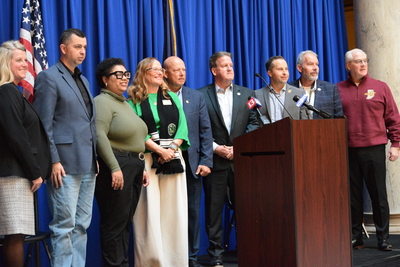
“From my perspective, it would just be a tragedy for us to not continue moving forward,” said Republican state Sen. Michael Crider, of Greenfield, who joined mental health care providers, local government officials and law enforcement representatives at the Indiana Statehouse on Tuesday. “We will not achieve what the collective goal is any other way.”
Millions in federal funding at stake
Indiana lawmakers laid the groundwork for the state’s current behavioral health system in 2023 with the passage of Senate Enrolled Act 1, authored by Crider.
The legislation sought to establish a statewide system in which Hoosiers experiencing mental health emergencies have someone to call, someone to respond and somewhere to go for treatment. Those three components are the state’s 988 suicide and crisis hotline, mobile crisis response teams and crisis stabilization units.
Lawmakers appropriated $50 million annually in the 2023 state budget to get the system off the ground. That fell short of the roughly $130 million in annual funding the Indiana Behavioral Health Commission had recommended to support a fully developed crisis response system.
Under the CCBHC model, participating clinics receive Medicaid reimbursements based on the anticipated cost of providing comprehensive care rather than relying solely on payments for individual services.
The pilot program provides Indiana with enhanced federal Medicaid matching funds and was intended to help the state expand the model statewide and establish a sustainable funding structure for behavioral health services.
Clinics must meet federal standards and provide a range of services, including mental health and substance use treatment, round-the-clock crisis response, care coordination and specialized services for veterans. They must also serve patients regardless of their ability to pay.
Frantz said the state is forgoing about $4 million in potential federal funding each month that the demonstration is not expanded statewide.
“The state is leaving federal match dollars for infrastructure, for workforce, for behavioral health needs — that’s an extensive amount to be able to use,” Frantz told reporters Tuesday.
Based on her conversations with state officials, Frantz said the administration’s top concern appears to be how Indiana would pay for those services once the demonstration ends in late 2028 and the enhanced federal match is no longer available.
She maintained, however, that providers have presented the state with options for sustaining the model beyond the demonstration period.
Crider said he had not spoken directly with Braun about the issue but has met with FSSA officials. The senator said he’s willing to consider modifications to the model to address any of administration’s financial concerns.
Story continues below.
“If you talk to the folks who are running the pilot sites, you’ll see that the the data is really positive,” Crider said, adding that he would also be open to an incremental expansion if state officials are unwilling to extend the program to all remaining counties at once.
“Can they go five more? Can they go 10 more?” Crider said. “I think that’s the discussion.”
In an Oct. 26 letter to Braun, Crider and 17 other senators from both sides of the aisle urged the administration to continue participating in the pilot program, allow additional providers to join as they meet state readiness requirements and establish a timeline for statewide coverage.
Lawmakers also asked the administration to outline how Indiana would sustain the Medicaid reimbursement model after the pilot program ends and fund crisis services in the meantime. They cautioned against delaying or replacing the model before the state can fully assess its costs and effectiveness.
“A custom approach should not replace the legislatively chosen pathway without clear evidence that it will preserve these standards, sustain the crisis continuum, and deliver equal or better access statewide,” the senators wrote.
Getting more Hoosiers into treatment
Frantz said the state’s investments in behavioral health infrastructure have dramatically shortened the time it takes for Hoosiers to get help.
“When I started five years ago, it was about six to eight months to get someone in, and now we’re getting people in same day,” she said.
“Game changer” bill aims to revolutionize mental health care system
Before the 2023 legislation took effect, mobile crisis teams were responding to emergencies in just 16 Indiana counties. By June 2024, that number had grown to 59 counties.
Between July 2025 and July 2026, Indiana recorded 14,676 mobile crisis dispatches and 23,781 visits to crisis stabilization units.
Crider and other legislators noted that community mental health centers and certified clinics operate nearly all of Indiana’s crisis stabilization capacity.
A May report from the National Council for Mental Wellbeing found that 12 Indiana providers operating under the CCBHC model collectively served more than 119,000 people — a 31% increase since adopting the model.
All 12 reported providing behavioral health services in schools, child care facilities or other settings that serve young people. All also reported partnerships with courts.
Nationally, the council estimated that certified clinics served 3.4 million people in 2025. Providers responding to its 2026 impact survey reported an average 42% increase in the number of patients served since becoming certified clinics.
Frantz said a statewide expansion is especially important in rural communities, where providers have historically struggled to recruit mental health professionals and patients can face long waits or have to travel substantial distances to get treatment.
Story continues below.
Local governments have made their own investments, too.
Hamilton County Commissioner Mark Heirbrandt pointed to the county’s partnership with community mental health provider Aspire Indiana Health to open the Rely Center in 2025.
He said his interest in improving local access to mental health treatment dates back to the 2018 shooting at Noblesville West Middle School. Hamilton County has since invested millions of dollars in behavioral health services.
“While there’s been a lot of good work that’s been done in our counties and also on the local level, we need the partnership with state government to make a greater impact on our local communities,” Heirbrandt said.
Easing burdens on Indiana’s jails and hospitals
Law enforcement officials have likewise backed a statewide expansion, arguing that better access to treatment outside of hospitals and jails could reduce the number of Hoosiers cycling through the criminal justice system.
Steve Luce, executive director of the Indiana Sheriffs’ Association and a former Knox County sheriff, said addressing mental illness and substance use disorders has been among the biggest challenges facing county sheriffs for years.
He said sheriffs want more resources to help people return to their families and become productive members of their communities after leaving jail.
“Law enforcement cannot solve the behavioral health crisis alone,” Luce said. “Certified community behavioral health clinics are proven they are essential allies in improving public safety and quality of life.”
Indiana is additionally grappling with the cost of providing psychiatric treatment to criminal defendants deemed incompetent to stand trial.
Competency restoration is intended to ensure defendants understand the criminal proceedings against them and can participate in their own defense. The state spends about $80 million annually on competency restoration, Crider said.
The senator said problems can arise when defendants are sent to state psychiatric hospitals for treatment and then returned to local jails, where their mental health can deteriorate again before trial.
Community-based providers could help maintain continuity of care and, in some cases, provide restoration services closer to home.
“We want them taken care of. We want them to understand the ramifications of the criminal proceedings against them,” Crider said. “It’s an obligation the state has.”
Expansion of the certified clinic model was among the recommendations made following a summer study of the competency restoration issue through the state’s Justice Reinvestment Advisory Council.
Crider said the goal is also to get Hoosiers into treatment before their mental health deteriorates to the point that they require hospitalization or become involved in the criminal justice system.
The senator said he witnessed the issue firsthand while working in hospital security, where he regularly encountered families who sought emergency psychiatric care but left without an immediate option for follow-up treatment.
“What you often saw was, under the old model, somebody would leave the emergency room with nothing fixed,” Crider said. “They’ve got a card to go see a counselor in 30 or 60 days.”
Expanding the model, he said, could also help address gaps in care between urban and rural communities.
“We don’t want access to care by geography,” Crider said.
What comes next?
Frantz told reporters on Tuesday that providers are pushing for action this week — ahead of the Dec. 1 deadline — because of the Thanksgiving holiday.
Additional providers can join the pilot at subsequent quarterly intervals, but each delay would shorten the amount of time those clinics could participate and receive the enhanced federal match.
Frantz said providers would likely seek $30 million annually from state lawmakers during the 2027 budget-writing session if the administration does not proceed. That money would come without the enhanced federal match.
“That’s not to expand,” Frantz said. “That’s really just to sustain our crisis services.”
Crider indicated that he, too, would pursue legislative solutions if the administration does not move forward, although he said the state would be better positioned financially if it could take advantage of the available federal funding.
“I could come back as a legislator and ask for the the whole amount to be funded,” Crider said. “But it really doesn’t make sense to not get the federal match, right?”
Among those advocating Tuesday for the expansion was Donnisha Duncan, an Army veteran and peer recovery specialist who spoke about her own experience living with schizophrenia and helping others manage their mental health.
She emphasized that peer recovery specialists draw on their personal experiences with mental illness or substance use disorders to help others navigate treatment and recovery.
“Hoosiers want the care provided by CCBHCs. Hoosiers want to get and feel better. They want to fill a place in society and feel productive,” Duncan said. “We can’t leave work unfinished. We can’t leave clients without care or without hope.”
“On my journey to recovery, in years of being a peer support specialist, I have never seen anything remotely like CCBHC,” she continued. “We need its expansion, not its extinction.”
Indianapolis, IN