Federal retiree clears hurdle with $8,200 refund claim against Kansas Department of Revenue
Nov 24, 2026 | 3:23 pm ET
Description
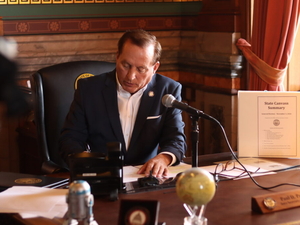
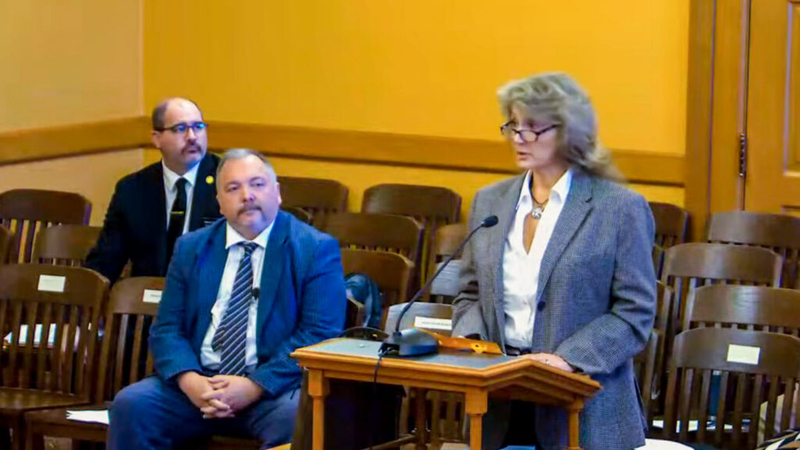
Ellen Goeckler testifies Nov. 10, 2026, before the Joint Committee on Claims Against the State to seek reimbursement of overpaid income taxes from 2017. (Kansas Reflector screen capture from Kansas Legislature video)
TOPEKA — The Kansas Department of Revenue confirms Ellen Goeckler overpaid state income tax during four consecutive years on distributions from a federal retirement plan.
The state agency agreed to refunds for Goeckler covering three years of improper tax assessed on payouts from a Thrift Savings Plan, but declined reimbursement for 2017 because of a three-year statute of limitations. Goeckler lost an administrative appeal, and complained to the governor’s office and to state legislators. Eventually, she sought relief from the Kansas Legislature’s Joint Committee on Claims Against the State.
Goeckler, of Manhattan, anchored her argument for the $8,232 reimbursement to an allegation the Department of Revenue conspired to limit public awareness of the agency’s 2013 policy change ending assessment of state income tax on withdrawals from federal 401(k)-style TSP plans. She asserted the agency’s leadership avoided proper transparency because of fear it could cost the state treasury $6 million per year in refund demands.
“In this case,” she said, “the executive branch failed the public, creating a situation where it was functionally impossible for an ordinary citizen to know they were overpaying their taxes. As a result, the state spent years quietly accepting overpayments from retirees like me who were relying on the state’s public-facing instructions.”
Ted Smith, the current chief counsel at the Department of Revenue, said there was no factual dispute about whether Goeckler overpaid on her state income taxes. He said there was no “purposeful intent” by the state agency to bury the administrative policy change on taxation of the federal retirement accounts, but otherwise accepted as accurate Goeckler’s explanation of what transpired in her case.
Smith urged the committee to reject Goeckler’s request for reimbursement on her 2017 assessment. He told legislators that waiving the statute of limitations on tax appeals would set bad precedent.
“The question for you is how granular does the Department of Revenue have to get with regard to everybody’s tax circumstance?” Smith said. “We would respectfully ask the committee not to approve the request.”
The committee left unresolved debate about a conspiracy of silence but approved a recommendation that the full Legislature mandate payment of $8,232 to Goeckler for the fourth year of overpayment on her state taxes. To do so, the committee agreed to waive its internal Rule 6(a) to sidestep a three-year cap on claims.
“Three years did get repaid,” said Rep. Susan Humphries, a Wichita Republican and an attorney serving on the claims committee. “Are we not going to repay one more year just because of a rule?”
Rep. Ken Rahjes, R-Agro, said the committee was a place where Kansans who lacked alternative legal recourse and believed they were treated unfairly by state government could be heard.
“I was trying to look at it from a non-attorney standpoint,” Rahjes said. “It seems like this is the court of last resort, if you will, and the state messed up. To me, when it comes to a matter of taxes, a partial payment doesn’t seem right.”
Goeckler, of Manhattan, said a statute of limitations on tax reimbursements made since if the state demonstrated it was operating on a level playing field.
“It assumes the state of Kansas acts with transparency,” she said. “I did not overpay my taxes because I made a mistake. I overpaid my state income taxes because the state chose to change their interpretation … and not tell anyone.”
Before 2013, the Department of Revenue applied state income tax to federal Thrift Savings Plan withdrawals. During the 2012 legislative session, revenue secretary Nick Jordan signed testimony endorsing House Bill 2480 to affirm TSP distributions as taxable income in Kansas. Jordan said at that time the department was fighting an administrative appeal related to TSP taxes that could grow into a court case and, if the state lost, impose a “potential negative fiscal impact” of $6 million per fiscal year. That bill wasn’t approved by the Legislature.
Goeckler said that in 2013 the Department of Revenue reversed course and relied on administrative authority to make TSP distributions exempt from Kansas income tax.
“But the Department of Revenue did not publish a formal administrative regulation,” Goeckler said. “They did not issue a broad public notice. They did not change the plain language in the annual tax booklets used by everyday citizens. Instead, they chose to roll out this massive statutory shift quietly, through internal administrative channels.”
On this point, Smith said the Department of Revenue wouldn’t deceive taxpayers to claim a $6 million benefit to the state’s bottom line.
“In scope of how much money we collect,” Smith said, “you know $5 or $6 million is not something that you’re going to say, ‘OK, let’s carve out a little exception. Let’s keep this secret.’ ”
Rep. Bob Lewis, an attorney and Garden City Republican on the claims committee, argued the Legislature should take into account the legal concept of “laches.” The doctrine allowed a court to deny relief to a plaintiff who unreasonably delayed assertion of a claim and caused prejudice against a defendant.
“In this situation we need to think about the equities,” Lewis said. “I don’t think the department was intentionally obfuscating or hiding this from taxpayers. At most it was maybe, perhaps, negligence.”
Sen. Brenda Dietrich, a Topeka Republican who chairs the claims committee, said it was noteworthy a tax refund claim for the 2017 tax year was being heard by the committee in 2026. If approved by the full Legislature, the resolution would take place a decade after the fact in 2027.
“If it was that urgent I would have hoped it would have gotten here sooner,” she said.
Goeckler said the statute of limitations was a vital legal tool that could be used to address questions of liability when taxpayers sat on their rights when the rules were clearly defined. In this instance, she said, the Department of Revenue didn’t publish sufficient clarifying information on the tax exemption for TSP accounts until 2021.
“It is not intended to shield the state from returning money it wrongfully collected because it kept a policy clarification secret,” she said. “I did not miss a deadline due to negligence. I missed it because of administrative concealment.”
Topeka, KS