Newborn vaccination rates for hepatitis B drop sharply
Nov 24, 2026 | 2:56 pm ET
Description
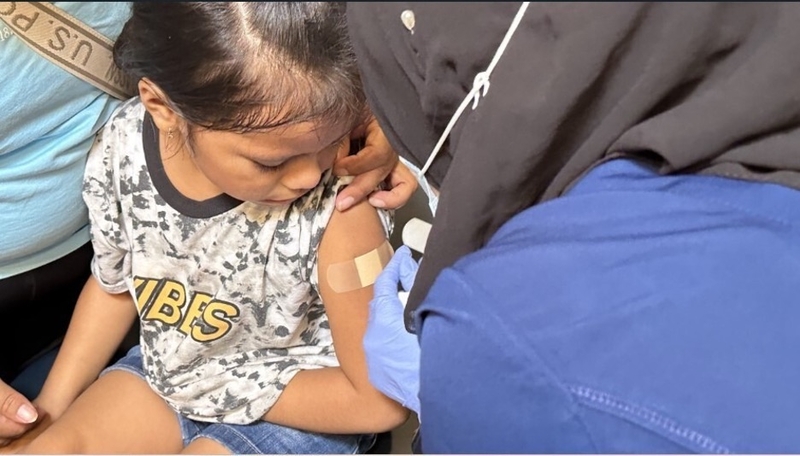
A worker applies an adhesive bandage to a child at a vaccination clinic in Minneapolis’ Corcoran Park in August 2023. A new study found the nationwide percentage of newborns receiving the hepatitis B vaccination has declined sharply since 2023. (Photo courtesy of the City of Minneapolis)
The percentage of newborns receiving the hepatitis B vaccine has declined sharply in recent years, falling to 65.6% in June 2026 from 79.8% in 2022, according to a new study published today in the New England Journal of Medicine.
The authors of the peer-reviewed study looked at health records from more than 1.3 million infants and found that the percentage of babies receiving the hepatitis B vaccination within one day of birth began declining around 2023. The study also found that fewer mothers testing positive for hepatitis B got the vaccine for their babies, from around 98% of those infants in 2025 to around 94% in 2026.
A panel of federal vaccine advisors, the Advisory Committee on Immunization Practices, voted in December 2025 to end the longtime recommendation for infants to receive the hepatitis B vaccination at birth even if the mom tested negative. That decision is on hold pending legal challenges.
The study was based on data from Truveta, a health data and analytics company owned and governed by 30 health systems across the nation.
In explaining the December change, the Centers for Disease Control and Prevention said screening of pregnant women is highly reliable and can spot disease early. But Nina Masters, an author of the new study and a principal applied research scientist at Truveta specializing in infectious disease and maternal health, told Stateline that “not every mother is tested during pregnancy, and not every person who gets tested has a known status.”
“And screening is imperfect,” she said. “This birth dose has been a universal recommendation to be a safety net to catch those kids that might fall through the cracks, and what we’re seeing here is that that safety net is kind of falling apart.”
Hepatitis B is a contagious liver infection that can cause symptoms of fatigue, loss of appetite and jaundice, and potentially lead to cancer. But it can be prevented through a vaccination. The virus can be passed down from an infected mother to a baby, so since 1991, the Centers for Disease Control and Prevention has recommended that all newborns receive the hepatitis B vaccination within a day after birth to prevent early infections, especially when mothers test positive.
A 2023 study by CDC researchers found that between 1990 and 2019, with the recommendation for newborn vaccination, there was a 99% decline in reported cases of acute hepatitis B among people younger than 19 years old.
But amid growing vaccination skepticism, the new study found that fewer babies are getting the shot. The shift began a few years before vaccine skeptic Robert F. Kennedy Jr. became secretary of the U.S. Department of Health and Human Services in February 2025.
Researchers noted the decline in vaccination rates for hepatitis B comes as the federal government and many conservative states walk back vaccine mandates for children. Just this month, the United States lost its status as a country that had eliminated measles, as the transmission of measles has risen in the last year. Children are particularly susceptible to the disease.
“When messaging gets confusing and there’s different recommendations coming from different medical bodies and different kinds of assessments of vaccine safety that are being publicized, I think it can become scary and hard to make the right choice,” Masters said.
“And I think that’s what we’re seeing is just extreme confusion as a result of the level of misinformation and changing recommendations around pediatric vaccines.”
Stateline reporter Shalina Chatlani can be reached at [email protected].