‘I’m the head,’ Morrisey insists to disjointed West Virginia GOP
May 21, 2026 | 5:55 am ET
Description
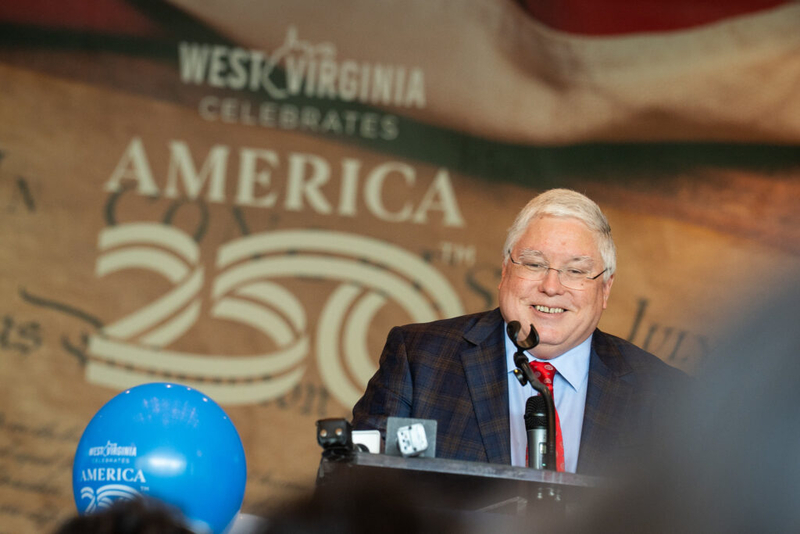
Gov. Patrick Morrisey announces the America 250 celebration at the state Capitol, scheduled for July 2-5. (Photo courtesy of the West Virginia Office of Gov. Patrick Morrisey)
We, as a free people self-governing, hold this truth to be self-evident: that if you have to tell folks you are in charge, you ain’t.
During the post-primary proceedings, West Virginia Gov. Patrick Morrisey proffered a particular claim. “Listen, I’m the head of the Republican Party in West Virginia, and I’m going to make sure that we’re going to stump for good people,” he declared to WOWK 13’s Amanda Barren. Career lawyer that he is, Morrisey understands what a proffer commits him to. Declaring himself the head of a West Virginia GOP — whose largest measurable change after the 2026 primary was an increase in same-team animosity — sets a standard we can examine.
Morrisey moving the 1,500 feet from the Attorney General’s office to the Governor’s Mansion was secured when he won a multi-person primary in 2024 with 33% of the vote. To do so, he defeated Moore Capito of the Moore/Capito family, headed by West Virginia’s senior U.S. Senator and Moore Capito’s mother, Shelley Moore Capito. He also bested Chris Miller, long-time car dealer and political donor who is the son of U.S. Representative Carol Miller. Morrisey’s first week in office was highlighted with a public fight over his predecessor and current U.S. Sen. Jim Justice’s spending priorities and budget gaps inherited by the incoming Morrisey administration.
That is an awful lot of West Virginia political and financial power structures to get sideways with after getting a plurality, not a majority, certainly not a mandate, for the office of governor.
After succeeding in winning the election, Morrisey failed to cobble together a governing coalition from the Republican electoral split he benefited from. Those intraparty divisions became more apparent across legislative sessions, leading to Morrisey and his donor network openly supporting primary challenges to the dissident lawmakers.
One primary and $5 million dollars later, the campaigning resulted in Morrisey’s faction clipping off Dels. Vernon Criss and Scot Heckert among other legislative chair shuffling, but did not meaningfully improve the governor’s governing coalition. The Criss situation is especially noteworthy. The governor and his faction of the GOP targeted and removed the West Virginia House finance chairman for two main reasons. The first and publicly stated reason was his committee entertaining the notion of putting nominal restrictions on the Hope Scholarship that ultimately did not happen. The second, subtler but widely understood, was the personal dislike between Criss and Morrisey that had spilled into pointed public comments and policy pushback.
In Criss’s place voters will see 23-year old newcomer Charles Hartzog on their ballot in November. The governor and his backers will tout this as a win and symbol of his leadership of the party in removing what he called on election night “some blocks that had existed in the past.” But leadership of his faction and leadership of the party has a new living navigational buoy to where that line is in Hartzog. Unfairly or not, a West Virginia House of Delegates that is even more divided now than it was before the primary will see the newcomer and his inexperience as a rubber stamp placeholder for the governor and his policies, since that was the prerequisite for the endorsement and money.
The governor and his donor network might have facilitated his win, but the machinations do Hartzog no favors going forward as he starts his public service career. At the same time, those Republicans opposed to the governor’s push for executive superiority over the legislative understand the not-subtle meaning of their colleague-who mildly disagreed on the very edges of policy but made it personal-no longer being present.
Morrisey went into the primary with a contentious relationship with the legislators, and exited the primary with an even more contentious relationship with the legislators. The big name targets that survived the money bombs and mailer tsunami are unlikely convinced now is the time for forgiving and forgetting. A post-primary pronouncement of “voters rejected the good-ole-boy system in favor of voices that fight for our values” by the governor, when the premise of gubernatorial intervention was getting a legislative branch that does what the governor wants without question, does not ring true. Because it is not true.
Threatening your own party’s super majority with outside money for not doing what you want on 5% of things when you agree on 95% of things isn’t governing. It is purity nitpicking for personal gain. It is also a bad long-term strategy. Strategy that is all but assured to produce a serious, well-funded, well-supported gubernatorial primary challenge in 2028 from those whom such naked power moves are meant to bring to heel. A challenge backed by familiar names with long-standing financial and power structures in West Virginia that will now have multiple years of the governor’s record and actions to hold up for public electoral judgment.
For being the self-proclaimed head of the West Virginia GOP, there sure are quite a few West Virginia Republican legislators and the support structures behind them getting more and more comfortable with being publicly and financially opposed to what they feel is an adversarial governor who revels in intraparty friendly fire that benefits only him and his network of support.
Morrisey facilitating eye-popping primary spending against his own party for nominal changes, while hardening his legislative opposition and giving ammo to his forthcoming primary challenge in 2028, is evidence against his leadership that demands a verdict.
“I’m the head of the Republican Party in West Virginia” isn’t a statement of strength or leadership; it is an unsupported projection. It is a confession that while the title of governor confers legal authority automatically, the governing authority to coalesce people around you as a leader has to be built. Earned. Nurtured. Patrick Morrisey’s actions show he either doesn’t know how or doesn’t care to try.
Charleston, WV