ICE agents are keeping watch outside courthouses. They upended a North Providence couple’s life.
Aug 11, 2025 | 5:22 pm ET
Description
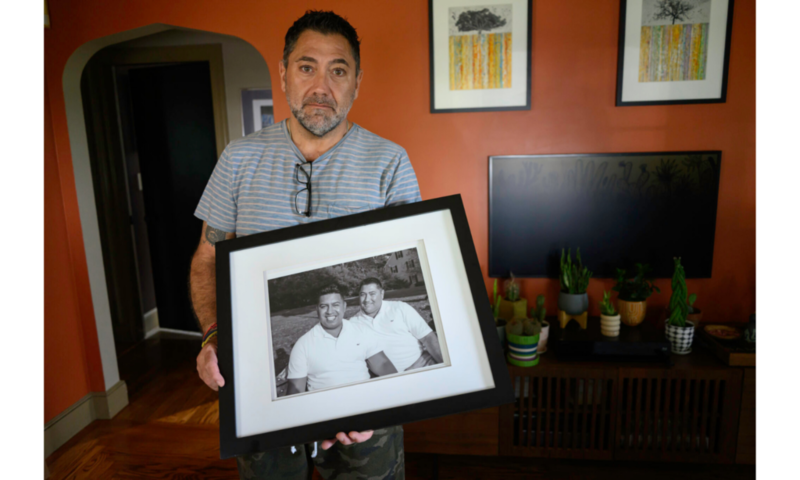
Sam Spadavecchia holds a portrait of him with his husband Pablo Grave de la Cruz, left in the photo, in the couple’s North Providence home. De la Cruz is now being held in detention in Texas and planning to self-deport to his native Guatemala. (Photo by Michael Salerno/Rhode Island Current)
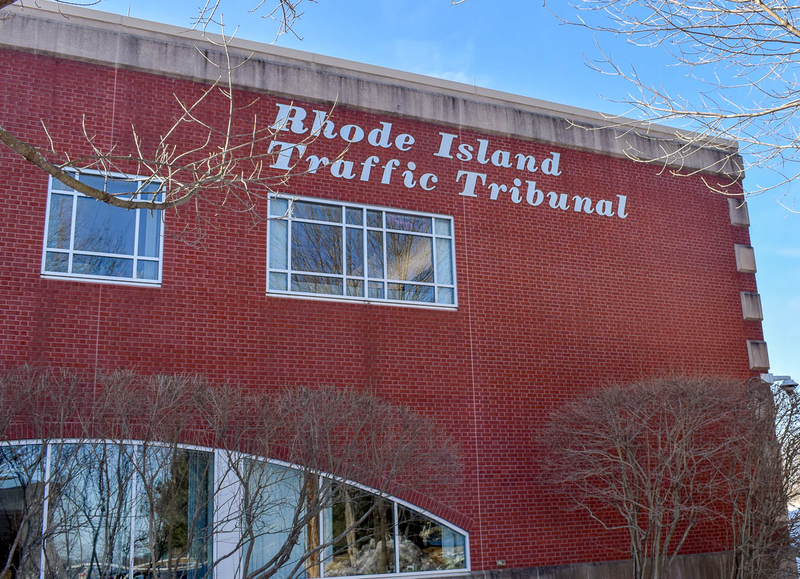
The SUVs pulled up quickly outside of the Rhode Island Traffic Tribunal in Cranston around 10:30 in the morning on June 17.
Pablo Grave de la Cruz, 36, had just left a hearing inside where he pleaded not guilty to a charge of refusal to submit to a chemical test after being involved in a one-car accident in Coventry. He was dressed for the occasion, in a collared shirt and slacks. He had plans to go out for breakfast.
He heard his name called. Moments later, a half dozen Immigration and Customs Enforcement (ICE) agents — wearing masks and carrying guns — surrounded and handcuffed de la Cruz, then hustled him into one of the vehicles and drove away. Neither his lawyer nor his friend, Brittany Donohue, who had accompanied him, were allowed to go with him.
“They pulled up on him like he was a murderer or a rapist,” Donohue said. “He was leaving traffic court.”
She was left trembling from the experience and had to wait another 20 minutes before she was calm enough to drive.
De la Cruz has lived in Rhode Island for 19 years and has been married to Sam Spadavecchia since 2016. The couple live in North Providence. De la Cruz came from Guatemala as a teenager illegally out of fear for his safety as a gay person around 2005 the same year Amnesty International wrote, “The LGBT community in Guatemala regularly faces attacks and threats.” Since then, he has worked as a server at two of Providence’s most recognizable restaurants — Los Andes and the Capital Grille — and spent time working or managing others.
De la Cruz’s enthusiasm and deep menu knowledge made a favorable impression on customers and coworkers at the restaurants where he worked. The Yelp page for Los Andes still includes reviews that single out de la Cruz. “To say he was phenomenal would be an understatement,” one reads. Another advises guests to “ask for Pablo as your server – he was great!”
His arrest is one of a growing number by ICE agents at or around Rhode Island courthouses in recent months. The practice has alarmed advocates, state lawmakers — including two Providence Democrats, Rep. David Morales, and House Deputy Speaker Raymond Hull, who wrote letters of support to the judge in de la Cruz’s immigration case — and even the chief justice of the Rhode Island Supreme Court.
In February, agents arrested a Venezuelan man outside the Garrahy Judicial Complex in downtown Providence after he appeared at a hearing for domestic violence charges.
In July, social worker Diego Tomas Arene-Morley filmed plainclothes officers arresting a woman from Ecuador he had just accompanied as his client to court in Providence. The woman had just had charges dismissed stemming from a domestic violence incident in which she was actually the victim. Video of the arrest, and Arene-Morley’s description of it, went viral on Instagram. The woman remains in ICE custody, Arene-Morley said.
Later in July, ICE agents arrested a Guatemalan man on Benefit Street in Providence right when he left Superior Court after appearing on charges of felony domestic assault and violating a protective order. He was charged with assaulting federal officers after an immigration officer and a DEA agent were injured during a scuffle, the U.S. Department of Justice said.
At least 15 arrests of undocumented immigrants have occurred outside Rhode Island courthouses since the beginning of Trump’s second term, including five outside the traffic court, said Juan Pablo Ocampo Sheen, coordinator for the Immigration Coalition of Rhode Island. But that estimate is likely an undercount since the coalition doesn’t hear about every arrest, Ocampo Sheen said.
The Department of Homeland Security (DHS), the parent agency for ICE, says courthouse arrests make common sense because they save agents time locating people and offer protection since people they’re looking for have passed through courthouse security screening.
James Covington, a spokesperson for ICE’s Boston field office, said de la Cruz was sought because he had a criminal record.
“Pablo Grave-De La Cruz is an illegally present, 36-year-old Guatemalan alien,” Covington said in a statement. “His criminal history includes TWO convictions for driving while intoxicated, an additional motor vehicle charge and a pending charge for a THIRD DWI. Officers with ICE Boston arrested Grave-De La Cruz in Cranston, Rhode Island.”
Records show de la Cruz was guilty of refusing to take a Breathalyzer test in 2014 and pleaded no contest to a DUI charge in 2015. He was also cited once for driving without a license in 2010 and driving with a suspended license in 2016. He was charged with DUI and refusal to take a Breathalyzer after his car went off Fish Hill Road in Coventry on June 8, 2025.
“Allowing this alien offender to remain on the streets of Rhode Island only places the safety of our neighbors in jeopardy,” Covington added in his statement. “ICE Boston will continue to prioritize public safety by arresting and removing criminal alien offenders.”
But courthouse arrests, Ocampo-Sheen said, could make it less likely that undocumented people or those in mixed-status households will report crimes or testify as victims, out of fear of deportation.
Steven Brown, executive director of the Rhode Island ACLU said courthouse arrests are part of a broader pattern of ICE tactics, including masked agents and smashing car windows during arrests, intended to spread fear. He warns the ripple effects of such tactics could harm even those who support the Trump administration’s aggressive immigration agenda.
“It’s really a dangerous step to take to engage in what is clearly intimidation tactics to prevent people from making use of the judicial system,” Brown said.
“When you get into a car accident and the person who witnesses that you weren’t at fault is afraid to go to court to support your position, you might think twice about whether these actions are in fact in your best interest,” Brown said.
‘Only a matter of time’
The debate over ICE enforcement at Rhode Island courthouses goes back at least to the early months of President Donald Trump’s first term, in 2017, when more than a dozen local organizations sent a letter to Rhode Island Supreme Court Justice Paul Suttell expressing concern over ICE arrests at courthouses around the country. The ACLU, the RI Coalition Against Domestic Violence, the Refugee Dream Center, NAACP, and other groups urged the justice to contact the then-Secretary of Homeland Security John Kelly asking that agents not conduct such arrests in Rhode Island.
“We fear it is only a matter of time before it happens here,” they wrote.
That prediction proved true.
One month after the letter, ICE agents arrested a Syrian man outside of the Licht Judicial Complex. Abulkhalek Darwich, who had stayed nearly 20 years past the expiration of a guest visa issued in the late 1990s, was facing state charges for the illegal importation and sale of cigarettes. He was taken into custody by ICE following a court appearance in that case. (Later in 2019, Darwich was charged with multiple counts of child molestation and sexual assault.)
Darwich’s detention prompted an outcry from the Rhode Island ACLU, which said, in a statement, “There will be no equal access to justice in Rhode Island if residents are afraid to make use of their judicial system.”
Suttell — who served as a Republican in the Rhode Island House of Representatives in the 1980s — spoke out too.
They pulled up on him like he was a murderer or a rapist. He was leaving traffic court.
After Darwich’s arrest, Suttell acknowledged federal authorities had a duty to enforce immigration laws. “But at the same time, our courts need to be accessible to everyone, regardless of immigration status, whether they are a crime victim, a witness, someone seeking a protection order or someone simply looking to pay a court fine,” he said.
In 2020, Colorado and New York passed laws aimed at curbing ICE arrests at courthouses. A third bill passed in Washington that year required courts to document instances of federal law enforcement entering courts for non-court-related business and prohibiting judges, prosecutors, and court staff from collecting or sharing info about immigration statuses unless relevant to a state criminal offense.
In 2021, the Biden administration issued a memo that acknowledged courthouse arrests “may chill individuals’ access to courthouses and, as a result, impair the fair administration of justice.” It encouraged agents to conduct them only in a narrow set of circumstances. That memo was rescinded on the day of Trump’s inauguration for his second term in January. Since that time, ICE has ramped up arrests in every state, including courthouse arrests.
Even in states with laws or rules designed to stop courthouse arrests, the issue remains unsettled. In Colorado, following reports of ICE arrests in defiance of the state law, the state’s ACLU sent a letter to ICE and DHS demanding a stop to the practice. In New York, the Trump administration sued the state to challenge its law protecting against courthouse arrests. In Ohio, after judges in Franklin County passed rules prohibiting immigration arrests at courthouses, lawmakers introduced a bill that would nullify such policies across the state.
Bills stall in Rhode Island
For the past three legislative sessions, Rhode Island lawmakers in both chambers have introduced legislation that would limit ICE’s ability to perform civil arrests. The latest versions of these bills — Senate Bill 0291 and House Bill 6121 — were introduced by Sen. Meghan Kallman, a Pawtucket Democrat, and Rep. Jose Batista, a Providence Democrat, during the 2025 legislative session.
Their bills wouldn’t have prohibited law enforcement officers from making an arrest at a courthouse if they have a warrant or if officers directly witness a crime. But the legislation sought to categorize civil arrests at courthouses as contempt of court and false imprisonment, and allow both the arrestee and the attorney general to sue for relief.
Both bills were held for further study after committee hearings. And both lead sponsors say they intend to file the bills again in 2026.
“As a matter of practicality, our judicial system relies on all Rhode Islanders having free and fair access to the courts — whether as defendants, plaintiffs or witnesses — without fear of detention and deportation,” the sponsors wrote in a March opinion piece.
Kallman said the bill is about protecting public safety.
“If the argument is that we want life to be safer for Rhode Islanders, then one of the ways that we need to do that is make the courts as safe as they possibly can be from outside interference,” she told Rhode Island Current. “And outside interference, in this case, is ICE.”
Kallman said she intends to submit legislation that would prohibit federal agents from conducting an arrest while masked.
Batista said he sees protecting immigrants’ basic rights as a moral imperative. “I feel like we’re literally living history, but in a bad way,” he said. “This bill is me embracing one of the few things I feel like I can do.”
Local efforts to mobilize
Absent local legislation or rules preventing ICE arrests at courthouses, some Rhode Islanders are working to disrupt enforcement on their own.
In July, the Olneyville Neighborhood Association (ONA), Alliance to Mobilize Our Resistance (AMOR), and Rhode Island chapter of the Party for Socialism and Liberation (PSL) launched a petition aimed at Gov. Dan McKee, Providence Mayor Brett Smiley, the Providence City Council, and Suttell. Calling ICE a “pandemic,” the petition demanded that courts across the state offer virtual hearings, trials, and conferences, “to all community members until they actually ensure real safety for our community members by banning ICE from the city.”
On social media, PSL and AMOR have been posting regularly about what they believe to be ICE near local courthouses. One post from late July included footage of two men wearing face coverings, tactical vests, guns holstered to their thighs and metal badges affixed to their clothing, with the Garrahy Courthouse visible in the background. “We know we can’t rely on politicians and their empty promises,” the caption read. “We have to take matters into our own hands and get organized in huge numbers to make sure ICE does not take anybody else from the courthouses.”
It’s really a dangerous step to take to engage in what is clearly intimidation tactics to prevent people from making use of the judicial system.
Arnoldo Benitez, an immigration lawyer with an office in Providence, said he has had at least one client detained by ICE.
Once a person is in ICE custody, it’s virtually impossible for them to participate in their state-level criminal proceedings, and so those local cases can remain open for years, Benitez said. If the person leaves the country, their still-pending criminal charges can make it difficult or impossible to come back legally. That’s a threat to due process, he explained.
“There goes the presumption of innocence, there goes your right to confront accusers, there goes your right to stand trial,” Benitez said. “All of your constitutional rights are just gone because you are not afforded that opportunity to fight your case.”
Benitez is torn over what to tell his clients who are scared to go to court. He can’t advise them not to go. “I do have to warn them that there is a chance that ICE can be there and can detain you,” he said.
Moved without notice
Spadavecchia drove to ICE’s field office on Jefferson Boulevard in Warwick after de la Cruz’s arrest to try to see his husband but was denied. Instead, Spadavecchia was given a bag of de la Cruz’s belongings, including his wallet, phone, and wedding ring.
De la Cruz was eventually transferred to the Wyatt Detention Facility in Central Falls, where he spent five days before being transferred, without notice, to a detention facility in South Texas around 20 miles from the U.S.-Mexico border. Spadavecchia learned his husband had been moved after it happened, via a phone call from de la Cruz. Before hearing from his husband, he had spent hours calling the Wyatt in search of his husband’s whereabouts.
De la Cruz’s friends and family members spent a month unsuccessfully trying to secure his release. Then they launched a GoFundMe fundraiser that has now raised more than $28,000. His case has been covered by WPRI, the Valley Breeze, and Newsweek, which ran the headline, “ICE Detains Man in US Since He Was a Teenager at Traffic Court.”
GoFundMe organizer Amanda Fullam said she wants people to know that ICE kidnappings” aren’t just targeting dangerous criminals. “They’re happening to our neighbors and our friends,” Fullam told Rhode Island Current. “And they’re not being given the treatment or the opportunity that they should and that they deserve.”
Spadavecchia, who works as a sales and marketing director for an event transportation company, said he and de la Cruz spent nearly a decade trying to get proper papers for de la Cruz to gain legal status in the U.S. Among the forms they have in various stages of processing: an I-589 application for asylum, an I-130 petition for an alien relative, and a I- 601A application for a provisional unlawful presence waiver. “It shouldn’t take 10 years…to get a green card,” Spadavecchia said.
At an Aug. 7 removal hearing with an immigration judge in Texas, de Le Cruz was granted permission to voluntarily self-deport. Given the facts of his situation, this was a good outcome, Spadavecchia said. If de la Cruz had been involuntarily deported, the path back to Rhode Island, if one exists at all, could take years. He must leave the country before Sept. 5. Spadavecchia said he plans to visit him in Guatemala.
Spadavecchia wants to share his husband’s story not to scare undocumented people, but to inform them of the risks.
“I’ve told everyone, ‘If you have a court case, just don’t go. Send somebody else…Pay the fine,’” he said.
On a recent afternoon at the couple’s house in North Providence, the dining room table had two table settings, with plates, silverware, cloth napkins. They had been there since the day that de la Cruz was first detained in June.
Spadavecchia, his voice cracking, said removing the table settings would be a form of giving up. And he wasn’t ready to do that.
When de la Cruz was granted permission to self-deport, Spadavecchia said he finally felt enough closure to sit at the table for dinner. That night he made his husband’s favorite dish: pasta bolognese.
Correction: The story has been corrected to say that records show de la Cruz was guilty in 2014 of not taking a Breathalyzer test.

Providence, RI