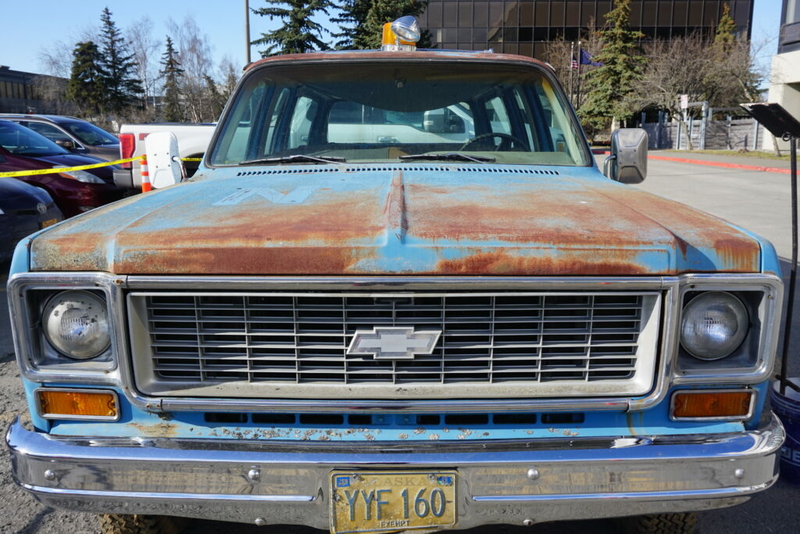
The 1974 Chevy Suburban that was the first vehicle to drive the full length of the Haul Road is seen on April 29, parked outside of the building that holds the Petroleum Club of Anchorage. The vehicle was brought there for an opening reception of an exhibit marking the 50th anniversary of the construction of the Haul Road, later named the Dalton Highway. (Photo by Yereth Rosen/Alaska Beacon)
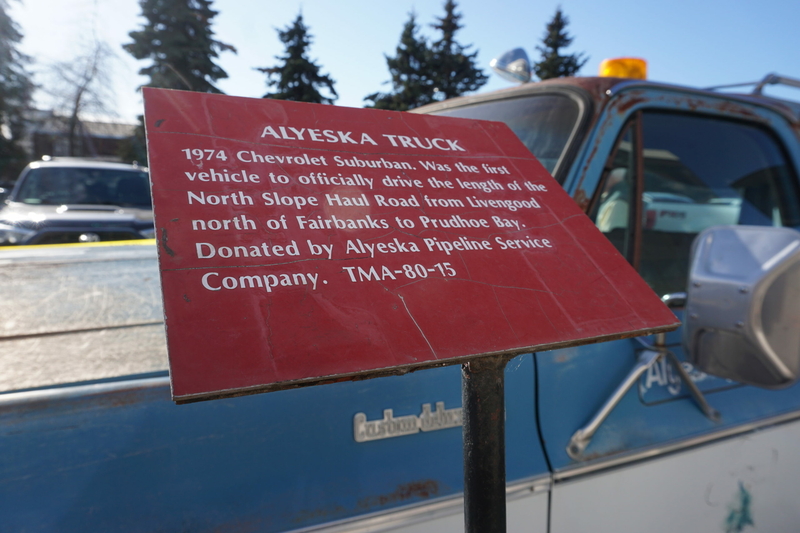
A sign describing the 1974 Chevrolet Suburban that was the first vehicle to drive the entire North Slope Haul Road is posted on April 29. (Photo by Yereth Rosen/Alaska Beacon)
Fifty years ago, work crews began a rush job to build what was then called the Haul Road, the gravel route to the site on the North Slope where the nation’s biggest oil field had been discovered. The road to the Prudhoe Bay oil field was completed quickly to accommodate the rushed construction of the Trans-Alaska Pipeline System.
Now a traveling exhibit memorializes the five-month construction of the road now called the Dalton Highway.
The exhibit opened on April 29 at the Petroleum Club of Anchorage in the city’s Midtown district, where it was kicked off with a packed reception.
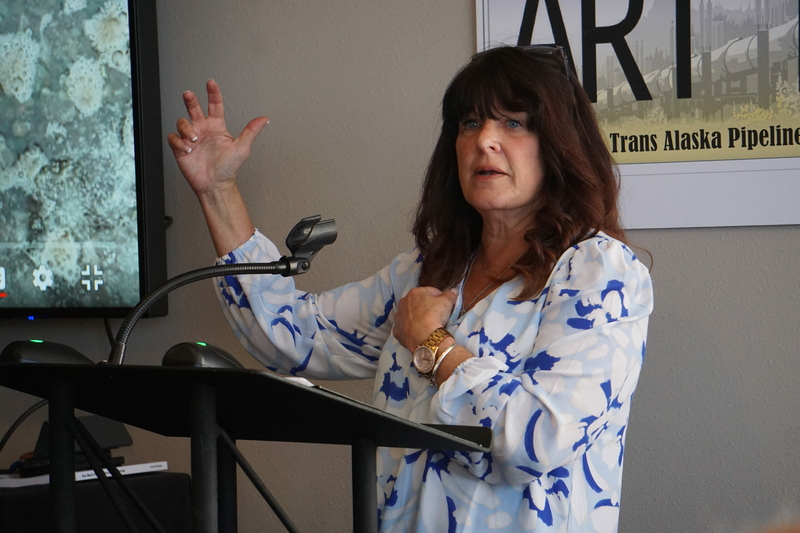
It is the first pop-up exhibit created by the Alaska Oil and Gas Historical Society, said Rebecca Logan, chief executive officer of the Alaska Support Industry Alliance and one of the society’s founders,
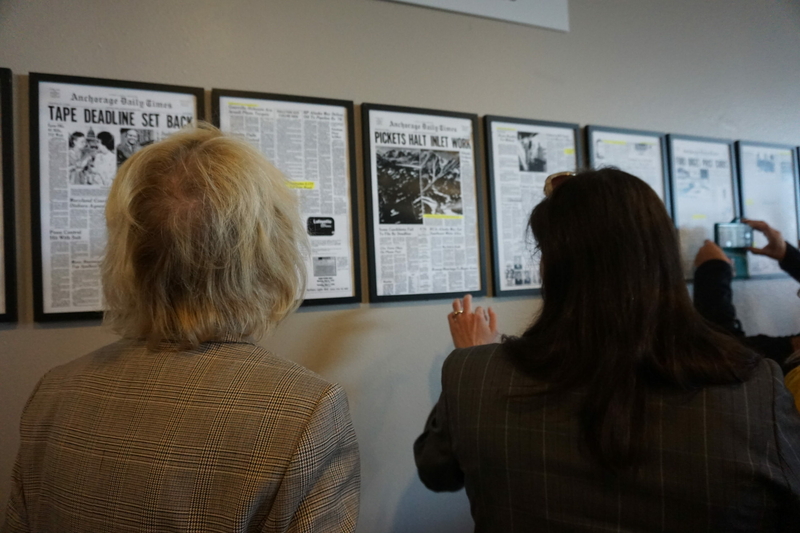
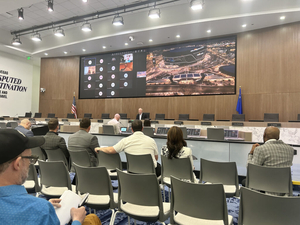
Attendees at an April 29 reception at the Petroleum Club of Anchorage examine newpaper reports from 1974, the time the Haul Road was built. A pop-up exhibit marking the 50th anniversary of the road construction was set up at the club by the Alaska Oil and Gas Historical Society. The route is now called the Dalton Highway. (Photo by Yereth Rosen/Alaska Beacon)
The historical society is a relatively new organization that incorporated in November 2022, Logan said. It has plans to create a museum in the next few years.
For now, though, the society is focused on gathering items that tell the story of Alaska’s oil and gas development – things like photographs, diaries, newspaper clippings and other artifacts that might be languishing in storage. Logan made a pitch at the reception for attendees to check for whatever items they might still have.
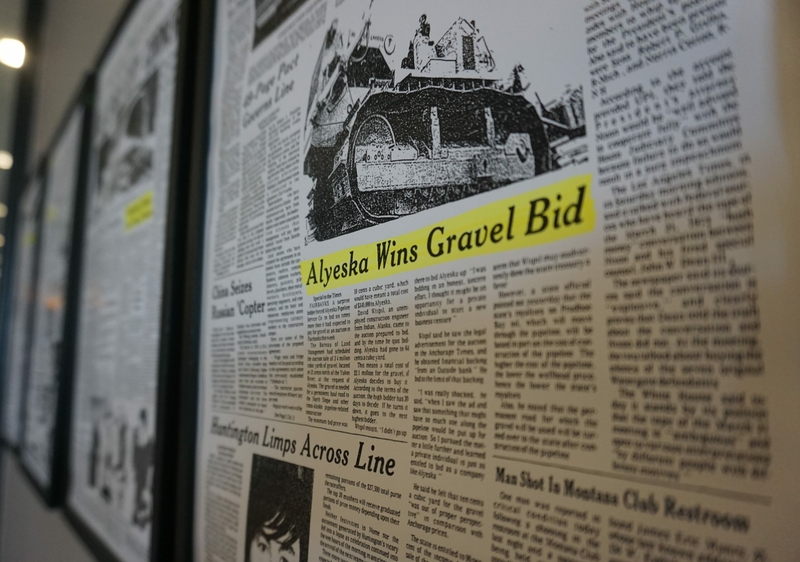
The copy of an Anchorage Times story about the construction of the North Slope Haul Road is displayed on a wall at the Petroleum Club of Anchorage on April 29. (Photo by Yereth Rosen/Alaska Beacon)
The road is a big part of that oil and gas history – and it will be part of Alaska’s future, said John Kurz, president of Alyeska Pipeline Service Co., the consortium that operates the oil pipeline that parallels the road.
Kurz made a toast to the road at the reception: “Here’s to another 50 years of driving Alaska’s economy.”
One particularly large Haul Road artifact was on display in the parking lot outside the Petroleum Club: a rust-flecked 1974 Chevy Suburban that was the first vehicle to drive the full road. Donated by Alyeska, the vehicle is no longer drivable. The keys were last seen in 1980, Logan said.
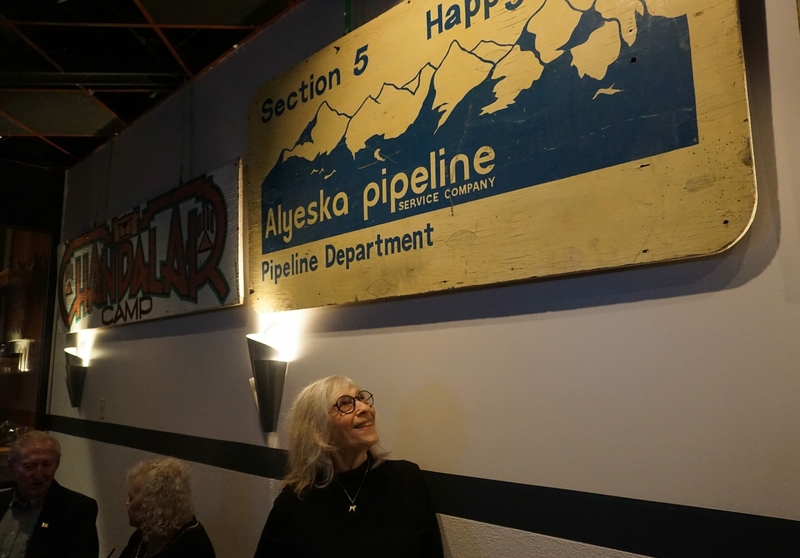
Nona Safra of Homer, attending an April 29, 2024, exhibit opening at the Petroleum Club of Anchorage, looks at a work camp sign that she found at a yard sale. The sign had been offered as scrap wood, she said. (Photo by Yereth Rosen/Alaska Beacon)
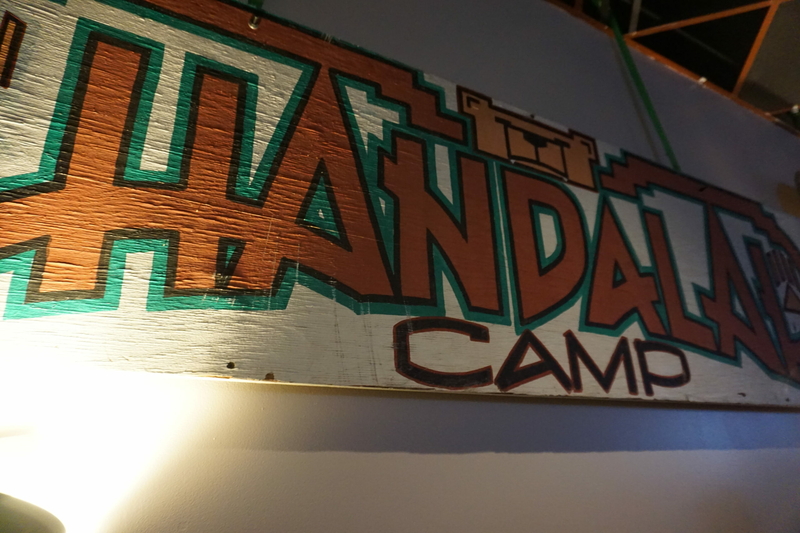
Some of the other artifacts in the exhibit were rescued from oblivion. At a yard sale in Homer, Nona Safra discovered two well-preserved painted signs that marked the locations of the Happy Camp and Chandalar Lake work sites. The owner considered them scrap wood, she said. They now hang on a wall at the Petroleum Club.
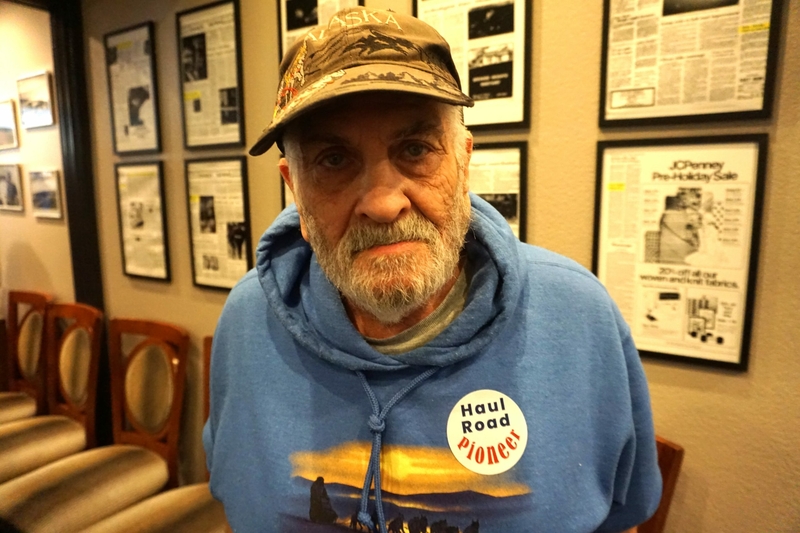
Attending the reception, along with Kurz and Alaska Department of Transportation and Public Facilities Commissioner Ryan Anderson, were several former road workers who wore stickers identifying themselves as “Haul Road Pioneers.”
One was Jack Laasch, who was drawn to Alaska from Wisconsin to work as a surveying manager. The work camp experience was intense, with eight-week shifts punctuated by two-week breaks. In those pre-internet days, news from the outside world arrived on a delayed schedule in the form of taped recordings delivered at least a day late. He had never ridden in a helicopter before, but in his Haul Road position he was assigned two of them. His survey work took him to “some of the most beautiful country that I ever saw,” he said. He fell in love with Alaska, he said, and made his home here.
Fred Agree of Homer, wearing a sticker identifying himself as a “Haul Road Pioneer” who worked 50 years ago building the route now known as the Dalton Highway, stands by framed newspaper pages at the Petroleum Club of Anchorage on April 29. An exhibit marking the 50th anniversary of the Haul Road’s consturction was set up at the club by the Alaska Oil and Gas Historical Society. (Photo by Yereth Rosen/Alaska Beacon)
Another former road worker at the reception was Fred Agree of Homer, who had come to Alaska three years earlier to mush sled dogs. Agree took a job on the road but later went on to other Alaska adventures from his homestead in Trapper Creek. He competed in the famous Iditarod Trail Sled Dog Race. ”I got beat by Susan Butcher and Libby Riddles and DeeDee Jonrowe – all the top women,” he said, naming two past champions and a repeat runner-up. He climbed Denali multiple times, he said. And he taught school in Wasilla, where one of his students was Sarah Palin, the former Alaska governor and Republican vice presidential candidate.
A sign for one of the work camps, rescued from a yard sale in Homer, is displayed on April 29 on the wall at the Petroleum Club of Anchorage as part of the exhibit marking the 50th anniversary of the Haul Road’s construction. (Photo by Yereth Rosen/Alaska Beacon)
The Haul Road was renamed in 1981 after James Dalton, an Alaska mining engineer and Arctic specialist who, among other accomplishments, was a consultant to early North Slope oil explorers. In 1994, the entire route was opened to public travel. Over the years, it has transformed through continuous maintenance and rebuilding from its bumpy beginnings to a more sophisticated transportation corridor. In contrast to the isolated days of the 1970s, Anderson noted at the reception, communications today are made easier by a fiber-optic line that runs the length of the highway.
In recent years, there has been rebuilding and realignment work to address a series of problems related to climate change: permafrost thaw, flooding and the downslope creeping of thawing conglomerations called “frozen debris lobes.”
Rebecca Logan, chief executive of the Alaska Support Industry Alliance and a founder of the Alaska Oil and Gas Historical Society, makes a pitch on April 29 for oil industry veterans to search for historical items that could be used as musuem exhibits. Logan spoke at the Petroleum Club of Anchorage at the opening of a pop-up exhibit commemorating the 50th anniversary of the Haul Road’s construction. The road is now called the Dalton Highway. (Photo by Yereth Rosen/Alaska Beacon)
The exhibit’s opening in Anchorage was timed with the 50th anniversary of the start of the Haul Road’s construction, Logan said. In the fall, the exhibit will move to Fairbanks to mark the 50th anniversary of the road’s completion, she said.
Guest passes to the Petroleum Club of Anchorage are available for non-members who want to view the exhibit, Logan said. Inquiries may be made by email to [email protected].
There have been other historical presentations telling the road’s story. The University of Alaska Museum of the North had an exhibit in 2015 and 2016, with information still available online. Through the University of Alaska Fairbanks’ Project Jukebox program, a graduate student collected oral histories and photographs for a 2007 thesis.
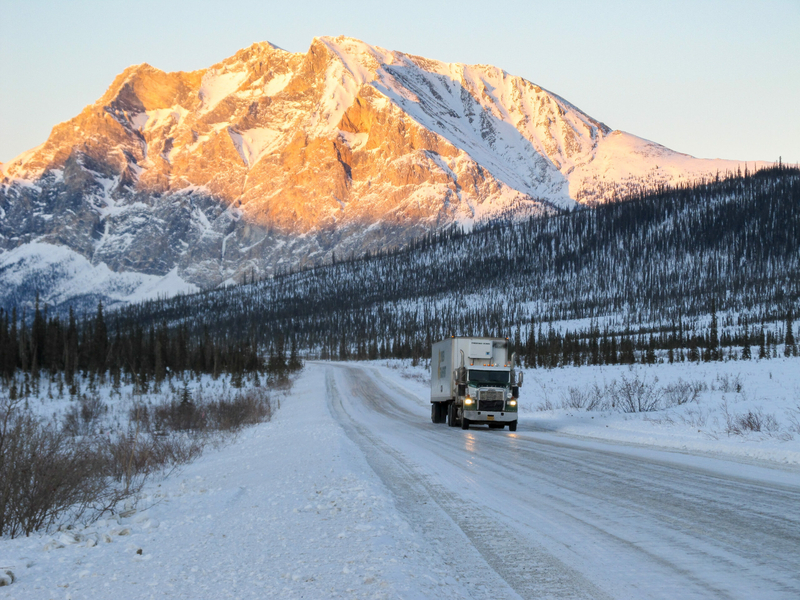
A truck passes Sukakpak Mountain in the Brooks Range on the Dalton Highway on March 15, 2011. The mountain is located at about the midway point of the 414-mile highway originally called the Haul Road. The road, built 50 years ago, has served since then as the overland supply route to the North Slope oil fields. (Photo by Karen Deatherage/Bureau of Land Management)
Correction: James Dalton’s first name has been corrected.