Medicaid expansion supporter hopes lawmakers ‘move on’ after latest ballot fight
Nov 08, 2026 | 8:00 am ET
Description
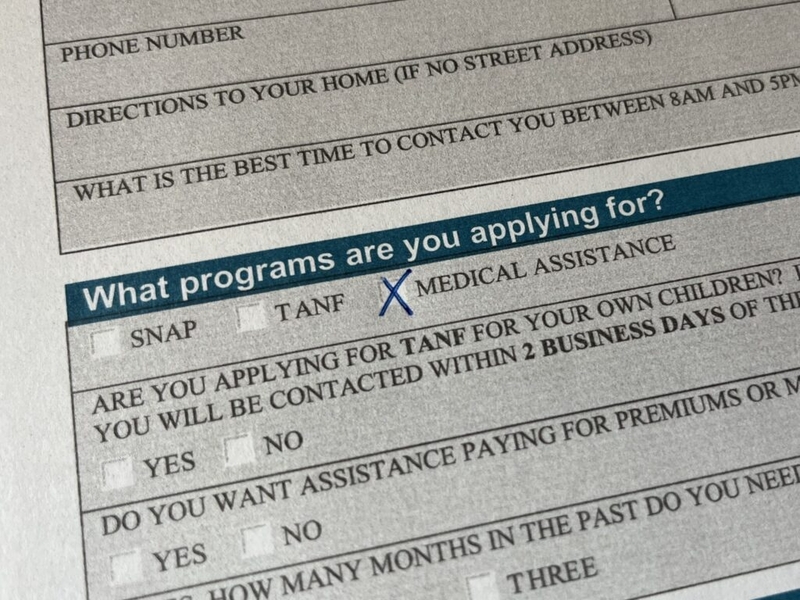
An economic assistance application for the South Dakota Department of Social Services. (Photo by Makenzie Huber/South Dakota Searchlight)
Listen to an audio version of this story produced by reporter Meghan O’Brien. Broadcasters: See below for a downloadable version with a host intro script.
After South Dakota voters rejected a ballot question Tuesday that could have triggered a repeal of the state’s Medicaid expansion mandate, some people who worked to defeat the measure said lawmakers should listen to voters and stop tinkering with the program.
Some lawmakers, meanwhile, remain concerned about the program’s effects on the state budget.
The state’s Republican-dominated Legislature sent Amendment I to the ballot, where it failed with 56% of the votes against it and 44% in favor.
Medicaid is a joint federal-state health insurance program for people with low incomes. In South Dakota, it traditionally covered specific low-income groups such as children, elderly people and disabled people. In 2022, South Dakota voters approved expanding Medicaid eligibility to low-income adults with the federal government paying for 90% of the program and the state paying the remaining 10%. Amendment I would have repealed the expansion requirement if the federal government reduced its funding share.
Opponents of the amendment said voters have been clear on Medicaid expansion.
“I think it shows that a majority of South Dakotans supported Medicaid expansion in the past and still do, and just don’t want to mess with it,” said Tim Rave, a Republican former legislator who’s now president and CEO of the South Dakota Association of Healthcare Organizations.
1,213 South Dakotans could lose Medicaid as federal work requirements take effect, department says
Rave said he isn’t sure if state lawmakers will ask voters again to consider changes to the program. In 2024, voters approved an amendment from lawmakers that authorized work requirements for Medicaid expansion recipients, predating a work requirement included in federal legislation approved the next year. Rave said his focus now will be on the state’s revenues and how they could impact healthcare funding.
Deb Fischer-Clemens, president of the South Dakota Nurses Association and a Democratic former legislator, led the opposition group No on I. She’s “hopeful that the message is clear and that we aren’t going to have to deal with this again.”
“I just hope that they move on,” she said of lawmakers. “Other than that, we’ll be watching. We will be watching and paying attention and listening.”
Her attention turns now to “the big picture,” she said, addressing Medicaid changes such as work requirements that came with President Donald Trump’s One Big Beautiful Bill Act. The state Department of Social Services has estimated 1,213 people on expanded Medicaid, about 4% of the group, could be disenrolled after federal work requirements are implemented next year.
Rep. Will Mortenson, R-Fort Pierre, sponsored the resolution that sent Amendment I to the ballot. He said Tuesday that South Dakota’s schools and nursing homes, and the state’s balanced budget, could be imperiled if the state has to shoulder a bigger share of expanded Medicaid costs in the future.
“I hope the Legislature keeps an eye on this issue going forward,” said Mortenson, who did not seek reelection this year.
Lawmakers estimated last year that if the federal government reduces its support to 70%, the state would be on the hook for about $72 million to sustain the expansion. That worries state Sen. Taffy Howard, R-Rapid City, who won her bid for reelection Tuesday and sits on the state’s budget committee. She said “something has to be done” about the potential budget constraints that would come with reduced federal funding, but she isn’t sure if lawmakers will address the program again in the near future.
Voters on Tuesday also rejected Amendment L, another lawmaker-proposed amendment that would have raised the threshold for voter approval of state constitutional amendments from a simple majority to 60%. Voters put Medicaid expansion in the state constitution with 56% percent support in 2022, after Republican lawmakers refused to approve the expansion legislatively.
Some lawmakers said a higher threshold for voter approval of constitutional amendments would protect the constitution from policies that don’t belong in it, while preserving it for fundamental elements like the structure and function of government.
It was the third time in recent elections that voters have denied attempts by lawmakers to raise the bar for certain types of ballot questions.
In 2018, voters defeated Constitutional Amendment X, which would have raised the threshold for constitutional amendments to 55%. Constitutional Amendment C failed in 2022. It would have required 60% voter support for ballot questions that increase taxes and fees, or require the state to spend $10 million or more in a measure’s first five years of implementation.
Reynold Nesiba, a Democratic former legislator from Sioux Falls who has worked on previous ballot questions, said Amendment L represented the Republican Party in South Dakota “whittling away at direct democracy” and engaging in “sour grapes” against approved amendments like Medicaid expansion.

Pierre, SD