Pillen eyes 2028 ballot if Nebraska lawmakers again stall on property tax reform
Nov 06, 2026 | 1:46 pm ET
Description
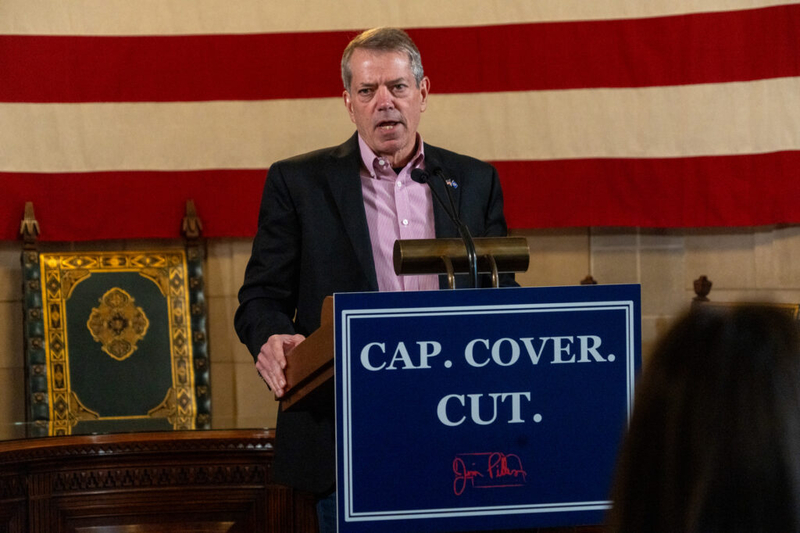
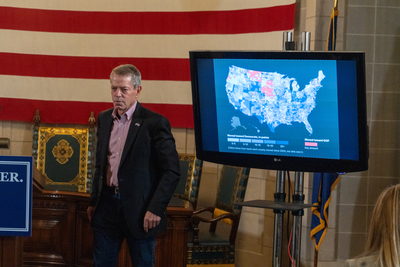
Nebraska Gov. Jim Pillen hosts a news conference talking about his approach for property taxes ahead of the 2027 legislative session on Nov. 6, 2026, in Lincoln, Nebraska, days after securing reelection for four more years. (Photo by Zach Wendling/Nebraska Examiner)
LINCOLN — Nebraska Gov. Jim Pillen hasn’t budged on his approach to cap local spending and cover K-12 education costs to alleviate property taxes he’s called for in the past four years.
But in 2027, Pillen’s second term begins with a more skeptical, divided Legislature to his ideas than before. Though he is adding a backstop: If the Legislature fails, he’ll go to the 2028 ballot.
“All of us, from the river to Harrison, from Falls City to Chadron, from South Sioux City to Benkelman, we’re all ticked off. It’s got to be fixed,” Pillen said at a 30-minute news conference.
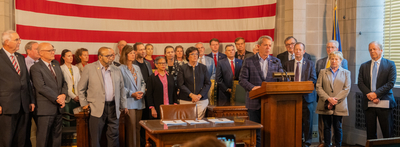
Many of Pillen’s proposals are familiar — capping local property taxes and valuations, having the state take on the operational costs of K-12 schools and encouraging local governments to cut spending to lower property taxes. The governor said Nebraskans “spoke loud and clear” and gave him and other state leaders a “mandate” to “solve the property tax crisis.”
He said his ideas should receive bipartisan legislative support and that a broadened sales tax base remains a solution, which is “such a no-brainer, it’s unbelievable, such common sense.”
“I believe in it so much that if we don’t get things accomplished in ‘27, our team will be working on taking it to the ballot for ‘28, and we’ll let the people speak,” Pillen said.
Going to the 2028 ballot
As for what going to the 2028 ballot would look like if needed — petitions, a legislative constitutional amendment (which requires 30 votes) or wading into legislative races — Pillen said he could not say. Some Republican lawmakers are proactively raising funds for reelection should they face primary challengers for opposing Pillen’s ideas.
“I don’t have all those specifics worked out in our head, but all I’m telling you is that we’re dead serious about fighting for Nebraskans to solve this property tax crisis,” Pillen said.
The governor also could not say exactly what deadline he’s imposing, such as whether it’s early on in the 2027 session, when the session ends in late May or a special session in the summer
Said Pillen, “We’ll just see what the attitude of the new Legislature is.”
“If the Legislature doesn’t want to solve the problem, we’ll get started sooner than later,” Pillen continued. “If they’re open to the conversation, if they’re going to make it a red-blue conversation, we’ll figure that out pretty quickly. It doesn’t take a rocket scientist to know that.”
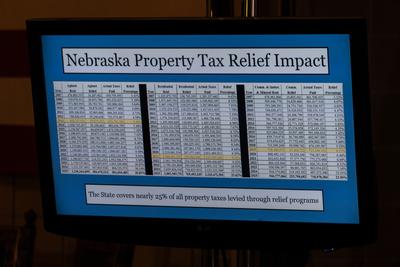
The governor presented data his team compiled indicating that ongoing property tax relief efforts, including state credits to offset local costs, have turned the tide on property taxes. For property taxes on agricultural land, for instance, Pillen said collections are effectively the same as 2013 levels. For residential property, it’s back to 2021 levels, and for commercial property, taxpayers are paying what they did in 2019.
Eric Underwood of Lincoln, former chair of the Nebraska Republican Party, has outlined a 15-petition effort aimed at the 2028 election, including many on property taxes.
It’s not yet clear whether Pillen might lend support to Underwood’s proposals.
A changing Legislature
Multiple lawmakers who usually supported Pillen’s ideas, such as broadening sales tax revenue, include term-limited state Sens. Rob Clements of Elmwood, Speaker John Arch of La Vista and Ben Hansen of Blair. Those three Republicans will be succeeded by more skeptical conservatives who have expressed some concern about a tax “shift” or more taxation.
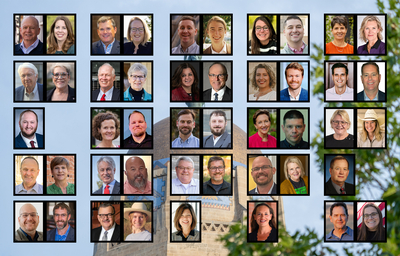
The Legislature’s 33-Republican legislative supermajority — the minimum votes needed to overcome a filibuster — is also set to end. State Sen. Merv Riepe of Ralston, a Republican, lost reelection, and two other Omaha-area races could flip blue or purple. State Sen. Brad von Gillern of Elkhorn, Revenue Committee chair, is another Republican who could lose reelection if results hold. He was seen as a frontrunner to succeed Arch as speaker.
Pillen has called for lowering the threshold to end filibusters from 33 to 30. However, a majority of lawmakers, across geography and ideology, have said they’re opposed to the idea.
As he’s done in the past, Pillen said his solution is talking more with lawmakers. He said he and his team will “communicate nonstop.”
“When we can all agree on what a definition of a tax shift is, what the definition of a tax cut is, it starts becoming crystal clear that we’ve been duped by special-interest lobbying groups for 50 years,” Pillen said.
He views sales taxes as the right solution because taxpayers can choose whether to make those purchases, as opposed to mandatory income or property taxes. He noted laundry services and ironing of clothes, for instance, which he said he’s done a few times. He joked that first lady Suzanne Pillen might argue with his ironing a little bit.
“I’ll iron my shirt. I’ll mow my own lawn. I’ll wash my car. I’ll do all the normal things that we used to do,” Pillen said. “That’s not people that are in tough shape. They have that opportunity.”
Yet for multiple years, Pillen has tried to rally lawmakers behind his cause. The needle hasn’t moved to push it over the edge of narrow defeats multiple times over.
2026 special session?
Multiple returning lawmakers and lobbyists have questioned whether Pillen might pursue a special session in the next two months, possibly with a more favorable Legislature. Some have wondered whether Pillen might try to cut spending, and some lawmakers have speculated whether legislators could pause lowering income tax rates before it lowers to 3.99% in January.
“Anything could be possible” in a special session, Pillen said, though he said he has not talked to any lawmakers as he’s “worked my brains out” running the state and running for reelection.
“I gave up speculation a long time ago because it almost broke me trying to speculate markets,” Pillen said.
Pillen called a special session in the summer of 2024 solely on property taxes.
However, multiple state senators and lobbyists the Nebraska Examiner has spoken to for months have said few ideas might have 33 votes to pass in 2026, let alone before a new Legislature with more than a dozen fresh faces coming in at voters’ wishes on Jan. 6.
Balancing Nebraska’s budget
Largely absent from Friday’s news conference was talk about Nebraska’s budget, likely in part because Pillen denies that Nebraska is in a “budget crisis.” Some Republicans, such as former state Sen. Julie Slama of Dunbar, have broken from Pillen and called it a “crisis.”
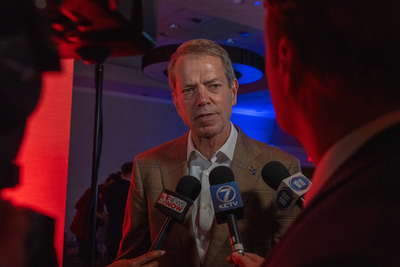
Through mid-2029, Nebraska faces a budget deficit that could grow as high as $1.2 billion.
“Those numbers over three years are not near as complicated,” Pillen told reporters.
Pillen said he held a cabinet meeting Friday and spent a couple of minutes celebrating cultural improvements and the work that’s already been done. He said the expectation across the Executive Branch is that agency heads will be in the office, rolling up their sleeves and finding efficiencies, such as cutting out “silly things” happening in government.
“Really, really crystal clear: Pleased but sure as heck not satisfied,” Pillen said of his cabinet.
The Legislature convenes Jan. 6. Pillen’s next four-year term begins the next day.
Lincoln, NE