Governor shares Wyoming’s education innovation model at DC forum
Jul 10, 2026 | 4:20 pm ET

Description
Photo courtesy of WyoFile
When it comes to learning fly fishing, an aspiring angler can watch hours of YouTube tutorials and spend a fortune on all the latest gadgets, Gov. Mark Gordon said. But none of that is as valuable as getting on a stream and casting.
“You have to try it,” Gordon told an audience in Washington, D.C. on Wednesday. “You’ll keep working at it and you’ll start to understand where the water is, you’ll understand what fish are doing … it’ll get better and better.”

That real-world, authentic engagement is a foundational piece of Gordon’s education innovation policies in Wyoming, along with adaptability, community involvement and cross-sector collaboration. The governor, who chairs the Education Commission of the States, leveraged those principles when creating a national playbook for states looking to reform or update education policy.
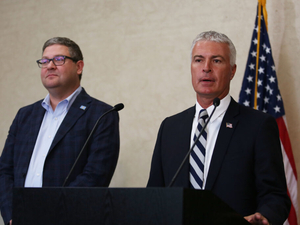
He unveiled that playbook Wednesday during a keynote speech at the National Forum on Education Policy in Washington, D.C. Gordon’s CHANGE Playbook offers a framework for government entities to establish and implement local, community-tailored, innovative visions for education measures.
“I hope that out of this we stop asking what program should we add, and instead we start thinking about cultivating and nurturing the conditions that can create for every learner and every community to thrive,” he told the audience. The annual nonpartisan forum convenes more than 700 attendees including governors, state school officers, lawmakers and other education professionals.
Local needs
Every two years, the Education Commission of the States selects a governor to act as chair. Gordon was tapped in 2025.
For his tenure’s initiative, Gordon crafted a policy roadmap based on recent Wyoming education measures. Those include both Reimagining and Innovating the Delivery of Education (the RIDE initiative) and the Wyoming Innovative Partnership (WIP).
Roughly 20 pilot schools participating in RIDE have used it to implement nontraditional methods such as internships for credit, teaching tax filing and flexible student schedules. WIP, meanwhile, is a workforce development initiative that aligns higher education with private industry in fields like energy, healthcare and advanced manufacturing.
Gordon’s new playbook also has an acronym: CHANGE. It stands for Community Hubs for Addressing Needs for Greater Education. Gordon developed the program in partnership with the Education Commission of the States.

The playbook has parallels with the Wyoming initiatives. Those include an emphasis on community-driven decisions, genuine student engagement and stronger workforce pathways.
Local districts are best equipped to tailor education to their specific community needs, Gordon stressed. No governor, legislature or superintendent “is going to be able to make that happen at the local level the way local folks can,” he said.
Build it yourself
Gordon recalled a survey that asked people about their most valuable piece of furniture. One might assume it was an expensive heirloom or antique tied to generations of relatives, he said.
“But it turned out the most valuable piece of furniture was the piece that they bought at IKEA,” Gordon said. “Why was that? It was because they built it. Their work was in it.”
He hopes his playbook can spur that spirit in education around the country.
“Here are some opportunities for sharing different ideas, here are some thoughts that maybe you could use,” Gordon said, “but you gotta build it yourself.”
Cheyenne, WY