GO-NORTH ‘cautiously optimistic’ ahead of federal rescoring of rural health program
Oct 13, 2026 | 5:00 am ET
Description
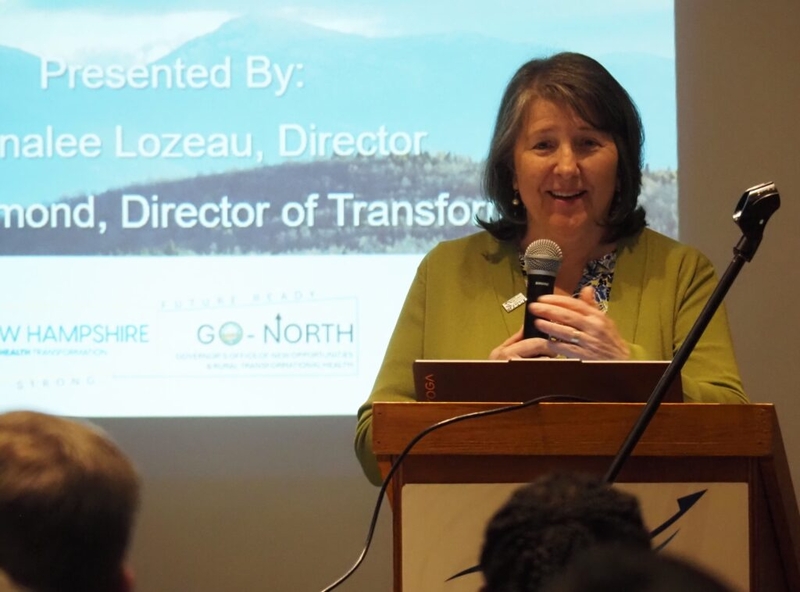
Donnalee Lozeau, GO-NORTH director, speaks to the New Hampshire Public Health Association at the McAuliffe-Shepard Discovery Center in Concord on April 23, 2026. (Photo by William Skipworth/New Hampshire Bulletin)
When the federal government revealed how much money it was giving New Hampshire as part of its Rural Health Transformation Program, Granite State leaders bragged that the state secured more funding than any other New England state (though Connecticut, Massachusetts, Rhode Island and Vermont received more per rural resident, according to a KFF analysis).
However, that could all change soon as the federal government rescores each state based on their first-year performance.
When Congress established the program, it mandated an annual reassessment. If states hit the appropriate marks and make progress in distributing the money effectively, the government will continue providing funding. If not, the funding will be cut. According to the U.S. Centers for Medicare and Medicaid Services, continued funding relies on “program authority,” “satisfactory performance,” “compliance with the terms and conditions of the Federal award,” and “compliance with reporting requirements.”
New Hampshire received roughly $205 million from the program late last year and hopes to receive the same amount each year until 2030 when the program concludes. According to CMS guidance materials, rescoring takes place across September and October.
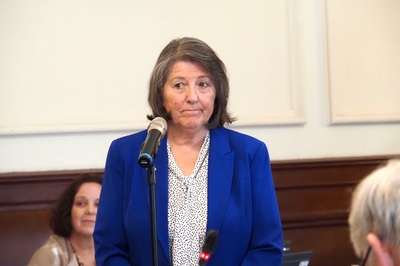
Donnalee Lozeau is the director of GO-NORTH, the office established to manage New Hampshire’s funding. She told the Bulletin her team is “cautiously optimistic.”
“We feel like if we follow through on what we told them that we would do, which was part of our notification of funding award, that we should be fine to continue the work,” Lozeau said. “We have not had any indications that we need to change our approach. We’ve had no indication that something is amiss. Everything has fortunately been going as we’ve planned.”
Lozeau pointed out that New Hampshire was one of the first states to be deemed “fully obligated” by the federal government in June. That means CMS approved the state’s budget well ahead of the October deadline. She called that “a really strong indicator” of CMS support.
Lozeau credits GO-NORTH’s “hub” model for its speedy approval. That model designates five “hubs” throughout the state to distribute money to different projects:
- The Foundation for Healthy Communities was tasked with distributing $283 million to projects aimed at expanding access to primary care, behavioral health and specialty services.
- The New Hampshire Community Development Finance Authority received $223.2 million to initiate capital infrastructure projects for rural hospitals, health centers, EMS providers, telehealth and more.
- The New Hampshire Behavioral Health Association received $132 million to distribute to community mental health initiatives.
- The University System of New Hampshire received $96.9 million to improve the higher-education-to-healthcare-workforce pipeline.
- The Community College System of New Hampshire received $37.8 million to work on other workforce development efforts.
“With the five hubs, we’re able to launch our initiatives concurrently,” Lozeau said. “You know what I mean, so it’s like it’s not just one entity doing something. It’s multiple entities.”
Lozeau said CMS officials visited in May and were supportive of GO-NORTH’s efforts and progress. CMS did not respond to the Bulletin’s questions or request for comment.
The financial landscape for rural healthcare across New Hampshire and the United States is rough. The New Hampshire Hospital Association reported last year that four rural critical access hospitals in the state were operating on negative margins. It also reported a 44% rise in operating expenses from 2019 to 2024 across all hospitals in the state and a 36.1% increase in labor costs.
With the Rural Health Transformation Program, Congress called on states to create “a transformational, long-term, sustainable health access solution” to the challenges facing rural healthcare, Lozeau said. Asked whether the threat of funding being revoked complicates GO-NORTH’s ability to create something transformative, long-term and sustainable, Lozeau said she doesn’t think so because she’s not concerned about losing the funds. She said the rescoring hasn’t changed the approach to disbursing the money.
Congress created the program as a counter-measure to cuts it made to several public health programs, including Medicaid and SNAP. In its One Big Beautiful Bill Act, Congress cut an estimated $991 billion of federal Medicaid spending over the next decade, per KFF. The Rural Health Transformation Program, which the Republicans behind the legislation said was designed to mitigate the Medicaid cuts, is providing states $50 billion over five years.
In April, the Bulletin asked Lozeau if she believes the federal government has given her enough resources to meet the lofty goal of mitigating Medicaid cuts. She said “the jury’s still out on that.” Last week, the Bulletin asked if she’d gotten a clearer picture in the months since.
“If your question is, what have we got that is out there that’s transformational,” she said, “I think some of the partnerships that are starting to develop in a way that they haven’t before will result in us seeing things that we can point out that are more transformational. I really can’t point at anything in particular right now. I mean, our most recent meeting was with the high school CTEs (Career and Technical Education centers) and the community college system and CDFA (Community Development Finance Authority) to talk about how all of those interconnections can work, which was very productive.
“The community college system already works with all the CTEs,” she said, “but for our group to hear from the CTEs about where they think they fit in this work, I think is information that we’re coming back with and looking at. So if we can save some steps for people as they go, I think that that will be transformational. If we can find a way to get more primary care in the North Country and make it sustainable, I think that’ll be transformational.”
She added that there’s “so many things happening at one time” and that leaders need to “see how some of these work to then say, ‘oh, you know, we could make this better,’ or ‘if we did this, it would have a bigger impact.’”
Concord, NH