The Forest Service’s ‘prescription’ for poisoning the populace
Apr 17, 2026 | 6:57 am ET
Description
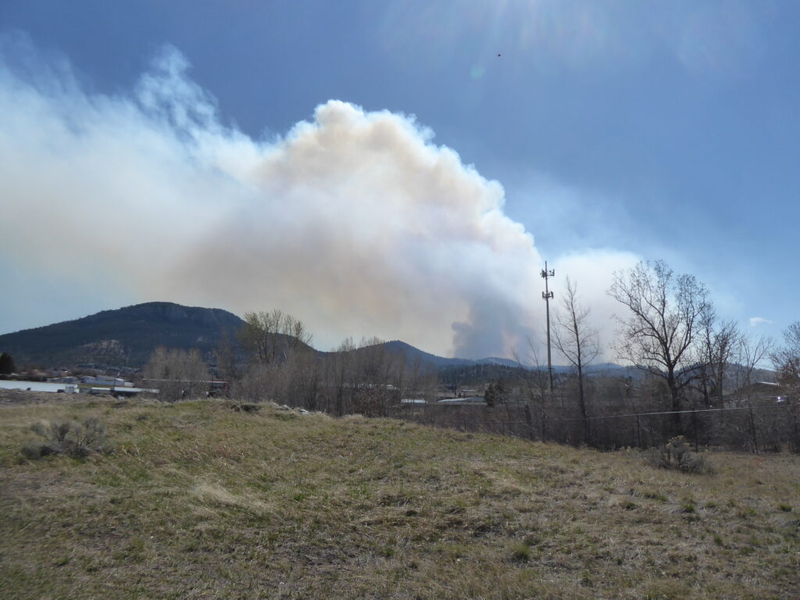
Plumes of smoke rise from a United States Forest Service prescribed burn near Helena. Plumes of smoke coated the Helena valley causing air monitoring stations to report unhealthy air quality. (Photo by George Ochenski)
April 9th was a glorious “bluebird” day for which the Big Sky State is famous. Not a cloud in the too blue sky, hillsides turning green, wildflowers heralding Spring’s colorful promise. The air coming down from the Continental Divide was fresh and clean flowing over the forested mountainsides.
But in early afternoon an angry orange pillar of smoke rose above the nearby ridge…and grew until it blotted out the sun. Then it began its descent into the Helena valley, becoming a thick, choking miasma blanketing the town and worsening as the night’s katabatic airflow from the Divide relentlessly pushed the smoke down to the valley floor.
Any and all outdoor activities were halted as residents scrambled to seal up their homes as the heavy, stinking smoke sought entrance to every vent, door, and window.
The cause? The Forest Service, under the direction of Forest Supervisor Emily Platt, had decided to “prescription burn” a whopping 330 acres of National Forest between Helena and the Continental Divide under a scientifically challenged theory that burning forests somehow prevents forests from burning.
But while Platt was busy lauding “forest health,” she apparently forgot about the public’s health as we choked on her “prescribed” burn.
Here’s what Platt’s “Forestwide Prescribed Fire Final Environmental Assessment said about her plans to burn thousands of acres in the Helena-Lewis and Clark National Forest:
“The Montana Department of Environmental Quality (MDEQ) is the state agency that has federal delegation of authority for meeting the Clean Air Act requirements. MDEQ oversees the state’s smoke management program, conducts continuous air quality monitoring to ensure smoke levels remain within safe limits for the public, and manages prescribed burning statewide to ensure compliance with the Clean Air Act. The Forestwide Prescribed Fire Project burns would be coordinated with the Montana/Idaho State Airshed Group. The operations of the Montana/Idaho State Airshed Group are critical to minimize cumulative smoke/PM2.5 air quality impacts.” (emphasis added)
That’s the story Platt told the public when she approved the project on the same day she set the forest ablaze. But she didn’t come close to fulfilling the commitment to “ensure smoke levels remain within safe limits for the public.”
The EPA monitors concentrations of tiny PM2.5 particulates because they’re inhaled deep into the lungs causing serious health problems, including cancer. The most at risk are the elderly, the ill, and children.
The EPA chart for dangerously unhealthy air tops out at 300 micrograms per cubic meter…but the air monitors at the base of Mt. Helena skyrocketed to 732 by 9 p.m., and remained deadly until after noon the next day.
Here’s what the EPA says about that level of air pollution:
“A PM2.5 level of 732 µg/m³ is classified as extremely hazardous and poses serious health risks that necessitate immediate action to reduce exposure and protect public health. Short-term exposure to such high levels can lead to increased risk of asthma attacks and exacerbation of chronic respiratory conditions; higher likelihood of heart attacks and hospitalizations due to heart-related issues. Shortness of breath, coughing, and throat irritation.“
Had such dangerous pollution been caused by an industry, it would have been shut down and fined. Had an individual caused it, they would be charged with arson. But when the Forest Service poisons the populace, nothing happens — and Platt plans to continue massive burns until “fire season” gets here.
Let’s get one thing clear: Montanans are not guinea pigs for Forest Service experiments in “forest health.” It’s time public health took precedent — especially since Platt and the Forest Service seem unable “to ensure smoke levels remain within safe limits for the public.”
Helena, MT