Florida Supreme Court upholds death sentence in challenge to 8-juror law
Dec 18, 2025 | 3:21 pm ET
Description
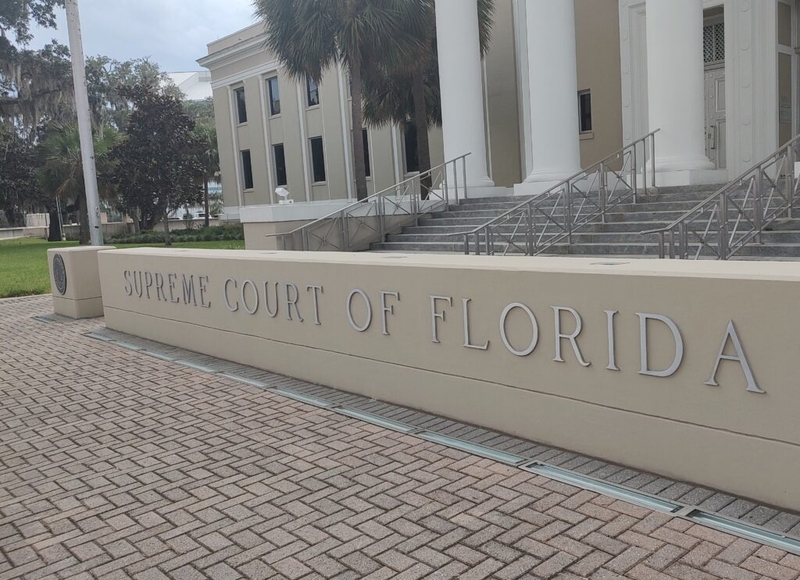
Florida's Supreme Court. Sept. 8, 2023. (Photo by Florida Phoenix)
The Florida Supreme Court on Thursday upheld the death sentence of a twice-condemned man, dismissing his constitutional concerns over a state law that allows just eight jurors to recommend death — the lowest threshold in the nation.
The state’s highest court in a 65-page opinion affirmed Michael James Jackson’s death sentence, which he’d received twice in 16 years for burying alive an elderly couple in 2005.
Although Jackson was one of 40 death row inmates resentenced when the state high court briefly found non-unanimous death recommendations unconstitutional, he remains the only one to be condemned again after lawmakers reversed course in 2023.
“In his initial brief, Jackson raises six issues (with some sub-issues) targeting the 2023 [law or its] application,” the opinion signed by six of the seven justices reads. “Each one fails.”
Jackson’s case falls amid a larger conversation in Florida spearheaded by Gov. Ron DeSantis and GOP lawmakers on expanding the death penalty. In 2025 alone, 19 inmates as of Thursday night will have been executed, shattering the state’s 1984 record of eight executions in one year.
Similarly, in the past few years, Florida has stretched the death penalty to include child rapists and human traffickers of children. It’s also allowed for fewer jurors to recommend death and increased potential execution methods.
Jurors death recommendations in Florida
The case centers on the state’s decades-long flip-flopping on how many jurors are needed to recommend the death penalty. For years, Florida allowed a simple 7-to-5 majority. Jackson, for example, was sentenced to death in 2007 on an 8-to-4 recommendation.
But in 2016, the state Supreme Court declared that unanimity was required for death recommendations, mirroring federal law and every other state except for Alabama (and now Florida). This led to the resentencing of dozens of death row inmates who’d been condemned by less-than-unanimous juries.
Jackson was on that list. So were Alan Wade and Tiffany Cole, his co-conspirators, although they both on resentencing drew life sentences instead of death.
Just four years later, in 2020, the state Supreme Court decided that the Florida Constitution does not require a unanimous recommendation of death. This prompted lawmakers in 2023 to lower the threshold for death recommendation from a unanimous jury to the 8-to-4 majority.
Florida is the only state to allow fewer than 10 jurors to recommend death. The only other state that doesn’t require a unanimous jury verdict is Alabama, with 10 jurors.
So, when Jackson had his resentencing trial delayed until just weeks after that 2023 law took effect, eight jurors recommended execution. And just like 16 years earlier, Jackson was sentenced to death by an 8-4 majority.
What did Jackson argue?
Jackson, now 43, argued a number of points, ranging from alleged improprieties during his initial trial to claiming that the 2023 law was unconstitutional, racist, indecent, and couldn’t apply to him.
Briefly, he also claimed that the law was improperly targeted at him. He pointed to legislative debate in which lawmakers acknowledged that only one pending capital case would be affected by the change, which was Jackson’s, and argued that this showed the statute was crafted to ensure it would apply at his resentencing.
Six justices rejected all of his claims, largely by pointing out that a non-unanimous jury is constitutional under the 2020 Florida Supreme Court case.
They also disagreed that Jackson’s resentencing order from 2017 prevented him from receiving the burden of a later statute, writing, “The 2017 order did no more than confirm that, under the decisional law at the time, Jackson was entitled to resentencing.”
Justice Jorge Labarga, the sole moderate justice, concurred in a separate four-page opinion, writing that he wanted to respect precedent but emphasizing his opposition to the 2023 law.
“I write to underscore that the 8-4 threshold renders Florida the absolute outlier among states that impose the death penalty. Florida now has the lowest standard in the nation, requiring the fewest number of jurors to recommend the death penalty,” he wrote.
What happened in 2005?
In 2005, 61-year-olds Carol and Reggie Sumner allowed Jackson and Tiffany Cole to stay with them at their Jacksonville home, according to the case record. While there, Jackson noticed they were “frail and would be easy victims,” and he “informed [Alan] Wade of the Sumners’ financial position, which included $90,000 from the sale of their South Carolina home,” the opinion says.
They hatched a scheme, bringing in 18-year-old Bruce Nixon to help.
Days before the murders, Jackson, Wade, and Nixon dug “a six-foot-deep hole in a remote area of Georgia.” Then, on the evening of July 8, 2005, Wade and Nixon held the Sumners at “gunpoint” using a “toy gun” and bound them with duct tape.
Jackson then entered the home “and began searching for bank statements” and ATM cards. Wade and Nixon later “ordered the victims to climb into the trunk of the Sumners’ Lincoln Town Car.”
With the Sumners trapped, they drove to the Georgia gravesite, where the elderly couple was placed in the hole and buried alive.
Jackson later used their ATM card “several times,” and impersonated Reggie in phone calls with the bank and the Jacksonville Sheriff’s Office.
The four were arrested in South Carolina. Nixon, who testified that Jackson was in charge and who led authorities to the gravesite, was the only one not sentenced to death in 2007. Instead, he received a 45-year prison sentence.
Cole and Wade had their death sentences changed to life during resentencing in 2017.
Update: This story has been edited to correct a capitalization error in Justice Labarga’s name.
Tallahassee, FL